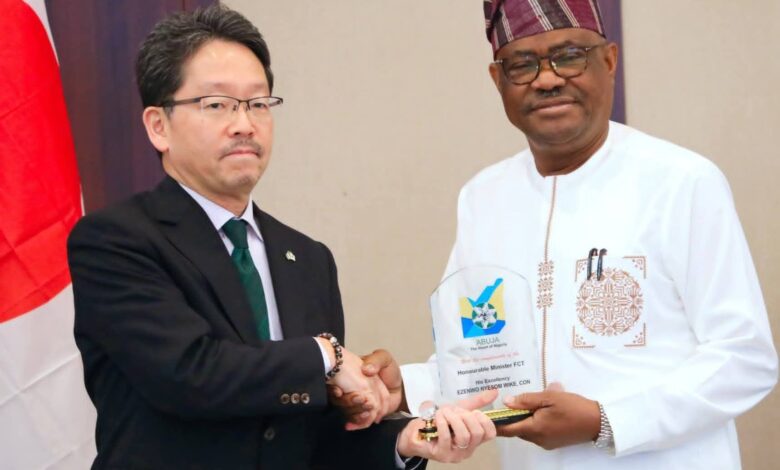
The Minister of the Federal Capital Territory (FCT), Nyesom Wike, has reiterated the FCT Administration’s commitment to strengthening collaboration with Japan to fast-track the development of Abuja in line with its master plan.
Wike made this known in Abuja while receiving the Japanese Ambassador to Nigeria, Suzuki Hideo, alongside officials of the Japan International Cooperation Agency, during a courtesy visit.
The minister commended Japan for its longstanding support to Nigeria, particularly its contributions to the development and ongoing review of the Abuja Master Plan, which he described as vital to the capital city’s sustainable growth.
He noted that Japanese interventions have impacted key sectors such as education, healthcare, and nutrition, adding that the partnership has directly improved the lives of residents.
Wike also highlighted Japan’s role in strengthening Nigeria’s education system through teacher training programmes and support for learning infrastructure, describing such efforts as crucial to improving educational standards.

Looking ahead, the minister identified agriculture and urban development as priority areas for deeper cooperation, assuring the Japanese delegation of the FCT Administration’s readiness to provide a conducive environment for sustained investment.
He added that enhanced collaboration would support the delivery of President Bola Tinubu’s Renewed Hope Agenda, particularly in transforming Abuja into a modern and well-planned city.
In his remarks, Ambassador Suzuki reaffirmed Japan’s commitment to Nigeria’s development, emphasizing the strategic importance of Abuja as the nation’s political and administrative hub.
He disclosed that Japan, through JICA, is implementing projects across infrastructure, healthcare, and economic development, while also advancing new initiatives in waste management and industrial growth.
The ambassador revealed that a plastics value chain project, being executed in partnership with the United Nations Industrial Development Organization, is underway, with a pilot facility set for handover.
Suzuki further noted that efforts are ongoing to upgrade the Abuja Master Plan through JICA, with a focus on enhancing residents’ quality of life and promoting sustainable urban development.
Also speaking, the Chief Representative of JICA Nigeria Office, Ishigame Keiji, said the agency’s interventions in the FCT span critical sectors including water supply, power, health, agriculture, and education.
He disclosed that JICA is supporting the review of Abuja’s 1979 Master Plan to align with the city’s projected growth up to 2050, with emphasis on infrastructure expansion, economic development, and climate resilience.

Keiji added that the agency stands ready to commence priority infrastructure projects once the updated plan is finalised, leveraging its global expertise in large-scale development initiatives.
Both Nigeria and Japan reaffirmed their commitment to deepening bilateral cooperation aimed at fostering sustainable growth and transforming the Federal Capital Territory.