Olusegun Olanrewaju
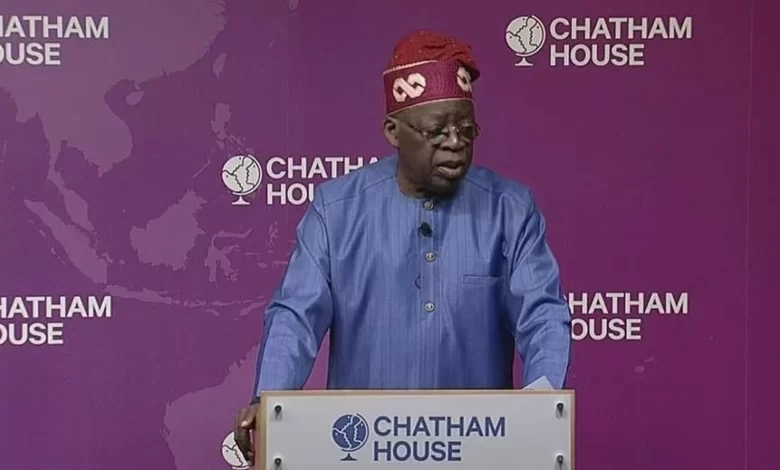
Pro and anti-protests rocked the presentation of the All Progressives Congress (APC) presidential candidate, Bola Tinubu, at the Chatham House in London, yesterday.
The event was meant to be a high-profile occasion to showcase Tinubu’s programme for Nigeria’s socio-economic development.
Chatham House, according to a citation, is globally admired and respected, a platform for intellectual engagement on different issues of contemporary interest to people around the world.
Ahead of the February 2023 election, Tinubu had been engaging different strategic groups in Nigeria at town hall meetings.
He then travelled around the world before finally travelling to the UK at the weekend to share his campaign plans at Chatham House.
Yesterday’s delivery was the second time the APC presidential hopeful was delivering a speech at the forum. The first was in 2011.
While a former aide to ex-president Goodluck Jonathan Reno Omokri led a band of protesters to register their displeasure against Tinubu as Nigeria’s next president, many of the supporters of the APC candidate sang “On your mandate, we shall stand” to subdue the anti-Tinubu protesters.
At some point, the anti-Tinubu protesters joined in the pro-Tinubu chorus.
Later, Omokri said the protest was to harass Tinubu out of London.
He wrote on his Twitter page “The #HarassTinubuOutofLondon protest against…Tinubu at Chatham House was a resounding success! The British media were there and Tinubu was projected to them for what he is…That is what will be remembered of his Chatham House event!”
*Ex-Lagos gov outlines agenda
Tinubu was accompanied to the event where he spoke on “Nigeria’s 2023 Elections: Security and Economic Development and its Foreign Policy Imperatives”.
His entourage was packed with a powerful delegation and some of his campaign council leaders, including governors: Nasir el-Rufai (Kaduna); Babajide Sanwo-Olu (Lagos); and Mohammed Badaru (Jigawa).
Others include the Speaker of the House of Representatives, Femi Gbajabiamila, Deputy Director-General of the Presidential Campaign Council (PCC), Hadiza Bala Usman, as well as former Ekiti State governor, Kayode Fayemi, as well as the Director of Strategic Communication of the APC PCC, Dele Alake, among others.
In his speech, Tinubu emphasised Nigeria’s role in Africa as a big brother and a beacon of hope to the continent.
He also dwelt on Nigeria’s impact in the ECOWAS sub-region through now entrenched democratic ideals, having run an unbroken democracy for over two decades.
He promised that when he becomes Nigeria’s president, his administration would continue to provide quality leadership to the sub-region, to ensure that democratic ideals are rallied in West African countries.
The APC presidential candidate in his address vowed that as president, Nigeria will epitomise the values of democracy during elections anywhere in Africa, by ensuring that democratic ideals are followed and all forms of electoral violence will be rejected, allowing only the will of the people to prevail.
He said, “Every election, wherever it is held, is important to the people or entity directly concerned. It is also important to the global democracy community. Equally, there are also countries whose elections, on account of their weight and influence, carry wider implications way beyond their immediate geographical boundaries. Nigeria is one such country.
“I stand firmly against all forms of electoral violence and intimidation. Having spent most of my career in the political opposition, I have long fought against electoral malpractice and any attempts to extinguish the legitimate choice of voters. I will continue to do so.
“And I urge all my fellow contestants in this election to do the same. Let the sovereign will of the people decide the path of our nation. And let this election be determined by voters making their choice freely rather than the domineering intimidation of the troublesome few.
“For one, as Africa’s most populous country and the continent’s largest economy, it is generally acknowledged that the fortunes of the African continent and indeed the Black race is tied directly to the health of Nigeria.”
Tinubu added, “Also, the Nigerian elections of 2023 are coming up at a time when the country’s immediate geographical neighbourhood of West and Central Africa is undergoing serious political turmoil that has manifested itself in the incursion of the military to power in several countries. Despite the legitimate concerns being expressed by observers, Nigerians are resolutely committed to democracy, regardless of their political differences.
“Nigeria shares direct land borders with four sister African countries with whose peoples Nigerians also share historical and cultural affinities. This effectively means that the relationship between Nigeria and its immediate neighbours is much more than just a geographical expression.
“To be fully secure at home, Nigeria has always believed it must be the brothers’ keeper. It was out of this understanding that Africa’s premier regional economic community, ECOWAS, was established in 1975. Uniquely, ECOWAS had embedded in its mandate, the promotion of regional economic integration as a good in its own right and in addition undertook sub-regional peace and security.
“I am convinced, as I am sure most of us are, that the broad principles that enabled successive Nigerian governments to interface development and security and establish an organic link between national security and economic development with regional peace and prosperity is both impeccable and remains relevant. It is an approach which I commit myself to uphold and advance” Tinubu said.
Tinubu promised to tackle the security situation head so that Nigeria can also effectively provide security support for its neighbouring nations.
He noted, “The challenges which have manifested themselves concerning our national and regional development and security trajectories are very well-known to all of us here: radical extremist violence, terrorism, banditry, kidnapping, human trafficking, trafficking in weapons, trafficking in drugs, climate change and resource-driven conflicts, etc.
“Mostly manifesting initially as national problems, these challenges evolved into trans-border and multinational challenges.
“We see the thousands of people who have been internally displaced at home or forced into refugee camps abroad. With farming activities disrupted, we have seen shortages of basic food items and food price inflation that are further undermining human security.
“To respond meaningfully to the discontents and to redress the many dislocations arising from them, we must begin by reminding ourselves of that old dictum: Foreign policy is but a continuation of domestic policy.
“As a first step, we must recalibrate domestic policy to revamp the foundation on which our quest to pursue human security rests.”
The former Lagos State governor reiterated that effective energy generation and distribution will help build the economy of the nation, promising to improve the framework already in place to boost the generation and distribution of energy across the country.
He also said the nation under his watch will emphasise the use of technology to improve the agricultural sector for better production and contribution to the nation’s economy.
“The present administration has invested heavily in agriculture, providing loans and expanding the country’s total acreage of cultivated land. We will build on this, but our focus will be on using technology and expertise to accelerate growth and development by providing the critical infrastructure necessary to achieve the commodity transformations in the agriculture value chain.
“Roads, rail, access to ports, and storage infrastructure are what we require to radically transform the agriculture sector and increase its value to the nation. Providing these will be the areas of our focus so that the full potential of our agro-economy can be achieved, and we can reap the benefits in jobs, improved economic opportunities, and increased prosperity.
“Fixing the perennial riddle of energy supply is another priority. There is no version of the world where Nigeria’s ambitions for itself can be achieved without solving the problem of how to provide energy to homes and businesses across the country. It is time to recognise that the centralised approach to energy policy and infrastructure is not an optimal arrangement and is unlikely to improve by mere tinkering around the sides.
“The Federal government as regulator and operator, and price fixer is a broken model and one that we fully intend to fix if elected.
“We have privatised power distribution in Nigeria and generation to a certain degree. What we need to do, going forward, is to improve the enabling environment and further reform the legal and regulatory framework to attract more private investments in the sector as we have experienced in the telecom industry.”
He promised to engage the private sector to better drive economic development across the country.
*Affirms parentage
Tinubu also used the lecture to address other high-profile issues, including the controversial almajiri system in the north, and controversial birth circumstances.
On Almajiri, he promised to reform the system in the northern part of Nigeria if elected as the president in 2023.
‘I’ll reform Almajiri system’
Almajiri refers to a system of Islamic education practised in northern Nigeria where male children and youths leave the comfort of their parents to seek Islamic knowledge.
However, the Almajiri has been widely criticised as these male youths are visibly seen on the streets of all northern Nigerian cities littering motor parks, ATM centres, hotels, brothels, gridlocks, and even religious places to beg for alms.
Most of them have been turned into pawns in the hands of the political elite which uses them for selfish interests to the detriment of Nigerian society.
Speaking on how his government will work to make Nigerian youths productive if he wins the 2023 presidential election, Tinubu said there will be student loans and there will be a conducive template for youths to develop the technology.
Though the former Lagos governor did not specify how to actualise the promise, he boasted that he succeeded in turning many liabilities into assets while governing the branded ‘Centre of Excellence.
“There will be student loans (for Nigerian students). We are going to reform the Almajiri system. The youth can develop technology language on their own,” Tinubu said.
G5 will not condone further attacks from PDP PCC, Wike tells Atiku
*Use DNA test to confirm my lineage -Tinubu
Following the complaints over his origins, the APC presidential candidate used the occasion to express his desire to make himself available for a Deoxyribonucleic Acid (DNA) test to confirm his lineage.
He made the bold move yesterday during his presentation at Chatham House in London, stressing that he remains a proper member of the popular Tinubu family on Lagos Island.
He faulted his counterparts from other political parties who have been criticising his identity, especially his date of birth and educational background at any opportunity.
He said, “I’m not claiming another father, I am Tinubu and Tinubu proper. If they want DNA, they could as well request it from us. One of them has even been accused of not being a Nigerian citizen, I didn’t touch that area,” Tinubu said.
He insisted that his birth, academic, and professional records are consistent, adding that his critics are only wasting their time and money.
Tinubu, however, said today that those in doubt of his paternity can request a DNA test to validate that he is indeed a scion of the Tinubu family.
Speaking about his date of birth, Tinubu said the question is inquisitive, but that at the time of birth, he was dated March 29, 1952.
“I’ve had very good exposure in life, my record is consistent in the school, in the university, they (critics) are now convinced that they wasted their money and their time. The record is there, the transcript is there showing March 1952,” he said.
*’My controversial certificates’
Speaking further on controversies surrounding his educational qualification and jobs abroad, Tinubu insisted that it all remains the same as he has shared earlier.
According to him, Deloitte, Chicago State University, where he graduated, had attested to his academic background.
“I can announce that I have received my original replacement degree certificate from them,” Tinubu said.
The APC presidential candidate said none of his contenders can match his professional records, which he described as ‘outstanding’.
“Deloitte trained me as an accountant. Mobil Oil has attested to my record, outstanding record, I got to the pinnacle of my career in the private sector. Who among them can brag about that?” he queried.
Budget padding allegations: Senate clears finance minister, flays NSIP implementation
By Nathaniel Zacchaeus, Abuja
The Senate Committee on Appropriation on Monday cleared the Minister of Finance, Budget and National Planning, Mrs Zainab Ahmed, over her alleged insertions of huge sums in budgetary provisions of some Ministries, Departments, and Agencies ( MDAs).
The panel, however, condemned the alleged shoddy implementation of the National Social Investment Programme (NSIP) based on the lack of records of verifiable beneficiaries.
The Finance Minister got her clearance on the alleged series of paddings in the proposed N20.51trn 2023 budget when she appeared before the Senate committee to make clarifications on the alleged insertions.
She expressed shock that
to the committee that some heads of agencies feigned ignorance of the sum in their budget during their interface with relevant committees for budget defence.
She explained that money was approved by the Federal Executive Council (FEC), before the budget presentation itself by President Muhammadu Buhari on October 7, 2022.
She said, “All the proposed budgetary sums like the N206billion in the Ministry of Humanitarian Affairs, Disaster Management and Social Development, the N8.6bn in the Ministry of Defence, N195.468bn in the estimates for the Ministry of Power, etc, were all captured before the presentation by Mr President.
“Most of these sums are bilateral or multilateral loans captured in the budget of agencies selected for project execution for the sole purpose of transparency.
“The totality of such loans captured in the proposed budget of the relevant agencies is N1.771trn. If the heads of the affected MDAs had carried out thorough scrutinisation of their approved budgetary proposals, the issue of insertion or budget padding wouldn’t have arisen at all.
“In fact after realisation of their mistakes, one of the ministers, the Minister of Defence , Bashir Magashi have to apologise after feigning ignorance of N8.6bn in his Ministry’s budget during an interface with Senate Committee on Defence “, she said.
The Chairman of the Committee, Senator Jibrin Barau ( APC Kano North), expressed satisfaction with her submissions.
Barau said the clarifications made by the Minister were well understood by all the committee members and commended her for ensuring transparency in capturing such loans or grants in the national budget.
Earlier at an interface with the Senate Ad – hoc committee on uneven disbursement of N500bn Development fund by the Development Bank of Nigeria (DBN), the Minister of Humanitarian Affairs, Sadiya Farouq, failed to supply the committee with verifiable evidence of beneficiaries of various intervention programmes of the ministry.
She said about 9.8 million pupils nationwide are already benefiting from the School feeding programme at the rate of N100 per meal, aside from beneficiaries of other clusters of the programme.
But the Chairman of the Committee, Senator Sani Musa, and other members like Ayo Akinyekure, Uche Ekwunife, and Mathew Urhoghide, among others, told the Minister that her presentation and that of the Coordinator of the programme, Dr Umar Bindir, were “beautiful on paper but lacked substance”
They described the implementation of the programme as a nullity.
The Committee consequently directed her to furnish it with names of beneficiaries of different clusters of the programme, their contact address, and telephone numbers based on states, local government, and wards within the week.
The minister promised the committee that all the information would be provided but cautioned that the ministry believes in the policy of confidentiality and would not allow the details of the beneficiaries to go public.