By Mudiaga Affe, Kassim Omomia, Idu Jude, Cajetan Mmuta, Israel Joel, Emma Obe
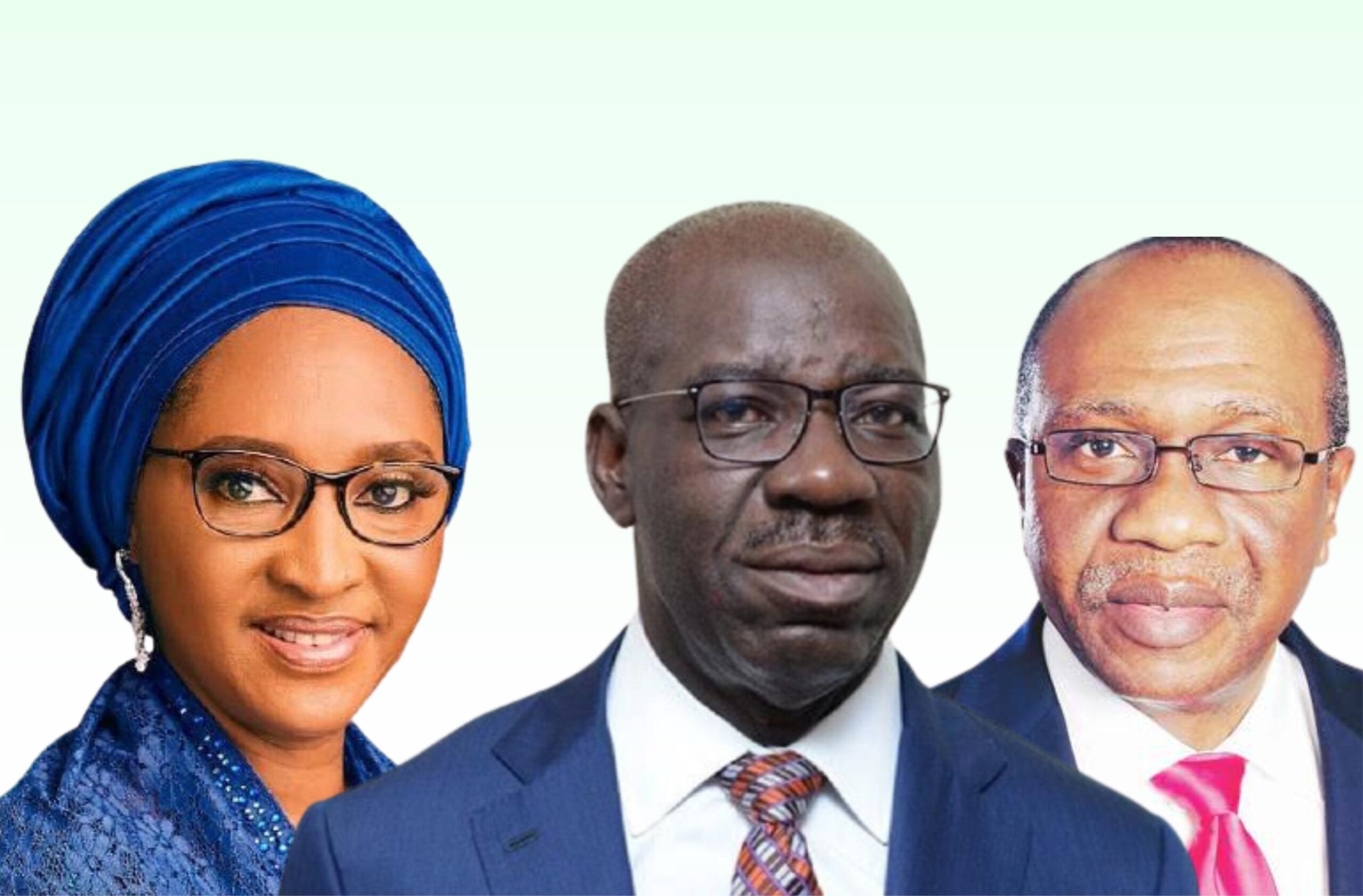
The recent revelation by Governor Godwin Obaseki of Edo State that the Central Bank of Nigeria printed about N60 billion to augment the March allocations given to states has continued to generate controversy.
The Edo State governor had on April 12 said Nigeria was facing a serious financial crisis with a call on the federal government to act quickly.
Obaseki said, “When we got FAAC for March, the federal government printed additional N50-N60 billion to top-up for us to share.”
But the CBN governor, Mr. Godwin Emefiele, described Obaseki’s claim that the apex bank printed and shared money to states as “unfortunate and inappropriate.”
He said printing money was a key mandate of CBN, adding that the apex bank must always act to support the government at times of financial difficulties.
“The concept printing of money is about lending money. That’s our job to print. It’s about lending money and so there’s no need putting the controversy about the printing of money as if we are going into the factory printing the naira and start distributing on the streets,” Emefiele reportedly said.
The CBN governor further stated, “Nigeria is unfortunately in a very bad situation. I am not going to pretend about it, in the sense that we are facing problems with productivity output, which is GDP. Luckily we managed to come out by a hair’s breadth.”
Also, the Minister of Finance, Budget and National Planning, Zainab Ahmed, dismissed the claim, insisting the FAAC allocation was revenue from different agencies of the government.
But disagreeing with the positions of the two top managers of the country’s economy, Obaseki again on April 15 said urgent steps must be taken to end the country’s current monetary rascality, to prevent the prevailing economic challenge from degenerating further.
“While we do not want to join issues with the Federal Ministry of Finance, we believe we must offer useful advice for the benefit of our country.
“The Minister of Finance, Budget and National Planning, Mrs. Zainab Ahmed should rally Nigerians to stem the obvious fiscal slide facing our country.
“Rather than play the Ostrich, we urge the government to take urgent steps to end the current monetary rascality, to prevent the prevailing economic challenge from degenerating further,” Obaseki said in a statement,
The claims and counter-claims by those managing the economy of the nation and state actors have led to the following questions among Nigerians.
Who is telling the truth? Who is lying? Did the country print N60bn to augment shortfall in revenue to states? If it did, what is the ‘big deal’ about printing of money? If this shows insolvency, what is the fate of the country and her citizens? How can the nation surmount the high unemployment and inflation already hitting the citizens hard? Questions, questions.
However, the biggest of the posers is: If the government spends N120bn monthly on subsidy and the Federation Account Allocation Committee (FAAC) shared N60bn among states, where then did it get the shortfall of N60bn to balance up the average payment for the grant or share to the federating states?
This remains the unanswered question.
Interestingly, these assertions and counter-assertions are coming when issues bearing on petroleum products subsidy have yet to be clearly explained to Nigerians.
According to a Bloomberg report of March 25, petroleum subsidies are costing up to N120bn ($294 million) per month.
In March alone, Group Managing Director of the Nigerian National Petroleum Corporation, Mele Kyari, at a briefing, said that the firm was absorbing monthly losses of between N100bn and N120bn on the average daily consumption of around 60 million litres of fuel.
If Kyari’s claim is anything to go by, the question still begging for answer is: where then did the corporation, and by extension the country, get the shortfall of N60bn to balance up the average payment for the subsidy?
“Again, if the government says that it did not print money, concerned Nigerians will like to know how it has been generating money, especially as it claimed that there is paucity of funds to execute certain projects” asked an Abuja-based political activist, Abba Mohammed.
Nigeria produces 1.6 million barrels of crude a day, even as NNPC imports virtually all its fuel from abroad and resells at subsidised prices due to low refining capacity of the country’s four refineries.
The NNPC said it would continue to maintain the price at which it sells petroleum products, especially Premium Motor Spirit (PMS) to wholesalers and retailers until the conclusion of ongoing engagement with the organised labour and other stakeholders.
Perhaps, Obaseki’s claims may have attracted further credence following the latest release from the National Bureau of Statistics (NBS) that the Consumer Price Index, (CPI) which measures inflation increased by 18.17 per cent (year-on-year) in March 2021. It is 0.82 per cent points higher than the rate recorded in February 2021 (17.33 per cent).
Experts react
For a development economist, Odilim Enweagbara, the CBN governor and the minister committed no offence by denying initially that there was no printing of money as alleged by Obaseki.
He, however, noted that printing of money must tally with the available goods in the market in order not to have so much money pursuing little supply in the market, otherwise there will be hyper-inflation.
“I believe that the two must not agree because that is the secret of the Nigerian economy and no one can take them to a court or prosecute them, should such come from them.
“I can tell you that this is just economic secrecy. And I believe that was what they were trying to apply. I can also tell you that countries print money. The United States of America prints, China prints, and such have never been a crime. It becomes a crime when economic policies are not followed. So, doing such has to be for the protection of the economy.
An emeritus professor of Political Science, Femi Otubanjo, said if what Obaseki said was true, then the country was heading for the worst times.
He said, “ Of course, what he said portends a great deal of danger. The printing of money is supposed to be backed by policies and that is how currencies are valued.
“If you are just printing, it means that your currency is valueless. In no time, the naira will become worthless. It will become like the Zimbabwe dollars where you will need a sack to carry just N5, 000. If we keep printing money, we will be running down our economy and we would not be able to buy food to eat.
“Obaseki is right if what he says is happening and we would prepare ourselves for tougher times to come. What we are expecting from the government they may not be able to do it because the situation is bad and it will get worse if we continue to print currency to sustain allocation.
“Despite what the ministry of finance and the CBN are saying, their job is to gloss over things. But investors may be affected as those who want to come will not come because they do not want to have anything to do with our paper money. It is very dangerous when you start running down your currency. It is the job of the governor of CBN to give a gloss of what is going on.”
A Lagos-based Attorney and Corporate Governance Consultant, Omoruyi Edoigiawerie, described the minister’s response as deflective.
He said, “The minister’s response that they did not print money to distribute at the last FAAC meeting is deflective. It did not address whether or not these monies were printed, the purpose and plans to stop it from adding to our growing inflation portfolio.
“It is evident for all to see that our naira is weak and I would have thought that the focus will be on putting in place a genuine approach to strengthening it instead of embarking on actions capable of leading to currency depreciation.
“This goes to show that there’s something wrong with governments’ ability to generate revenue and as we can all see, its overhead is unbearably high. The government is living above its means and rather than readjust its expenditure, it appears to be taking the easy way out: printing more money to spend.
“All over the world a country’s economic well being is gleaned from the strength and bargaining power of its currency and I do not think CBN needs to be told that the weakness of our currency poses a serious threat to Nigeria’s economic well being which is unarguably taking a capriciously dangerous toll on the citizens.
“Frankly, if we don’t backtrack, we may well be on our way to having a devalued naira that cannot compete in the regional or global market space and an economy on life support.”
The Chairman, Civil Society Organisation, South-East, Aloysius Attah, faulted the Buhari administration for what he termed “lack of direction in its financial and economic roadmap.”
Attah said, “The national currency is not something you can just print and distribute at the whims and caprices of the moment.
“Such situation doesn’t only show disconnect in the FG’s economic team but a sign that the country is heading for a financial doom.”
‘FG in too many unclear business’
Also, an economic governance expert, Ezeh Onyekpere, alleged that the federal government had in the last couple of years been engaged in unclear deals in terms of economic policies.
He also urged the CBN governor to stop blackmailing the governors over the money lent to them, because one of them told the truth.
Onyekpere said, “You see I’m not saying that anyone should resign but they should be able to tell Nigerians the truth and apologise. I can tell you that by the CBN Act, it is only allowed to fund the Federal Government deficit with five per cent, which the Federal Government pays back into the Federation account within 12 months.
“Now the CBN loses the power to demand that such money is refunded. If you tabulate the number of years such as five per cent has not been paid, then you would know how much that has gone out of the Federation account unaccounted for. Unfortunately, the CBN governor has breached the law as against the act that established the institution.
Prof. Sarah Olarewaju-Anyanwu of the Department of Economics, University of Abuja, told ThisNigeria, “In case what Obaseki alleged is true, it means something wrong is about to happen to the Nigerian economy.
“But I doubt it, because Nigeria has not come to the level where the country would remain in recession for a long period of time.
“What we need is bringing in expertise who will get across all Nigerian economic sectors, and pull the resources together.
“If we diversify, we have no reason to be in economic crises because Nigeria is blessed with so much endowment. There is no state in the country that cannot boast one natural resource or another.
“I think our economic team cannot be sleeping on the advice of printing money, while many things that would generate money are lying untapped.
There is nothing wrong in printing money, ACP tells PDP
“Let me tell you, printing of money creates a sense of nervousness between economists and the general public. It immediately conjures up memories of hyper-inflation in Weimar Germany in 1923 and Zimbabwe in more recent times.
“If a government prints money faster than the growth of real output, it reduces the value of money, and this invariably causes inflation. Governments often resort to printing money when they cannot finance their borrowing by selling bonds. This hyper inflation can be extremely damaging to an economy.”
Also, Mangnus Yamahao, a social critic, insisted that something must have prompted the outburst of the governor.
Yamahao said, “Let everyone know that something is not working well in the country. As a social critic, I sometimes wonder the kind of economic team we have. Look at the minimum wage issue, some states cannot pay, while a bag of rice is sold above the minimum wage.
“Simple economic indicators show that when more money is chasing little amount of goods in the market, it means that the highest bidder will buy all, while others go home hungry.
“So, when you print paper money that does not coincide with your economic power, then soon paper money will see nothing to buy.”
Also, a human rights activist, Emeka Umeagbalasi, faulted what he called the FG’s ‘11th hour denial’ of the statement credited to Obaseki.
Obaseki’s N60bn claim can’t be spurious – Wike
Umeagbalasi, who is also the Chairman, International Society for Civil Liberties and Rule of Law, criticised the government for allegedly “toeing a dangerous path of the late President Idi Amin of Uganda and President Robert Mugabe of Zimbabwe.
Umeagbalasi said, “If a country is experiencing good economy, it has the capacity of healing many wounds, but when the economy is bad, then things can go awry; the country can find itself in a sorry state.
“I think what the Nigerian government is doing is setting a dangerous precedence. The country is already gravely wounded, and they are bringing more wounds to it.”
Another human rights activist, Patrick Eholor, hailed Obaseki for speaking up on the state of the economy.
Eholor said, “I commend him for speaking the truth, because he is an economist, and he knows that if we allow the Federal Government to be printing money unnecessarily, it will lead to high rate of inflation in the country.
“We are currently experiencing over 33 per cent of unemployment, and we cannot pay the present minimum wage.”
According to a Jos-based economist, Bolcit Barshep, the situation is a reflection of the weak revenue performance of government in the face of growing expenditure.
Barshep, who is the Managing Director of Anista Marketing and Events Limited, added, “this will ultimately result in a disruption of macro-economic stability, weaken our currency, cause hyper-inflation and increase poverty in the country. This will reduce the worth of the naira and the nation’s bonds.
“We can do better by harnessing states’ wealth in natural and human resources to ensure that we discourage the habit of borrowing, and or printing of money, to finance state expenditures.’’
But Danjuma Bentu, a businessman in Jos, said, “Obaseki made a feeble allegation without presenting intriguing data to substantiate his claim.
“He should have used his position as a governor to prove his claims for the sake of national interest and the economy. I’m subject to correction, but If his claims were true, I think it would have spawned severe adverse effects to our fragile economy.
A businessman, Yekini Babalola, said, “Let’s try to isolate the message from the messenger. Is the economy not in trouble? Obaseki is in a position to know, being in the corridors of power.
“How long can you hide your lamp under the bushel? The truth will still come out. Let’s get the true position of the economy, so that Nigerians can be galvanized to work harder.
“The alert by the governor is a clarion call to all Nigerians to expect tougher times, even, under a better administration than this. An import-dependent economy is a disaster in the waiting. We abhor the truth here.’’
Meanwhile, the Youth Party of Nigeria has urged the FG to review some of its monetary policies and take urgent measures towards reforming key sectors of the economy.
The YPN, in a statement by its Chairperson, Tomiwa Aladekomo, expressed disappointment over the mismanagement of the economy by the federal government which it noted has continued to drive inflation and unemployment, thereby inflicting pain and hardship on citizens.
The party was reacting to the March 2021 Consumer Price Index/Inflation Report released by the NBS on Thursday.
The data revealed that Nigeria’s inflation rate has continued to rise as the Consumer Price Index (CPI) which measures inflation increased to 18.17 per cent (year-on-year) in March; the highest reported in four years, since April 2017.