Cross Udo
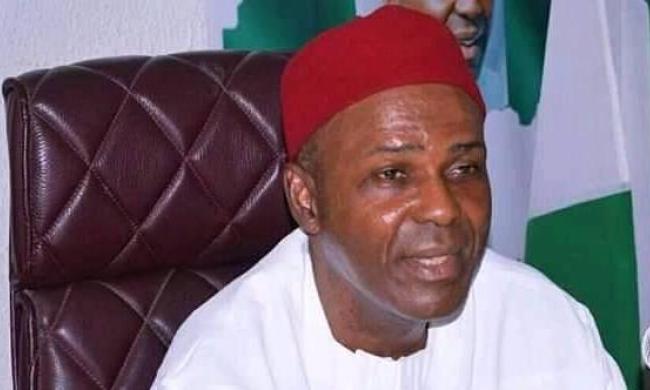
A former Minister of Science, Technology and Innovation under the ex-President Muhammadu Buhari administration, Ogbonnaya Onu, died yesterday.
Onu, the first civilian governor of Abia State, it was gathered, passed on in the morning at an Abuja-based hospital.
A source close to the deceased, the former governor died after a brief illness in an undisclosed hospital in Nigeria.
It was further learnt later in the evening that Onu’s burial programmes would soon be announced by the family.
A professional engineer, the deceased was a Chemical Engineering lecturer at the University of Port Harcourt, Rivers State, Nigeria, before foraying into politics.
The first-class engineering graduate was later elected the governor of the old Abia State in 1992 before the tenure of his administration was abruptly shortened by the military in 1994.
A native of the Uburu community in Ohaozara local government area, in what stands today as Ebonyi State, Onu’s political odyssey started when he became national chairman of the defunct All Nigerian Peoples Party (ANPP) which later collapsed into now ruling All Progressives Congress (APC) in 2013.
That was after a merger of the then-major opposition political parties in the country.
Onu was later appointed Minister of Science and Technology in 2015 by the immediate past president of Nigeria, Muhammadu Buhari.
He held the position for a compact eight years.
*Political career
In 2023, he contested, but lost the primary race for the APC presidential ticket, to current president, Bola Tinubu.
Onu started his political career as an aspirant for a senatorial seat in the old Imo State on the platform of the National Party of Nigeria (NPN).
He also contested for the position of Governor of Abia State in 1991 under the umbrella of the National Republican Convention (NRC) and won.
Apart from his exalted position as the first executive governor of the ‘God’s Own State’, Abia, from January 1992 to 1994, he also held forte as the first chairman of the Conference of Nigerian Elected Governors.
In 1999, he became the presidential flag bearer of the APP, but relinquished the position to Olu Falae after a merger of his party with the AD, who eventually lost to Olusegun Obasanjo of the Peoples Democratic Party (PDP).
Onu later learnt the ropes well, to emerge as the national party chairman of the ANPP in 2010.
In 2013, he and his party (ANPP) successfully merged with the Action Congress of Nigeria (ACN), Congress for Progressive Change (CPC), Democratic People’s Party (DPP), and some factional members of the All Progressives Grand Alliance (APGA), to form the All Progressives Congress (APC).
During his lifetime, the late was a recipient of several awards and he recorded several achievements.
Onu was a certified member of the Council for the Regulation of Engineering in Nigeria (COREN), a fellow of the Nigerian Academy of Engineering (NAE), and a fellow of the Nigerian Society of Chemical Engineers (NSCE).
In October 2022, he bagged the Nigerian national honour of Commander of the Order of the Niger (CON), which was conferred on him by President Muhammadu Buhari.
Sometimes controversial, Onu said Nigeria would begin local production of pencils by 2018, which he said, will provide 400,000 jobs.
Even to date, the said production of pencils has not commenced.
Onu died at the age of 72. He is survived by children and other family members.
*Reactions
Following the death of Onu yesterday, there was a gale of mourning across the landscape.
Eminent citizens turned out in numbers to eulogise the former governor, minister, and party chair, widely considered a gentleman.
*Tinubu mourns
Among the ranks of high-grade mourners was President Bola Tinubu, who expressed his ‘deepest condolences’ to the Onu family ‘’over the passing of Chief Ogbonnaya Onu, who died on Thursday at 72.”
In a statement by the Special Adviser to the President on Media and Publicity, Ajuri Ngelale, in Abuja, the president said he ‘’mourns the first civilian governor of Abia State; former minister of Science, Technology, and Innovation, a principal draughtsman in the founding of the All Progressives Congress (APC), and a valiant partner in the victory of the party in the 2015 elections.
“Most importantly, the President celebrates the life of an accomplished scholar, first-class engineer; a man of proven integrity; defiant to indiscipline, but ever yielding to the highest standards of rectitude.”
Ngelale said that Tinubu acknowledged that Onu epitomised the spirit of Nigeria, adding that the deceased believed in and defended the country’s unity, advocated peace, and promoted fellowship.
He said that the President also condoles with the friends and associates of Onu, Ebonyi, and Abia State governments, and all Nigerians grieving this gaping loss.
*Buhari: Nigeria lost an intellectual, scientific mind
Another leading mourner goes in the mould of former President Muhammadu Buhari, who joined family members of the deceased and the entire nation in mourning the demise of a notable politician, Onu, the first civilian governor of Abia State and former minister of Science, Technology, and Innovation under his administration.’’
In his reaction to the death, Buhari said the nation had lost “one of its most outstanding scientific minds and intellectuals.”
A statement issued on his behalf by the former president by his spokesman, Garba Shehu, in Abuja yesterday described the late ex-minister as an intellectual giant.
Buhari said, “My heart goes out to his family, the government and people of Abia State, and the country at large. May his soul rest in peace.”
*Akpabio mourns
President of the Senate, Senator Godswill Obong Akpabio has sent his heartfelt condolences to the family of Onu.
A statement from Akpabio’s Special Adviser on Media and Publicity, Eseme Eyiboh described the late Onu as “A perfect gentleman who will be sorely missed for his wisdom, mature composure, zest for excellence and proven integrity”
He said Onu was known for coming first in every endeavour he engaged in and played politics without bitterness in all his life.
“I am deeply saddened by the death of Chief Ogbonnaya Onu, a man with first in all his life endeavours. He came first in his secondary school (WAEC), he was the overall best student in the high school (HSc), and made a first class in chemical engineering at the University of Lagos, coming top of his class.
“He sacrificed in the formation of the All Progressives Congress (APC) and contributed immensely to the successes recorded by the party. He played a significant role in President Muhammadu Buhari’s administration. He was an accomplished family man, politician, academic, and leader in all ramifications.
“On behalf of my family, the Senate, and the National Assembly, I wish him eternal rest with the Lord. and may God grant his family the fortitude to bear the loss.”
*Obi: A significant loss to the nation
The 2023 presidential candidate of the Labour Party (LP), Peter Obi, also mourned the passing of Onu.
In a condolences message signed by his media aide, Victor Obienyem, and made available to newsmen in Onitsha, Obi described Onu’s death as a “significant loss to the nation”.
The former presidential candidate also described the late Onu as a “patriotic and inclusive Nigerian leader” who served the nation diligently in various capacities.
He highlighted what he called the deceased’s notable contributions to Nigeria’s educational advancement, both as a lecturer and an author.
“The late Dr Onu epitomised leadership characterised by a commitment to peace, progress, and justice. “He courageously championed equity and good governance, leaving a lasting impact on our nation,’’ Obi said.
*Kalu: He was a consummate politician, selfless philanthropist
Yesterday’s ratchet of mourning also featured that of former Abia State governor, Senator Orji Kalu, who expressed sadness over the passing of Onu.
In his condolence message issued by his media office in Abakaliki, Kalu described Onu, as a nationalist with a passion for unity and the progress of Nigeria.
Kalu, who is the Senate Committee Chairman on Privatisation, acknowledged Onu’s invaluable contributions to nation-building.
He also the deceased’s family, as their late patriarch lived a purposeful life.
“I urge the deceased’s children and loved ones to sustain his worthy legacies, as his death is a huge loss to Ndigbo and Nigeria in general.
“The late statesman was a consummate politician and selfless philanthropist who served meritoriously in various capacities in the public sector.
“His wise counsel on national issues will be greatly missed, as he will be remembered for his outstanding leadership qualities,” the Abia senator said.
*His death, a national tragedy- Ebonyi APC, others
Some political leaders in Ebonyi, in their reaction, described the sudden death of Onu, as a national tragedy.
The leaders, who spoke in Abakaliki at separate interviews, described the minister as a “detribalised Nigerian and a man who always stood for the truth”.
In his tribute, the member representing Ohaukwu/Ebonyi Federal Constituency in the House of Representatives, Eze Nwachukwu, said that Nigeria had been robbed of a political giant and truth-bearer.
Nwachukwu, who served as the chairman of the APC under Onu as the leader of the party, also said that Ebonyi had lost a great son and path-finder who worked tirelessly to birth the ruling APC.
Also speaking, Chief Stanley Okoro-Emegha, state chairman of APC, said the entire Ebonyi and APC family were saddened by the news of the death of the minister.