By Seyi Odewale
The Lagos State Government has intensified efforts to address the state’s worsening housing crisis with a multi-pronged strategy expected to deliver 14,022 housing units by 2025, as authorities battle rapid urbanisation, population pressure and rising affordability concerns.
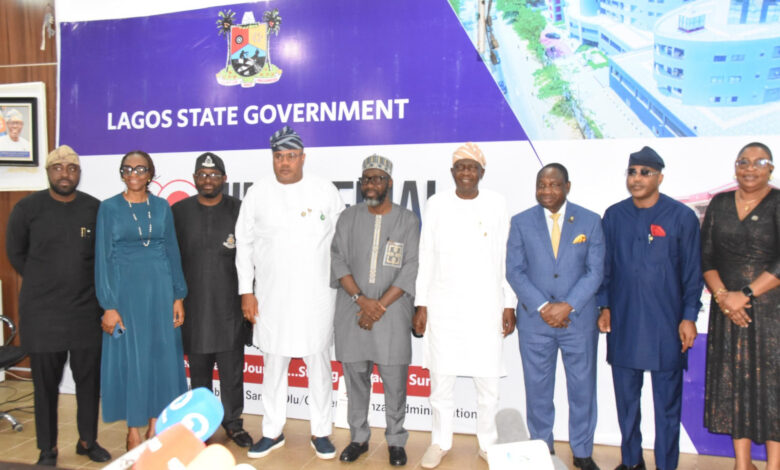
Commissioner for Housing, Moruf Akinderu-Fatai, disclosed the projections during the 2026 Ministerial Press Briefing marking the third anniversary of Governor Babajide Sanwo-Olu’s second term in office.
Akinderu-Fatai described housing as one of the most pressing socio-economic challenges confronting Nigeria and Lagos in particular, warning that migration into the state and escalating construction costs continue to widen the gap between supply and demand.
According to him, Nigeria’s housing deficit has exceeded 22 million units, while Lagos alone accounts for nearly 3.8 million of the shortfall due to its growing population and status as the nation’s commercial hub.
He noted that urban migration and prevailing economic realities had placed enormous pressure on housing availability, especially for low- and middle-income earners.
“At the current rate of development, with annual formal production struggling to keep pace, experts warn that the effective shortage could reach 28 million units within the next few years,” the commissioner said.
Akinderu-Fatai said the state government had adopted “direct budgetary allocations, public-private partnerships and innovative financing mechanisms” to expand access to affordable housing.
Highlighting achievements of the Sanwo-Olu administration, he disclosed that the government completed and delivered 4,202 housing units across several estates in the last six years, while another 6,209 units were delivered through Public-Private Partnership arrangements.
He explained that with ongoing projects expected to be completed before the end of 2025, total housing delivery under the administration would rise to 14,022 units.
Major projects nearing completion include the Egan-Igando Mixed Housing Scheme with 576 units, LagosHOMS Sangotedo Phase II with 528 units, Epe Housing Scheme with 192 units and the Ajara-Badagry Housing Estate. Other joint venture schemes are ongoing in Ikorodu, Ibeshe, Igbogbo and Imota.
The commissioner stressed that the government was prioritising low-income and first-time homeowners through flexible payment structures and mortgage-backed initiatives.
“Our approach operates on multiple fronts: direct budgetary allocations for constructing housing units targeted at low-income groups and fostering a business-friendly environment for private developers through Public-Private Partnerships,” he said.
Akinderu-Fatai further revealed that the Lagos State Mortgage Board had facilitated mortgage and rent-to-own schemes benefiting over 20,000 residents in the last 12 years, while 2,207 applications from prospective homeowners were currently pending.
On real estate regulation, he said the Lagos State Real Estate Regulatory Authority received over 505 petitions relating to fraudulent property activities and resolved 393 cases, recovering three properties and more than N20 million for victims.
He also disclosed that the state was proposing a new tenancy bill to address arbitrary rent increases and excessive charges imposed on tenants.
“The bill will address, among other things, registration of all agents in Lagos State by LASRERA. Failure to register will be an offence and punishable upon conviction,” he said.
Earlier, the state Commissioner for Information and Strategy, Gbenga Omotosho, stressed that housing remained important to all Lagosians, noting that the Sanwo-Olu administration was committed to improving access to decent and affordable accommodation across the state.
He added that sustainable housing development remained vital to social stability and economic growth in Lagos.
In his closing remarks, the Permanent Secretary in the Ministry of Housing, Abdulhafis Toriola, stressed that the ministry viewed housing as critical public infrastructure essential to reducing the state’s housing deficit and improving living conditions for residents across Lagos.