By Nathaniel Zacchaeus, Abuja
The Senate has called on the military authorities in the country to intensify actions following a fresh wave of Boko Haram attacks that had left dozens dead, entire communities destroyed, and thousands displaced across the North-Eastern states of Adamawa, Borno, and Yobe.
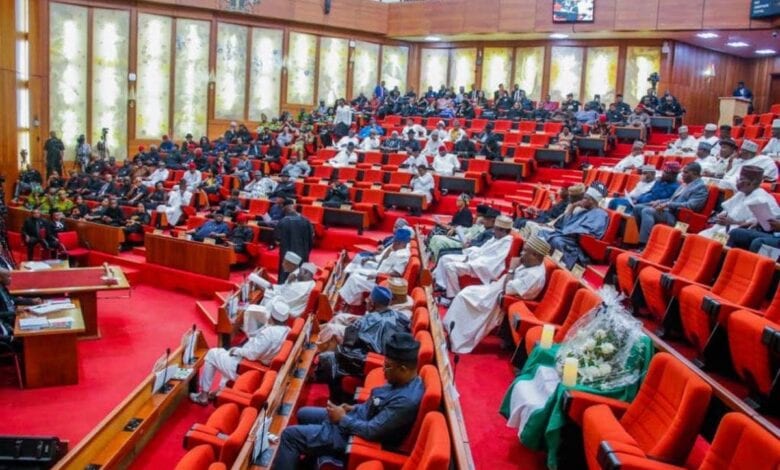
The resolution followed a motion sponsored by Aminu Abbas (Adamawa Central) and backed by over a dozen senators in plenary yesterday.
Abbas recounted recent attacks that have devastated his constituency.
He said, “In Kwampre and Zar, homes were burnt and schools destroyed on February 25. In Banga and Lar, five people were killed on April 15, and churches and houses were set ablaze.
“Then, on April 26, eleven volunteer vigilantes from a neighbouring local government were murdered while defending a corporate community.
“Just last week, the attack on the Kulda community in Hong Kong LGA on May 16 was particularly devastating. Sixteen people were killed, and 90 per cent of homes and places of worship were reduced to ashes. These people now live as refugees in their land.”
Senate Whip, Mohammed Tahir Monguno (Borno North), expressed concern that the previously restored peace in parts of Borno was rapidly deteriorating.
Monguno said, “Boko Haram is back. Just last week, five soldiers were killed in Marte LGA. Government lodges and police stations were destroyed.
“In Kukawa, 23 people were massacred in one community, and 40 in another—simply for allegedly pledging allegiance to a different faction of Boko Haram.”
The Senate also raised concerns over the redeployment of military resources from the North East to the North-West, where operations against banditry have taken priority.
In its resolutions, the Senate asked the government to urgently strengthen military presence in the most affected areas, particularly in the Hong LGA of Adamawa State.
It also urged the National Emergency Management Agency (NEMA) to provide immediate humanitarian relief to displaced residents.
*Moves to regulate domestic staff, others’ employment
Meanwhile, the Senate passed for second reading yesterday a bill to regulate and formalise jobs in the informal sector through private agency involvement.
Sponsored by Musa Sani, the Bill seeks to regulate and formalise the employment of domestic workers, apprentices, interns and other informal sector employees in Nigeria.
It empowers the National Directorate of Employment to issue licenses and monitor privately owned employment agencies, whose responsibility will be to enrol employees in their data bank.
The bill explained that this would safeguard and enhance their social security and oversee their recruitment by employers who engaged in legitimate occupations on such terms and conditions as may be agreed by the parties.
Musa noted that the informal sector was usually regarded as the residual labour market, where labour is highly heterogeneous, sources of income are not largely wage-dependent, working time is discretionary, and some jobs are not paid for at all.
He said, “Operations in the sector are usually small-scale; production technique is labour-intensive, and ownership is generally private. In most cases, the workers in this sector are family members, apprentices, and a few paid employees.
“The informal sector of the Nigerian economy shows evidence of violation of employees’ rights and non-implementation of labour regulations, although the informal sector provides a safety net for skilled, semi-skilled or unskilled labour who could not find a job in the formal sector of the labour market.
“However, the informal sector in Nigeria has practices that do not conform with the International Labour Organisation (ILO) best practices as ratified in its conventions”, to which Nigeria is a signatory.
One such area of concern relates to the decent work deficit. Decent work is work with fair and equal treatment, decent remuneration, fair employment conditions, safety and social protection, opportunities for training and development, and collective bargaining.
“The primary goal of this bill is to regulate this sector to promote strategic objectives: the promotion of rights at work, employment, social protection, and social dialogue,” he stated.
Musa lamented that employees in the informal sector are often seen as having no rights and are not treated fairly by their employers, which the bill also seeks to correct.
The lawmaker added, “This bill empowers the National Directorate of Employment to issue licenses and monitor the activities of Employment Agencies throughout the country.”
However, Adams Oshiomhole, while contributing to the debate, noted that public and private sector agencies use third parties to recruit their low-level staff.