By Babs Oyetoro
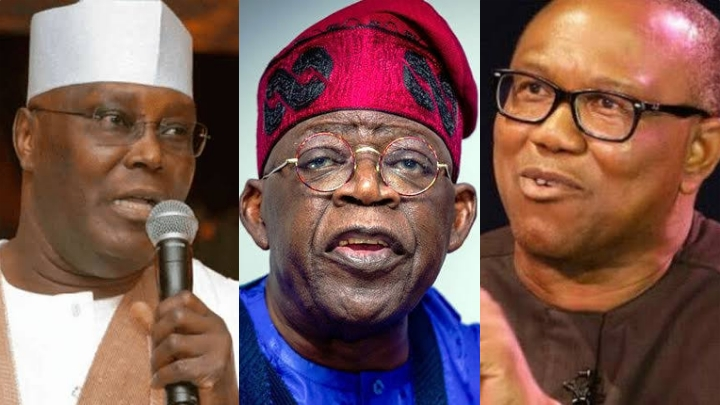
President Bola Tinubu, former Vice President Atiku Abubakar and presidential candidate of the Nigeria Democratic Congress (NDC), Peter Obi, have offered contrasting perspectives on Nigeria’s direction as the country marked its 66th Independence Anniversary.
While Tinubu declared that his administration had completed the difficult phase of economic reforms and was entering an age of prosperity, Atiku challenged the impact of the policies on ordinary Nigerians, with Obi proposing a different approach centred on production, security and accountable governance.
The three Independence Day messages offered competing assessments of the country’s progress and differing prescriptions for addressing the challenges confronting citizens.
In his address, Atiku, who is the presidential candidate of the African Democratic Congress (ADC), questioned whether the gains cited by the administration were translating into better living conditions for ordinary Nigerians.
“Bola, where is this prosperity?” Atiku asked, arguing that millions of Nigerians were struggling with food, transportation, healthcare and employment.
He said lower inflation should be assessed alongside household purchasing power, which he contended had weakened significantly.
“Growth must improve lives. It cannot be a certificate of success that government awards itself while citizens struggle to survive,” he said.
Atiku also criticised the removal of fuel subsidy, arguing that it had increased transportation and food costs without delivering the relief promised to Nigerians.
He proposed a capped and budgeted production subsidy tied to verified fuel refined in Nigeria, including fuel from modular refineries.
“The principle is simple: produce here, refine here, create jobs here and pay less here,” Atiku said.
The former vice president also made insecurity a central part of his message, saying farmers were unable to safely access their farms and families remained exposed to attacks and ransom demands.
“A government that cannot make life affordable and cannot protect life has failed the two tests that matter most to its people,” he said.
He called for greater transparency in government spending, contracts, borrowing and social intervention programmes, saying Nigerians should be able to establish how public funds were spent and who benefited.
Obi, meanwhile, focused on governance, security and the need to move Nigeria towards greater production.
The NDC presidential candidate pledged that, if elected, his administration would make governance measurable and centre it on the welfare and productivity of Nigerians.
“My message today is not one of despair. It is a message of hope, determination and responsibility. I dare to proclaim with full assurance that a new Nigeria is possible,” Obi said.
He pledged to confront insecurity so farmers could return to their farms, children to schools, and businesses could operate without fear.
“We will confront insecurity decisively so that our farmers can return to their farms, our children can return to school, businesses can operate freely, and families can live without fear,” he said.
Obi said agriculture, manufacturing, human capital development and job creation would receive priority under his proposed administration.
He also pointed to the plight of internally displaced persons, citing his recent visit to a camp in Sokoto.
“These are Nigerians who should be living in their communities, going to school, farming their land, conducting their businesses and contributing to the economy. Instead, they live as displaced persons in their own country,” he said.
Obi said Nigeria’s challenge was not simply a lack of resources but the failure to convert those resources into human development, security and opportunity.
He identified poverty, insecurity, out-of-school children, hunger, unemployment, maternal and infant mortality, drug abuse and low life expectancy among the challenges requiring urgent attention.
The NDC candidate also pledged to lead by example, saying he would spend his holidays within Nigeria if elected president to interact with citizens and understand their challenges.
“I want to continue to see Nigeria. I want to know Nigeria. I want to spend time with Nigerians, listen to them, understand their challenges and celebrate their resilience,” Obi said.
He said the Nigeria he envisaged would be “secure, united and productive,” governed through competence, accountability and justice.
*President says reforms have opened new phase
Tinubu’s Independence Day address provided the government’s case for its economic direction, arguing that difficult decisions taken since 2023 had confronted structural weaknesses and created room for the next phase of development.
“When this Administration assumed office, we resolved to do things differently. We chose to excise the cancer. The reforms that followed were difficult. The side effects were real,” he said.
The President said the economy had grown by more than four per cent, with oil and non-oil sectors contributing to renewed growth.
He also cited lower inflation, improved foreign exchange stability and more than $6 billion in non-oil export revenue in 2025 as evidence of increased economic resilience.
“Our reforms did not create the weaknesses in our economy. They confronted them,” Tinubu said.
He declared that the immediate task had shifted from correcting the country’s economic course to delivering what he described as “shared and widespread prosperity.”
“The emergency treatment is over. The foundation has been repaired. The central economic task before us has changed,” he said.
Tinubu said the next phase should ultimately be judged by improvements in the lives of Nigerians rather than economic statistics alone.
“When I speak of prosperity, I do not speak merely of a larger economy, abstract numbers or better statistics. I mean something much more personal,” he said.
He described a Nigeria where farmers could cultivate safely, factories had reliable power, businesses could access credit, and young Nigerians could find productive work.
He also said food and transportation should become affordable and education remain within reach of ordinary families.
The President acknowledged the difficulties of Nigeria’s 66-year journey, saying the country had endured war, military rule, economic crises, insecurity and political upheaval.
“Our journey has not always been easy. In truth, it has generally been too hard for too many,” he said.
Tinubu nevertheless urged Nigerians to look ahead, maintaining that the reforms had created a stronger foundation for the next stage of national development.
“Our destination is in sight. Our foundations are strong. Our direction is clear. So let us go forward. No looking back,” he said.