FG lauds Diri’s commitment to sports as curtain falls on Bayelsa Governor’s Football Tournament

The Federal Government has commended the contributions of Bayelsa State Governor, Senator Douye Diri, to the development of sports in Nigeria.
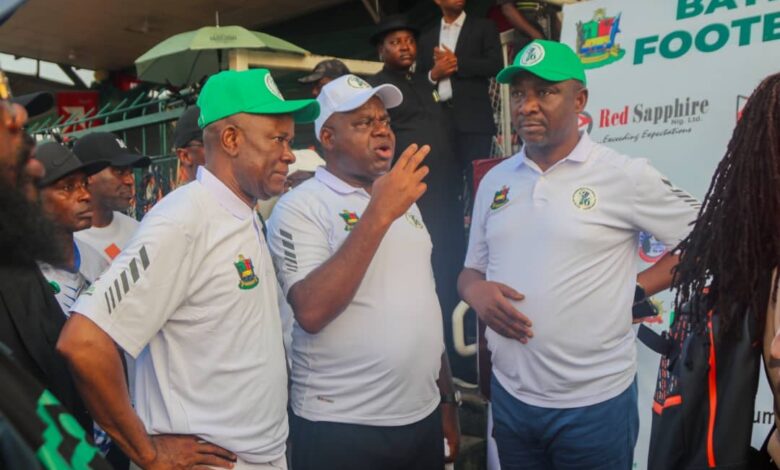
The Minister of Sports Development, Senator John Enoh, gave the commendation on Saturday, during the final of the 6th edition of the Bayelsa Governor’s Football Tournament christened Prosperity Cup, which held at the Samson Siasia Sports Complex in Yenagoa.
Senator Enoh, who witnessed the final games between NDU Queens and Peremo Academy in the female category as well as male category between Ogboinbiri of Southern Ijaw Local Government Area and Nembe City of Nembe Local Government Area, noted that since becoming minister, Governor Diri had been a recurring decimal in Nigeria’s sports sector.
The Sports Minister said Governor Diri has continued to encourage and sponsor the growth of football and other sports not only in Bayelsa but also has been very supportive of the Super Eagles of Nigeria.
He stated that the motto of the Prosperity Cup, “Taking Sports Development to the Grassroots,” resonates with the determination of the Federal Ministry of Sports Development to bring back its zonal offices across the country, stressing that the future of sports lies in the grassroots.
“Since becoming Minister of Sports, I have found one governor that has been a recurring decimal in Nigeria’s sports sector and he is the Governor of Bayelsa State.
“Wherever I have gone to, this governor keeps recurring. He keeps providing support, encouragement and sponsorship, particularly when Nigeria competed in AFCON. He is one governor that made a commitment to the team and redeemed it immediately.
“The Nigeria Wrestling Federation has the Commissioner for Sports in Bayelsa, Daniel Igali, as president. This governor has done more for that federation than anyone else. I am supposed to leave for Germany tomorrow to be with our Olympic team but I said I must be here and I am glad I came,” he said.
Senator Enoh said with over 200 teams registered for the tournament, the Prosperity Cup was a model that other states should copy.
He said his ministry in partnership with the Nigeria Football Federation (NFF) might institute a similar national grassroots competition having Diri as their ally.
He also thanked the governor for the tremendous support to the wrestling federation as Nigeria prepares for the 2024 Olympics and expressed the optimism that the support would translate to medals for the country.
Speaking during the Minister’s courtesy visit to the Government House, Governor Diri described football as a money-spinning sport if the young talents are well nurtured to become stars.
He noted that football stars earn more than the allocation of a state in the country, which, according to him, was the idea behind the Governor’s Cup.
He said his administration will continue to encourage and develop talented male and female athletes in the state and expose them to the world.
Diri urged the youths to be focused in pursuing their dreams, taking a cue from the likes of Daniel Igali.
He expressed satisfaction that the community-based competition has lived up to expectation, especially seeing a grassroots team from Ogboinbiri community emerging champions and congratulated the organisers for making judicious use of approved funds.
“Since this competition started three months ago, youths have been busy. The security agencies have also told me that the little crimes we experience have declined because the youths are involved.
“This competition is not just urban-based; it is also community-based. You can imagine a team from Ogboinbiri, all the way from Southern Ijaw, subduing the urban teams from Yenagoa. So I am very happy with the organisers of this competition. Mr. Ono Akpe and his group have done so well.” the governor noted.
Dignitaries at the closing ceremonies included the Governor of Edo State, Godwin Obaseki, represented by his Sports Commissioner, Yusuf Ali, who commended the Bayelsa government for the football tournament and for giving sports a pride of place not only in the state but nationally.
He expressed the hope that the Governor’s Cup would outlive his administration to the benefit of the country.
Also, the NFF President, Ibrahim Gusau, particularly lauded the organisers for introducing the female version and said the federation had started the training of female coaches to acquire the CAF ‘C’ licence.
In his remarks, the Chief Executive Officer of Premium Trust Bank, one of the key sponsors of the tournament, Mr. Emmanuel Emiefenim, hailed the state government for its commitment to sports development, noting that as strategic partners, they thought it wise to identify with the competition.
Emiefenim said one way to empower the youths was to engage them positively, especially through sports, stressing that his bank was the official sponsors of the Athletics Federation of Nigeria to the Olympic games in Paris.
He also disclosed that the bank will donate a Coaster bus to Bayelsa United as well as brand the team’s jerseys as part of its sponsorship support to the team.
In his welcome address, the Commissioner for Sports, Daniel Igali, thanked the governor for his unrelenting support for sports.
Director-General of the Prosperity Cup, Mr. Ono Akpe, while commending Governor Diri’s commitment to grassroots sports development, said the central and local organising committees would work to make the tournament better and more exciting in the next edition.
Ogboinbiri, which defeated Nembe City 3-0, got a cash prize of N5m while winners of the female category, NDU Queens, which beat Peremor Academy by a lone goal, received N1m as prize money.
Total prize money in the tournament was N15m.