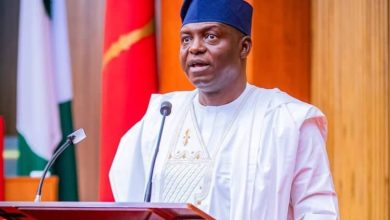
Lere Olayinka, media aide to the Minister of the Federal Capital Territory, Nyesom Wike, has said his principal declared support for President Bola Tinubu’s 2027 re-election bid before the Peoples Democratic Party selected its presidential candidate.
Olayinka, the Senior Special Assistant on Public Communications and Social Media to the minister, said Wike’s position could therefore not be described as “treacherous”, insisting that the minister had consistently made his political preference known.
He made the clarification during an interview on Arise TV on Friday while responding to criticism of Wike’s decision to back Tinubu despite remaining a member of the PDP.
According to Olayinka, treachery would involve secretly working against an individual while maintaining the appearance of friendship, a description he said did not apply to Wike.
“The word ‘treacherous’, I don’t believe he should have used it because, to my own understanding, a treacherous person is somebody who is doing something against you behind you and presenting himself to be your friend,” Olayinka said.
He maintained that Wike had made his position clear long before the PDP presented Professor Sandy Onor as its presidential candidate.
“The FCT Minister, Nyesom Wike, has never hidden his position. He said it even before PDP presented Professor Sandy Onor as candidate, that he was going to support President Tinubu in 2027. He did not hide it, and up till now, he has not hidden it. He has been saying it,” he said.
Olayinka added that Wike had also told Onor that he was entitled to pursue his presidential ambition but suggested that the state of the PDP could limit the party’s prospects in the election.
He argued that merely presenting a presidential candidate did not automatically translate into a serious electoral challenge, noting that candidates could enter an election for reasons other than winning.
“For instance, in this 2027 election, we have 19 presidential candidates. Can we say, honestly, that all the 19 are contesting with the mindset of winning? The answer is no,” he said.
The minister’s aide then questioned the nationwide structures of some opposition parties, arguing that the absence of candidates in several state elections could weaken their ability to mobilise voters and operate effectively at polling units.
He cited the African Action Congress presidential candidate, Omoyele Sowore, who he said secured 14,600 votes in the 2023 presidential election, and questioned how the figure could translate into a nationwide victory in 2027.
Olayinka also claimed that the New Nigeria Peoples Party did not have governorship candidates in 15 of the 28 states where governorship elections are scheduled for 2027.
“How do you win election when you don’t have people on ground to canvass vote for you, to manage election for you?” he asked.
He similarly questioned the strength of the African Democratic Congress, claiming that the party lacked governorship candidates in nine of the 28 states.
Olayinka said presidential candidates required extensive grassroots structures and polling-unit agents to compete effectively in a national election.
“In Nigeria today, there are 176,846 polling units. To make good impression on election day in election in Nigeria, you need at least five people to manage each polling unit for you, at least,” he said.
He linked Wike’s confidence in Tinubu’s chances in 2027 to what he described as the weakness of the opposition, rather than to any secret political arrangement.
“And that’s why the Minister has been saying consistently that this election of 2027 will be the easiest for the President to win, because there’s no opposition, nobody is contesting against him to win. Others are contesting to make impression,” Olayinka said.