By Idu Jude
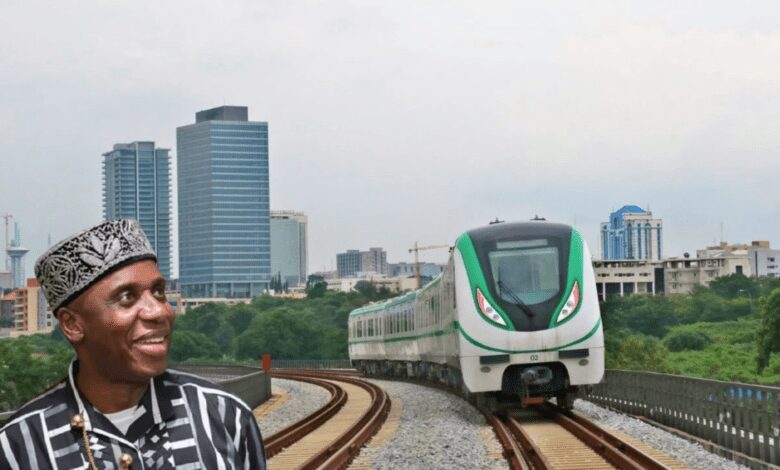
The Federal Government has stated that prioritizing the completion of ongoing railway projects and commencing new ones will spur economic growth while facilitating trade not just in Nigeria but with her West African neighbours.
The Minister of Transportation, Mr. Rotimi Amaechi disclosed while presenting a total capital budget of N 147, 931, 691, 294, and overhead of N 358, 799, 998, as the 2022 Budget proposal of the Federal Ministry of Transportation to the Joint Committee of the Senate and House of Representatives on Land and Marine Transport at the National Assembly Complex in Abuja
“We will continue to construct more rail to connect other African or West African countries who are involved in rail management. The moment we do this, from point A to B, you can move cargo, you can move human beings, you can move trade” the Minister said.
During the interactive session with the Joint Committee members, Amaechi stressed the need for members to support government drive the ongoing Dry Ports projects across the country which includes the Baro Dry Port and Lokoja River Port, saying they will only thrive if an interface or linkage of the proposed rail lines are completed as Rivers Benue and Niger have a depth of 3 meters and only barges and tugboats can operate within such parameters.
“Railway is the key to Baro, the railway is the key to Lokoja, whatever you produce, you can put it on top of that train if you can excavate it and put it on top, that rail will take it to where you want it to go. So, our intention is, if we can take the railway to everywhere in Nigeria, we would have peace, if it is passengers, it will have, if it is cargo, it will have” Amaechi said.
Reacting to “Why rail line should lead to Maradi in Niger Republic Amaechi said construction of the Standard Gauge line will enable interconnectivity with countries in the West Africa sub-region for the promotion of trade and commerce”. He also explained that Kano-Maradi was not borne out of his ambition but rather a survey which had been carried out by previous administrations and government been a continuum, he only deemed it fit to implement the plan taking into consideration the viability of the project when completed. Besides, he further explained that the rail linkage that gets to Maradi is only 20 kilometers.
On the issue of why the Eastern rail line was narrow gauge and not standard gauge, the Minister explained that he had two approvals from President Muhammadu Buhari for narrow gauge and standard gauge. But since getting the money to reconstruct the narrow gauge is easier, it made economic sense to connect the whole country by narrow gauge while still sourcing for funds to do the standard gauge.
Furthermore, the Minister explained that the main difference between the narrow gauge and the standard gauge was merely speeding. While the former does 100 km/h, the latter does 120 km/h.
Reacting to the issue of loans, the Minister said the only money borrowed so far is the $ 1.4 billion spent on Lagos – Ibadan rail, explaining that loan approvals do not translate to cash.
According to the Minister, thus far, the completed and flagged-off rail corridors of Lagos-Ibadan, Warri-Itakpe, Abuja-Kaduna for commercial operations have employed over 500 skilled workers, 1 million indirect employments not forgetting to mention commercial activities that have received a stimulus along these corridors.
Responding to reasons behind the cut in the budgetary submission of the Nigeria Railway Corporation (NRC) from 18 billion in 2021 to 7 billion naira in 2022. The Transport Minister said “The NRC must move from being dependent on government to be dependent on themselves. I am not saying they are not doing well. After all, we are getting 350 million Naira now from Abuja -Kaduna
Construction workers desert high-rise in Lagos after 21-storey building collapse
….. It was 70 million Naira” He further disclosed that from the proceeds, the Ministry has been able to sustain work along other rail corridors. The Minister charged the Managing Director, NRC, to run the Corporation as though it was a personal business to generate more funds for the government while charting a course for self-reliance.
In her contribution to the ongoing rail projects, the Minister of State for Transportation, Sen. Gbemisola Ruqayyah Saraki, maintained that the rail projects are not personal as against public opinion. Adding that with the ratification of the African Continental Free Trade Agreement, the proposed and ongoing rail projects positions Nigeria to be more competitive regionally.