There is no denying that Nigeria is endowed with abundant resources in the mining, which when harnessed, could serve as a catalyst for the nation’s development.
The words of the British-born parliamentarian, Ivan Lewis, sum up the essence of the successful creation of value in the solid minerals sector by Nigeria, more than those of others.
He wrote, “Nigeria is too rich to be poor.” According to the Deputy Chairman, Senate Committee of Solid Minerals, Mines, Steel Development and Metallurgy, Senator Yakubu Oseni, (APC, Kogi), the opinion of the former British member of parliament could not be unconnected with the fact that the mineral sector has failed to meet the public expectation of driving economic growth and generating employment to teeming populace.
Lewis’ opinion obviously tallies with those of many Nigerians who are unsettled by the present pitiable contribution of the solid minerals sector to Nigeria’s annual Gross Domestic Product (GDP).
This has also highlighted the essence of the much-needed attention to be given to the solid minerals sector, host communities, and other related issues, for the much-talked-about diversification of the Nigerian economy to be feasible.
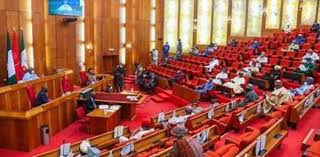
This, among other reasons, are the basis for the two-day public/investigative hearing on four bills and a motion organized by the Senate Committee held at the New Senate Building in Abuja last week.
The proposed legislation includes the Solid Minerals Producing Area Development Commission Bill; Nigerian Minerals Development Corporation Bill; Institute of Bitumen Management Bill; and Explosives Act 1964 Repeal and Re-enactment Bill.
The investigative hearing focused on the urgent need to probe the loss of $9 billion annually lost to illegal mining of gold in the country.
The Solid Minerals Producing Assets Developed Commission Bill sponsored by Senator Oseni is to provide for an act with a special focus on inherent and latent environmental devastation as a result of exploratory mining activities.
In his presentation at the event, Oseni said the bill, if it sails through, will empower the commission to formulate policies and guidelines for the development of solid mineral-producing areas.
According to him, the proposed commission would implement all the measures approved for the development of the areas by the Federal Government and member states of the agency.
“It will equally identity factors inhibiting the development of the Solid Minerals Producing Areas and assist the member’s status in the formulation and implementation of policies to ensure sound and efficient management of the resources of the solid minerals producing areas.
“Some other salient expectations of the commission will be to tackle environmental problems that arise from the mining, excavation, and exploitation of solid minerals in the producing areas and advice the Federal Government and the member states on the prevention and control of environmental devastation.
It will also empower the commission to liaise with the various solid minerals mining, excavation, and exploitation companies on all matters of environmental problems,” he explained.
Oseni, who is also an economist, was optimistic that with the right legislation, and political will which the present administration is ready to muster, the over-dependence on crude oil, poor legal, regulatory, and institutional framework as well as lack of up-to-date geoscience data that can facilities investment decision making, the situation could be turned around.
He also highlighted the finding that almost all states in Nigeria had at least one mineral deposit, with some states boasting of two or more in each of their local government areas, including gold, iron, lead, zinc, rare metals, coal, and gemstones, among others.
Similarly, the Chairman of the Senate Committee, Senator Umaru Tanko Al-Makura, presented to the public hearing, the salient details and justifications for his Nigerian Minerals Development Corporation (NNDC) Bill, pointing out that Nigeria is blessed with an abundance of solid minerals in five distinct classes: precious mineral/gemstones, metallic ores, construction minerals, and energy minerals.
He called on the stakeholders to support the need for the commission given the mundane and incongruent manner in which the solid mineral industry had over the years found itself due to a lack of policy that could stimulate production and adhere to international best practices.
“With these problems, it is observed that unbundling of the sector can be the salvation.
“This is even more so that the present administration is receptive to making decisions that align with a template in more advanced climes.
“As part of this administration’s effort towards the diversification of the Nigerian economy, one of nine priority areas is stabilizing the macro-economy by strategically diversifying Nigeria’s economy from being a mono-product economy to the productive development of various sectors of the economy,” Al-Makura said.
He also noted that, next to agriculture, the solid minerals sector had been identified as one with the potential to compete and eventually replace crude oil as a major source of foreign exchange earnings.
“The Economy Recovery and Growth Plan (ERGP) created focus labs made up of professionals from the mining sector to create intervention programs to de-risk the solid mineral sector and increase revenue for all stakeholders, making the sector more attractive to both local and foreign investors.”
Also in the reform effort, the NMDC is proposed to be a State-Owned Enterprise (SOE), with private sector participation and governance control as the vehicle for unbundling upstream and downstream commercial activity in the Nigerian solid minerals sector.
Today, the need to establish the Nigerian Mining Development Corporation (NMDC) cannot be over-emphasized as this will accelerate infrastructural development and bridge the gap of unemployment and foreign exchange earnings, thereby bringing the nation to financial prosperity in the short to medium term.
So, this is the most pragmatic approach to the diversification of the Nigerian economy, Al-Makura argued.
According to the senator, upon establishment of the NMDC, initial funding shall be by way of a sovereign guarantee covering the sum of N5 billion for a successful take-off of its operation, including all initial capital and operating expenditure with the Federal Government accounting for its 70 per cent equity contribution and the institutional investors paying their respective equity participation to the corporation.
However, Patrick Odiegwu, one of the major stakeholders at the forum from the Organised Private Sector (OPS), said the desire to realize the goals of NMDC with N5 billion is a self-deceit.
To him, the amount cannot even support one mining company, thus subsequent funding of the corporation through the Nigerian Mineral Development Fund (NMDF), which will be managed by the corporation strictly in accordance with Nigerian monetary policy and international best practices, should be a priority.
On the bill seeking the establishment of Solid Minerals Producing Area Development Commission (SMPADC), with a special focus on inherent and latent environmental devastation and other connected matters, Odiegwu opined that the nation would be sitting on a time bomb if the issues of mineral producing area development were not taking seriously because mining is a very destructive industry.
Also speaking, a member of the Senate Committee, Smart Adeyemi, cautioned that the problem of solid minerals producing areas should not be allowed to get to the stage of oil-producing areas before the bill proposed by Senator Al-Makura is enacted.
Adeyemi, who described the Al-Makura’s bill as apt because the nation may not be able to ascertain the damage illegal miners would do in years to come, said: “Today, mining is done without recourse to health hazards of the miners and others.”
The lawmaker also expressed concerns that the insecurity in Zamfara State might not be unconnected with illegal gold mining in the state.
In a keynote address, the Minister of State, Solid Minerals, Mines and Steel Development, Dr. Uche Ogah, frowned at the neglect of mines and solid minerals sector by the Central Bank of Nigeria (CBN).
He urged the Ministry of Finance, Budget, and National Planning to speed up the process to ensure the export of the nation’s resources is recognized.
Dr. Ogah, who revealed that plans were underway for the solid mineral ministry to establish a database of minerals being exported from Nigeria, noted that the proposed bills would be critical to the development of the minerals sector.
He warned that the issue of illegal mining was too critical to be left for the government alone, saying “we must all be involved in resolving the issue.
“We must not allow any minor to be exploiting our minerals illegally.”
The minister, however, charged the National Assembly to examine all existing laws and the new bills to strengthen the exploration of minerals in the country as the ministry of solid minerals had already embarked on establishing six processing plants across the six geo-political zones for different minerals to further drive the present administration’s diversification programme.
Akeredolu speaks on Bola Tinubu’s health
The investigative hearing harped on the urgent need to investigate the alleged N9 billion annually lost to illegal mining of gold in the country.
The forum rose with a resolve to seek further professional help from the apex bank, the Nigerian Port Authority (NPA), and security agencies among others.