By Chukwudi Obasi
For more than 40 editors and journalists, the journey through Benue State was more than another media assignment.
It was an opportunity to leave behind government statistics and official presentations and see for themselves what the Renewed Hope agenda looks like on the ground.
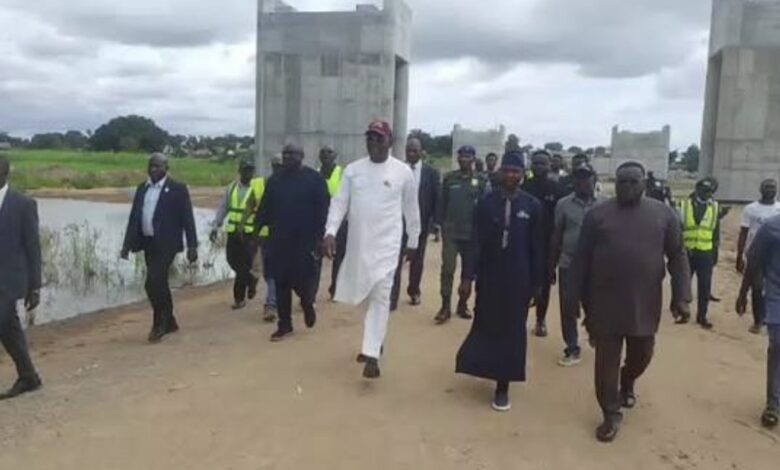
From the once-moribund Taraku Mills in Gwer East to major road projects linking Benue with neighbouring states, and from the Otobi Waterworks to state-funded roads cutting through rural communities, the Renewed Hope Ambassadors National Media Team went looking for evidence of development—and the stories behind the projects.
Led by the Special Adviser to the President on Information and Strategy, Bayo Onanuga, the delegation embarked on the inspection to independently assess, document and showcase the implementation and impact of Federal and State Government projects.
Their Benue tour offered a glimpse of a state attempting to convert infrastructure investment into economic opportunity, while revealing what such investments could mean for ordinary farmers, traders, workers and families.
At the centre of the state’s emerging story is Taraku Mills.
For years, the facility in Gwer East stood largely silent, a relic of a period when Benue’s agricultural potential was expected to feed not only its people but also a thriving agro-industrial economy.
Established in 1989 under the administration of the late Governor Aper Aku, Taraku Mills once produced vegetable oil, animal feeds and other agro-allied products.
Now, the Benue State Government is rehabilitating the facility.
For the media team, the sight of work at the old industrial complex offered more than another project to photograph. It raised a fundamental question: can Benue finally build an economic system where the farmer who produces the food also benefits from processing, marketing and employment opportunities?
Governor Hyacinth Alia believes it can. He told the visiting journalists that increased federal allocations under President Bola Ahmed Tinubu had created greater fiscal space for his administration to invest in infrastructure and revive abandoned economic assets.
“The increased Federal Allocation has given us more fiscal space to do some of the things that we could not do before,” Alia said.
But his argument was not simply about money. It was about what the money could accomplish.
“We are using the resources responsibly to revive industries, build roads and provide infrastructure that will directly impact the lives of our people,” he added.
That distinction was central to the Renewed Hope Ambassadors’ mission.
Rather than relying solely on government releases or completion figures, the journalists physically visited project sites and interacted with officials responsible for their implementation.
For Onanuga, the road projects offered one of the clearest examples of infrastructure changing everyday experiences.
The team inspected the ongoing Lafia Bypass and the dualisation of the 250.627-kilometre Section II of the Makurdi-Otukpo-9th Mile (Enugu) road.
Implemented by the Federal Ministry of Works and executed by China Harbour Engineering Company (CHEC), the strategic corridor connects Nasarawa, Benue and Enugu states.
On paper, it is a major federal infrastructure project. On the ground, its significance is simpler: shorter journeys, easier movement of farm produce and lower transportation costs.
Onanuga noted that even before completion, the road had already reduced travel time between Makurdi and Otukpo.
“I learned the road was so bad that from Makurdi to Otukpo used to take about three hours, but now just about one and a half hours or so,” he said.
For a farmer transporting perishable produce, saving time can make a difference. For traders, it can mean lower operating costs. For families travelling between communities, it means less time on difficult roads.
Onanuga described the project as commendable and said President Tinubu deserved applause for infrastructure interventions across the country.
The road project connects directly to the story of Taraku Mills.
Benue is known as Nigeria’s food basket, but producing food is only the first step in building an agricultural economy.
Without processing plants, storage facilities, good roads and accessible markets, farmers can remain trapped at the lowest end of the value chain.
That is why the rehabilitation of Taraku Mills could be significant.
According to Alia, the revived facility will provide a market for farmers, particularly soybean producers, while creating jobs and stimulating economic activities in surrounding communities.
His administration’s ambition is to build an integrated system in which farmers produce, industries process, and markets distribute finished products.
The state has also provided financial support to smallholder and other farmers to strengthen agricultural production.
For the Renewed Hope media team, Taraku therefore became more than an industrial rehabilitation project. It represented a test of whether infrastructure can be connected to economic empowerment.
A functioning mill needs farmers. Farmers need markets. Markets need roads. Workers need industries. And communities need the economic activity generated by all of them.
That is the chain Benue is attempting to rebuild. A state rebuilding its connection with Abuja
The Renewed Hope Ambassadors also inspected the 52-kilometre Awajir-Oju Road, a major Benue State Government project cutting across Gwer East, Konshisha and Oju Local Government Areas.
Alia said the state-funded project complements federal interventions and demonstrates what cooperation between the two levels of government can achieve.
For the governor, the improved relationship between Benue and the Federal Government has been important.
He recalled a period when strained relations between the state and the centre left Benue with limited influence and fewer opportunities to benefit from federal interventions.
“Before we came in, we had seen how relationships between Benue and the Federal Government got bad. So the result was that the state lost so much,” he said.
The administration, he explained, deliberately sought to rebuild the relationship. “So, we had to renew our relationship with the centre,” he added.
The results, according to Alia, are reflected in federal infrastructure projects across the state.
But increased revenue, he stressed, must come with increased responsibility.
The governor acknowledged that Benue is receiving substantially more from the Federation Account than previous administrations but stressed that the critical issue is how the resources are managed.
“The management skills of those funds are what would be of importance here,” he said.
At Otobi Waterworks in Otukpo Local Government Area, the delegation encountered another form of infrastructure—one whose importance is measured not in kilometres but in litres.
The facility supplies Otukpo, Otobi and surrounding communities and has a capacity of 10,000 cubic metres of water daily.
Mrs Juliet Maka, Director of Urban Water Supply and Quality Control, supervising the Benue State Water Board, told the team that the facility was already operating at full capacity.
“The Otukpo town and Otobi community are benefiting from this water scheme now,” she said.
Unlike a major highway, water infrastructure may attract little public attention. Yet its importance is immediate for households, businesses and communities.
It is another reminder that development is not only about impressive structures. Sometimes, it is about restoring basic systems that make everyday life easier.
For Fredrick Nwabufo, Senior Special Assistant to the President on Public Engagement, the media tour was about ensuring that Nigerians received first-hand information about the pace of development.
That mission placed the Renewed Hope Ambassadors at the heart of the Benue story.
The journalists were able to see the roads, inspect the facilities and hear directly from officials responsible for them. It also allowed them to document what remains unfinished and what must be done to ensure that the investments eventually deliver their promised benefits.
Infrastructure projects are often reduced to figures—contract sums, kilometres, completion percentages and budgetary allocations.
But behind every kilometre of road is a traveller. Behind every revived factory is a worker. Behind every agricultural market is a farmer. Behind every water scheme is a household.
The Renewed Hope Ambassadors National Media Team set out to connect those figures with those human stories.
And in Benue, those stories are beginning to converge. At Taraku Mills, an old industrial dream is being revived.
On the Makurdi-Otukpo-9th Mile corridor, journeys are becoming shorter even before the road is completed.
Along the Awajir-Oju route, the state is expanding its road network. At Otobi, water is reaching communities.
The inspection was part of the team’s wider national assessment of Federal and State Government projects and their impact on citizens.