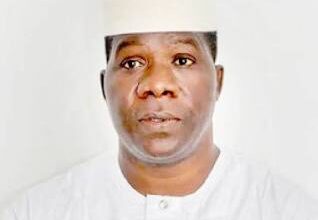
By Lemmy Ughegbe, PhD
On Christmas Day, the United States, acting in coordination with Nigeria, carried out airstrikes against Islamic State-linked terrorist camps in Sokoto State. Both governments publicly acknowledged the operation and confirmed that it was conducted with Nigeria’s consent, within the existing security and intelligence cooperation frameworks.
In strictly military terms, that confirmation might appear to close the matter. In civic, political, and moral terms, it does the opposite. It opens a far deeper conversation.
The most revealing aspect of the episode was not the airstrike itself, but how swiftly it became a contested domestic narrative. Even before official clarifications, speculation surged and public opinion fractured.
Some Nigerians welcomed the action as a long-overdue response to terrorism. Others raised alarms about sovereignty, legality, and civilian risk. That speed of polarisation was not accidental. It was symptomatic.
The strike became a domestic narrative not because it was foreign, but because it was believable.
Nigeria has lived with violent extremism for more than a decade. From the northeast to the northwest, citizens have watched armed groups entrench themselves while official assurances recycle familiar phrases about improved capacity and decisive action.
Against this backdrop, the idea that foreign military support could be deployed, even on Nigerian soil, no longer sounds implausible. It sounds like an extension of a reality Nigerians have already internalised: that the state’s monopoly of force is under severe strain.
This is not an argument against international security cooperation. Modern counterterrorism is inherently transnational. Intelligence sharing, training, logistics, and joint operations are standard practice among states confronting non-state actors. Nigeria should wallow in insufferable arrogance when it could use some international help.
The real problem lies elsewhere. It lies in trust and communication.
In functioning democracies, even sensitive security actions are accompanied by deliberate narrative management. Governments understand that silence breeds suspicion and that trust itself is a strategic asset.
In Nigeria, however, communication around security is often reactive, minimalist, and cloaked in technical language that does little to calm public anxiety. By the time official statements emerge, speculation has already hardened into belief.
This explains why one of the most damaging claims following the Christmas Day strike gained traction so quickly: that the United States acted without Nigeria’s knowledge or approval, amounting to a unilateral invasion. That claim is false. It is contradicted by official confirmations from both Abuja and Washington. The operation was not foreign adventurism. It was an authorised collaboration.
Correcting this record matters. Not to stifle criticism, but to anchor debate in fact. Sovereignty is not violated when a state consents to cooperation. It is weakened when citizens no longer trust their institutions to speak clearly and promptly about such collaboration.
Predictably, prominent critics emerged. Sheikh Ahmad Gumi, whose public interventions over the years have repeatedly drawn criticism for appearing indulgent towards bandits and extremist actors now formally designated as terrorists, condemned the airstrike and framed it as an attack on the Muslim North. Other voices echoed this framing more quietly.
That characterisation is as misleading as it is dangerous.
An airstrike against designated terrorist camps in northern Nigeria cannot, by any honest logic, be described as an attack on the Muslim North unless one is prepared to equate terrorism with Islam. To do so is to stigmatise millions of peaceful Muslims by collapsing their identity into the crimes of armed extremists. Ironically, this rhetoric achieves precisely what it claims to resist. By portraying action against terrorists as a religious assault, it indirectly tarred the Muslim North with terrorism.
The contradiction deepens when placed against recent history. When former United States President Donald Trump warned of an impending strike against terrorists in northern Nigeria who he claimed were killing Christians, Sheikh Gumi reacted with vehemence, describing those same criminals as his brothers, relations, and sons. That language was not accidental. It reflected a persistent tendency to humanise perpetrators while dehumanising their victims.
One is compelled to ask how long such incendiary rhetoric will continue to be indulged. In a country as fragile as Nigeria, the words of influential figures carry consequences. When the line between criminality and community is deliberately blurred, the result is not peace but provocation.
Terrorists operating in the North are not representatives of the North. They are criminals exploiting it. Conflating the two is not advocacy. It is intellectual recklessness.
Concerns about civilian safety, proportionality, and long-term strategy are legitimate and must constantly be interrogated. But criticism must be anchored in truth, not distortion. The same standard applies to political commentary.
Peter Obi expressed unease about the symbolism of foreign military involvement and went so far as to call on President Bola Ahmed Tinubu to apologise to Nigerians over the strike. His position resonated with those who view external military support as evidence of deeper governance failure.
Yet this reaction sits uneasily alongside his earlier public position. Peter Obi had previously stated that if he were President, he would welcome military and intelligence support from the United States and other willing partners to address insurgency and restore security. That stance was widely praised as pragmatic. When the sitting government accepted precisely such collaboration, culminating in the Christmas Day operation, Obi demanded an apology from Tinubu for the airstrike by the United States. This raises a fundamental question. At what point does principled concern give way to selective outrage?
If foreign military cooperation is acceptable in theory when articulated from opposition platforms, but objectionable in practice when implemented by an incumbent government, then the issue ceases to be policy. It becomes politics. And insecurity is far too grave to be reduced to politicking.
For communities living under constant threat, protecting lives is not an abstract principle. It is an urgent necessity. Terrorists do not pause for political debates. Victims are less concerned with rhetorical purity than with whether the state can finally disrupt those who terrorise them.
There is also the symbolism of timing. Christmas Day is a period of religious reflection, communal vulnerability, and emotional sensitivity. Military action on such a day, however justified operationally, demands heightened communication discipline. Silence or delayed explanation only magnifies misunderstanding and inflames sentiment.
It is in this context that the conduct of Mohammed Idris Malagi, the Minister of Information and National Orientation, deserves recognition. Rather than retreat into propaganda or defensive bluster, he has consistently chosen to communicate with respect, relying on data, context, and verifiable indicators of progress. His approach reflects an understanding that Nigerians are stakeholders, not subjects, and that credibility is built through clarity rather than noise.
The same cannot be said of the posture adopted by Yusuf Maitama Tuggar, whose response to public concern leaned more towards dismissal than engagement. Calls for accountability were treated as irritation rather than democratic inquiry. In an era of heightened scepticism, such a stance does not quite doubt. It deepens it.
The broader lesson of the Christmas Day airstrike is therefore not primarily military. It is communicative. In an age of instant information and deep scepticism, governments that fail to shape their own narrative will be shaped by speculation. Silence is no longer neutral. It is consequential.
Security is fought on the battlefield. Trust is fought in the open.
Nigeria must confront terrorism decisively, but it must also confront its trust deficit honestly. That requires timely communication, factual clarity, and a political culture that resists turning national emergencies into partisan scorecards.
The protection of lives should be the overwhelming consideration. Where collaboration saves lives, it should be acknowledged. Where concerns arise, they should be addressed consistently and constructively.
Anything less risks turning insecurity itself into yet another arena for endless political contestation, while citizens continue to pay the ultimate price.
Dr Lemmy Ughegbe, FIMC, CMC
Email: lemmyughegbeofficial@gmail.com
WhatsApp ONLY: +2348069716645