By Francis Ajuonuma
Africa’s fast-rising virtual cinema platform, Circuits, has sparked a new economic conversation in Nollywood after unveiling a welfare intervention that delivers monthly pensions and comprehensive health insurance to ageing screen icons.
The initiative, the company says, is aimed at correcting decades of financial injustice in Nigeria’s multi-billion-naira film sector.
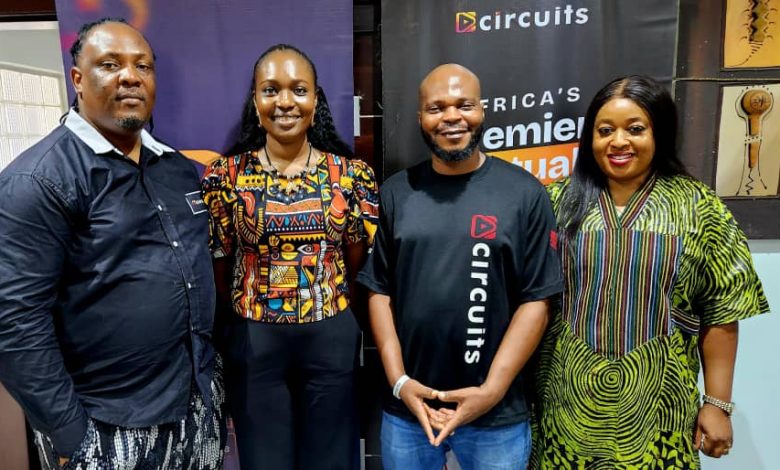
Speaking with senior journalists in Lagos on Friday, Chief Operating Officer of Circuits, Mrs Imade Bibowei-Osuobeni, said the pension-style support for three industry pioneers, Chief Pete Edochie, Idowu Philips (Iya Rainbow) and Chief Lere Paimo, signals a structural shift in how African cinema accounts for those who built its cultural and commercial value but grew old without institutional protection.
She said, “This is not charity, it is an economic responsibility. The men and women who built Nollywood’s cultural wealth deserve lifetime dignity, not abandonment. We designed the Dignity Fund to correct a long-standing economic injustice in the creative industry.”
Bibowei-Osuobeni described the scheme as the first private-sector, recurring welfare mechanism in Nollywood’s history, noting that pensions and royalties had been largely absent from the industry since its formation in the 1990s.
“For years, the industry depended on informal structures. Contracts were weak, royalties were inconsistent, and piracy wiped out incomes,” Bibowei-Osuobeni said. “We believe the new economy must honour the old creators.”
She added that the fund will scale in phases, with more veterans joining in the coming months as partnerships deepen. “No Nollywood trailblazer should grow old in financial distress,” she said.
Bibowei-Osuobeni said Circuits’ broader strategy is to position African cinema as a platform for economic growth, job creation and global market expansion.
She described Circuits as “Africa’s first true virtual cinema—scheduled, pay-per-view, and designed to protect intellectual property while expanding revenue channels for filmmakers.”
Films premiere on the platform at specific times, mirroring the experience of physical cinema attendance.
“When you buy a film on Circuits, you are paying for a scheduled seat, not random access,” she said. “That ensures creators receive real-time, measurable income.”
The COO noted that the platform’s limited-release model, in which films remain available only for a set period, has increased scarcity value and improved yield for producers.
But the greatest financial battle, she stressed, remains piracy.
“In one day, we can record 10,000 infringements, and we take down more than 9,900 almost immediately,” she said.
“In under a year, we removed over one million illegal channels and URLs. Without this fight, creators cannot earn, and the economy cannot grow.”
Circuits’ state-focused creative development programme is another economic pillar.
Ekiti State was the first to commit $15 million to its Creative Platform partnership, which will train residents, produce state-owned content and drive new Internally Generated Revenue (IGR).
“Fifteen other states have approached us,” Bibowei-Osuobeni said. “This is not another government project, this is a commercially anchored system that builds jobs, strengthens state finances and gives young people paid digital skills.”
She said the rollout begins in January, with projections that thousands of young people across participating states will enter creative and technical employment pipelines.
In December, Circuits will debut its most ambitious distribution experiment: a community cinema model for Agesinkole: King of Thieves Part 1.
The platform secured exclusive rights to reintroduce the blockbuster after its 200,000-ticket run in cinemas.
“We are taking cinema to communities across the South-West—halls, event centres, town squares—at ₦3,000 outside Lagos and ₦4,000 within Lagos,” she explained. “We want families at the grassroots to experience Nigerian film at a price they can afford. This is an economic inclusion model.”
The platform will also stream AFCON matches to more than 100,000 viewers at no cost.
“It is part of testing mass-market digital behaviour in a tough economy,” she said.
A new Kids’ Corner launches in January to deepen family-oriented content consumption and expand subscription value.
Through a partnership with NIHOTOUR, Circuits is enabling digital training for hospitality and tourism workers nationwide.
“Entertainment technology must serve multiple sectors,” Bibowei-Osuobeni said. “If we strengthen tourism training digitally, we expand another job-creating value chain.”
The LaunchPad programme, Circuits’ flagship youth employment scheme, has also on-boarded more than 1,600 trainees, with hundreds already earning stipends in digital marketing, customer support, content operations and technical roles across more than 25 states.
“Our goal is one million young Nigerians empowered within 18 months. Creativity and digital work are now economic lifelines,” she said.
Bibowei-Osuobeni said Circuits’ long-term vision is to anchor a combined creative-technology-tourism economic network.