By Nathaniel Zacchaeus, Abuja
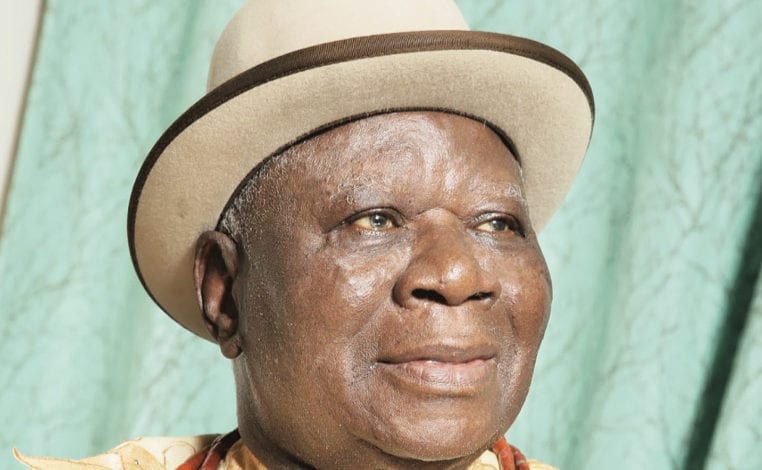
Foremost Ijaw leader, Chief Edwin Clark, has warned President Bola Tinubu’s administration to resist the proposed plans by some people to end the Presidential Amnesty Programme.
He said ending the programme would spark a serious crisis in the Niger Delta region.
He stated this in Abuja yesterday while addressing journalists.
Clark also appealed to the President to ignore the advice of a former governor of Zamfara State, Ahmad Sani, and an Islamic cleric, Sheikh Ahmad Gumi, who were urging Tinubu to grant amnesty to terrorists.
The elder statesman said he was disappointed in the statement credited to the Chief of Army Staff, Major General Taoreed Lagbaja, to the effect that the Federal Government does not need to grant amnesty to any group of people in the country.
Lagbaja was quoted to have said that beneficiaries of amnesty in the past usually use their compensation to acquire dangerous weapons to cause further havoc.
He said, “I deeply regret the unfortunate statement credited to our newly appointed, most respected Chief of Army Staff, Maj. Gen. Taoreed Lagbaja on his statement as published in the media.”
Clark said Lagbaja was quoted to have said, “I think we need to look at this issue of Amnesty Programmes. The agreement has proven to be incorrigible and so Amnesty has created an avenue for them to re-organize and launch attacks on defenceless citizens. So, I think we need to look at that.
“We also have the issue of the Amnesty Programme that has been instituted, and which has failed not only in the North but also in many other states.
“The statement of the Chief of Army Staff comes across to me as a proposal for the scrapping of the amnesty granted to legitimate agitators for a better life and environment by the Niger Delta youths.
“If my understanding is correct, I seriously disagree with the Chief of Army Staff. I will rather advise him to consult through the records of his former colleagues since the inception of the Fourth Republic in 1999.”
He warned that there could be fresh agitations if the amnesty programme was discontinued.
Clark said, “Our living condition in the region has worsened. The Presidential Amnesty Programme should be allowed to continue for some more time.
“I wish to advise the Federal Government to tread cautiously, except they have prepared another ‘Operation Crocodile Smile’. Wake not a sleeping lion. This is not a threat; it is a clarion call for peace.
“I strongly appeal to Mr President, Asiwaju Bola Ahmed Tinubu, not to be carried away by various statements by some uninformed Nigerians that the Amnesty Programme in Niger Delta has not contributed to the peace in the Niger Delta, it has, contrary to their misgivings.
“I, therefore, advise Mr President to pay special attention to the survival of the Amnesty Programme in the Niger Delta which still has some phases.
“The Amnesty Programme should not be confused by the massive oil theft being carried out by some elitist Nigerians in collaboration with some security agents which came to the open in 2005 when the scandalous arrest of the Russian MT African Pride by Admiral Bob Manuel.
“I sincerely appeal to our youths to remain patient and not to do anything to affect the smooth operation of the oil companies while we continue to fight for our rights legitimately.
“May I remind Mr President, Bola Ahmed Tinubu, and the people of Nigeria, that it is only in Nigeria that the oil-producing communities are among the poorest, whereas, in other parts of the world including the USA, the oil-producing states like California, Texas, and so on, are among the wealthiest states in America. Here in Nigeria, the oil-producing areas are being oppressed and dehumanised.
“My first reaction to those who compare the murderous blood-sucking bandits from the northern part of the country, with the legitimate agitators from the Niger Delta, is that of pity at their ignorance on national affairs, and myopicism.”
Clark wondered why a prominent Islamic cleric in the North, Ahmad Gumi, has repeatedly pleaded for amnesty for the bandits.
“He constantly defies logic by claiming that the bandits kill because of their “maltreatment” by the Nigerian state. The amnesty advocates ignore the fact that many of the bandits are not even Nigerians.
“They also mistake amnesty for a blanket idea, to be politicised or invoked to reward mass murderers. It is not. Amnesty worked in the Niger Delta primarily because its militants anchored their fight on the sound economic and federalist principle of resource control.
“With their people alienated from the oil wealth extracted from their land, and the environmental despoliation in the region, the agitators had legitimate demands. However, the blood-thirsty bandits ravaging the North have no legitimate, political, or economic claim that Nigeria is obliged to countenance.
“Because of the bandits, killer Fulani herdsmen, Boko Haram/ISWAP/Ansaru, and IPOB, the 2023 Global Terrorism Index ranks Nigeria as the eighth most terrorized country in the world. Together, these terrorist groups slaughtered 63,111 Nigerians between 2015 and May 2023, the National Security Tracker estimated.
“Therefore, any deal with them translates to rewarding mindless criminality. As some North-West states discovered, negotiating with amorphous groups of bandits with no central command or leadership has no positive outcome.”
He commended the Arewa Youth Consultative Forum (AYCF), for their forthrightness in condemning the advice of the former governor of Zamfara State.