By Francis Ajuonuma, with agency report
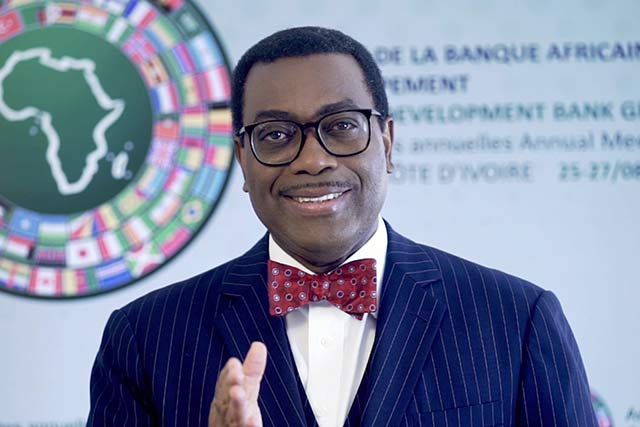
President of the African Development Bank (AfBD), Akinwumi Adesina, has described the recently introduced duty-free imports policy on food commodities by the Federal Government as depressing.
Adesina spoke at a retreat organised by the African Primates of the Council of Anglican Provinces of Africa (CAPA) in Abuja, the AfDB stated in a statement over the weekend.
Recall that Minister of Agriculture and Food Security, Abubakar Kyari, had on July 8, revealed that duties, tariffs, and taxes on the importation of maize, husked brown rice, wheat, and cowpeas will be suspended through Nigeria’s land and sea borders for 150 days.
Kyari said the plan would ease the price hike of food items, adding that the government has adopted measures to be implemented in 180 days.
Speaking on the theme ‘Food security and financial sustainability in Africa: The role of the Church,’ Adesina said the plan would only address short-term food prices hike in the country.
He said the policy might jeopardise the significant efforts and private investments made in Nigeria’s agriculture sector.
“Nigeria’s recently announced policy to open its borders for massive food imports, just to tackle short-term food price hikes, is depressing,” he said.
“Nigeria cannot rely on the importation of food to stabilise prices. Nigeria should be producing more food to stabilise food prices while creating jobs and reducing foreign exchange spending that will further help stabilise the naira.”
AfDB president said Nigeria must not be turned into a food import-dependent country.
“Nigeria cannot import its way out of food insecurity,” he said.
Adesina said Nigeria must feed itself with pride, adding that a nation that depends on others to feed itself, is independent only in name.
However, a professor of Capital Market, Uche Uwaleke, and some farmers have disagreed with Adesina’s position and backed the Federal Government’s move.
They said that the move was a stop-gap measure that would help moderate food inflation in the country.
Uwaleke in his reaction advised the government to urgently engage existing commodity exchanges such as AFEX, the Lagos Commodity and Futures Exchange, and the Nigeria Commodities Exchange to fashion how best to achieve food security within the shortest possible period.
According to him, any fiscal measure at this time to reduce the high rate of hunger in the land is welcome.
”I think it is a welcome stop-gap measure aimed at moderating food inflation, which is largely caused by supply constraints occasioned by insecurity in the food belt regions of the country.
”The reality is that the government needs to buy time to deal with the legacy supply-side factors fuelling inflation in Nigeria.
”These legacy factors include insecurity and transport challenges. So, the government should intensify efforts to deal with banditry and kidnapping.
”It should equally include utility vehicles and trucks for conveying goods in addition to the CNG passenger buses it plans to roll out,” he said.
National President of Nigeria Women Agro Allied Farmers Association, Mrs Lizzy Igbine, in her comment, said it was a good interim decision.
Igbine, who said the decision would impact negatively on local production of food, appealed to the government to ensure that the duty suspension does not exceed the stipulated time.
”It may be a temporary measure to tackle the food insecurity now but it will not impact on our production; it will reduce our profit this year.
”Government should be critical in any decision they are taking now. It is a good decision in the interim because of the situation in which we found ourselves.
”We are hoping that it will not exceed the stipulated time of 150 days because even in three months, we will be harvesting our crops,” she said.
Igbine appealed to the Federal Government to ensure the prompt release of farm inputs to farmers for improved production.
In his remarks, the Secretary of the National Fish Association of Nigeria (NFAN), Chidike Ukoh, said the country was in dire need of food supply.
Ukoh, also the President of the National Youth Empowerment Association, said that although the decision would encourage capital flight, it would ensure that citizens do not die of severe hunger.
”I think the government wants to use this to bring in food and then promote local production so that we can measure up by maybe the first quarter of 2025,” he said.
He called for the use of available data to facilitate the implementation of policies in the country.
”A data-wise economy is a sustainable developed economy.”
However, the Coordinator and Chairman of Nigeria Agro Exporters Group, John Okakpu, said the country was not in any form of food shortage.
Okakpu, also the executive member of the All Farmers Association of Nigeria (AFAN), said the country was experiencing man-made (artificial) food shortage.
”We do not have a food shortage in Nigeria. The problem is irresponsibility from both the public and private sectors. Some people are taking advantage of the circumstance to cash in,” he said.