By Cross Udo and Nathaniel Zaccheaus, Abuja
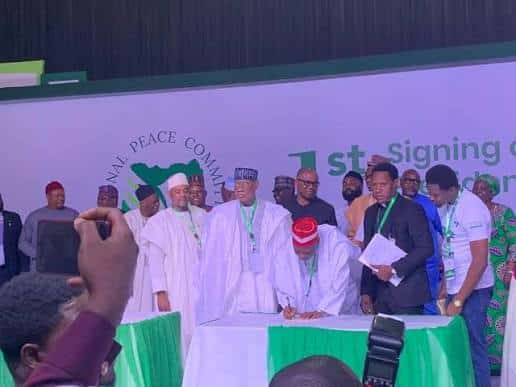
Presidential candidates and leaders of political parties preparing for the 2027 general elections on Tuesday signed a National Peace Accord amid growing security concerns, committing themselves to peaceful campaigns and rejecting violence, hate speech, misinformation, intimidation and ethnic or religious incitement.
The accord was signed in Abuja under the auspices of the National Peace Committee, in partnership with The Kukah Centre, barely 24 hours before the official commencement of the 2027 electioneering campaign on Wednesday (today).
The peace pact came against the backdrop of a troubling security picture.
The National Peace Committee disclosed that its Election Security Information Hub recorded 2,510 security incidents between June 2025 and August 2026, and 381 electoral offences during the same period.
The development has raised concerns over the ability of political parties, candidates and security agencies to prevent the increasingly competitive 2027 contest from degenerating into violence.
The committee identified banditry, kidnapping, terrorism, political violence, thuggery, vote-buying, intimidation, misinformation, party conflicts and voter suppression among the major threats that could undermine the electoral process.
With the campaign season set to begin on Wednesday, political actors were warned that the peace accord would be meaningful only if its commitments translated into responsible conduct on the campaign trail.
The accord requires political parties, presidential candidates, campaign spokespersons, officials, and supporters to conduct their activities in accordance with the Constitution, the Electoral Act, the Independent National Electoral Commission guidelines, and other relevant laws.
It specifically commits political actors to issue-based campaigns while prohibiting violence, personal attacks, hate speech, fake news and statements capable of provoking ethnic, religious or sectional conflict.
*Tinubu represented, Obi, Sowore, Adebayo sign, Atiku absent
President Bola Tinubu, the presidential candidate of the All Progressives Congress, was represented at the ceremony by the Secretary to the Government of the Federation, Senator George Akume.
Other presidential candidates who attended and signed the accord included Peter Obi, Omoyele Sowore, and Adewole Adebayo of the Nigeria Democratic Congress, African Action Congress, and Social Democratic Party, respectively.
However, the absence of former Vice-President Atiku Abubakar, the presidential candidate of the African Democratic Congress, was conspicuous.
The Chairman of INEC, Prof. Joash Amupitan, also attended the ceremony.
Representing Tinubu, Akume said the President and the APC remained committed to the principles contained in the peace agreement.
He pledged the ruling party’s adherence to peaceful campaigning and condemned the use of violence, hate speech and misinformation, including content generated through artificial intelligence.
“As the campaign season kicks off, I commit myself and my party, the All Progressives Congress, to the tenets of this accord,” Akume said.
He also urged political parties to avoid ethnic and religious sentiments and instead focus their campaigns on policies that can improve Nigerians’ living conditions.
Akume commended the National Peace Committee for its interventions in strengthening peaceful elections, while noting that technology deployed by INEC had contributed to improvements in election management.
*2,510 security incidents recorded
The most striking warning at the event came from the National Peace Committee, which revealed the scale of security incidents recorded since June last year.
The Project Manager of the National Peace Committee at The Kukah Centre, Asabe Ndaye, said the committee’s Election Security Information Hub documented 2,510 security incidents between June 2025 and August 2026.
Zamfara, Borno, Kaduna, Niger, Benue and Plateau were identified among the states most affected, with banditry, kidnapping, terrorism and other forms of insecurity posing serious threats.
The monitoring platform also recorded 381 electoral offences, with the Federal Capital Territory, Osun, Oyo and Lagos recording significant incidents.
Ndaye listed vote-buying, political violence, thuggery, physical attacks, intimidation, misinformation, party conflicts, electoral malpractice and voter suppression among the leading electoral threats.
She warned that electoral violence rarely begins on election day, stressing that political tensions often build through party primaries, defections, litigation, political realignments and nomination disputes before exploding into violence.
She identified intra-party conflicts, factionalisation, defections, litigation, misinformation, vote inducement, threats, intimidation, thuggery, hate speech and attacks on campaign rallies as warning signs requiring early intervention.
Ndaye also disclosed that the committee’s monitoring of the 2023 electoral cycle exposed significant violations of the previous peace accord.
According to her, the commitment to issue-based campaigns accounted for 43 per cent of recorded breaches, making it the most violated provision.
She said violations involving insults and violence accounted for 13.5 per cent, while fake news and disinformation accounted for 9 per cent.
Party spokespersons were responsible for 58 per cent of violations linked to issue-based campaigns, with 22 states affected, including Kaduna, Plateau, Kano, Lagos, Rivers and Benue.
“Political language is not just communication. In a tense electoral environment, it can actually become a risk signal,” Ndaye warned.
She said the committee had continued to monitor electoral developments since 2023, including at least 70 off-cycle elections, by-elections, and re-run polls, during which attacks involving candidates, supporters, and campaign teams had been recorded.
Against this background, she urged political parties and candidates to engage in robust but respectful debates focused on policies and programmes rather than personal attacks.
She also placed a responsibility on campaign spokespersons to verify information before disseminating it.
“For the party and candidate spokesperson, we expect a lot from you because this is where most of the issues start,” she said.
“We expect respectful messaging. Kindly verify information and avoid inflammatory or inciting statements.”
She urged the media and civil society organisations to verify information equally before publication, while calling on security agencies to remain neutral, exercise restraint, and provide equal protection to all candidates and citizens.
Traditional and religious leaders, she added, should use their influence to promote peace and discourage inflammatory rhetoric during the campaign.
*Obi demands votes must count
Obi, who was among the candidates who signed the accord, challenged Nigerians to hold political actors accountable for their conduct by voting against those who breach the agreement.
Asked what punishment should be meted out to candidates or political parties that violate the pact, the former Anambra State governor said the electorate should impose the ultimate sanction.
“The punishment is that Nigerians should not vote for them,” Obi said.
He maintained that candidates seeking public office must demonstrate the character expected of leaders.
“You can’t answer ‘His Excellency’ without being an excellent person. So, the process that will make you answer ‘His Excellency’ should be excellent, and the only way to do it is to conduct yourself properly,” he said.
Obi also demanded an election in which Nigerians would have confidence that their votes would count.
“For the sake of the children of Nigeria, can we have an election where people’s votes will count?” he asked.
He expressed concern over the deaths recorded during the recent Osun State governorship election, insisting that no political contest should cost Nigerians their lives.
“We should conduct ourselves in a way that in our democracy, nobody needs to die for an election,” Obi said.
He also questioned why politicians needed to sign peace accords at all, arguing that candidates seeking public office should naturally be expected to conduct themselves responsibly.
“We don’t even need to sign this. We’re seeking an office where we should be exemplary,” he said.
Asked whether he still believed in Nigeria’s electoral process, Obi responded that his desire to reform the system made participation necessary.
“Because I want to change the process, I have to go through it. So, I have to believe in it,” he said.
Ndaye said the agreement should not be dismissed as another ceremonial document, insisting that it represented a public commitment backed by existing laws.
“The Peace Accord is a public commitment by political parties and candidates to peaceful political competition, respect for the rule of law, democratic accountability and the will of the people,” she said.
She disclosed that the committee had convened electoral stakeholders in March 2026 and provided legal annotations to the agreement to ensure that political actors understood its provisions and the consequences of violating them.
“The accord we’ll be signing today is not just a document, but it is a document that is backed by law,” she stressed.
Ndaye said the committee had facilitated 31 peace accords since its establishment and would continue to use mediation and alternative dispute-resolution mechanisms to prevent political disagreements from escalating into violence.
She, however, warned that the exercise would achieve little if political actors failed to honour their commitments.
“Today, we are here to establish the boundaries within which political competition must take place,” she said.
“We’re here also today to set up for the 2027 campaigns before political competition escalates into electoral conflict.”
She added, “Our competition will not become war, and disagreements will not degenerate to violence. Political mobilisation will not become intimidation. Electoral disputes will not become conflict, and information will not become a weapon against electoral integrity.”
*INEC sets January 16 presidential poll
Amupitan said the signing came at a critical stage of the electoral calendar, with campaigns scheduled to commence on Wednesday, August 19.
He disclosed that the presidential and National Assembly elections would hold on January 16, 2027, while governorship and House of Assembly elections would take place on February 6.
The INEC chairman expressed concern over the resurgence of hate speech, toxic political polarisation, coordinated misinformation and personality-driven campaigns.
He urged candidates to address issues confronting Nigerians, including economic growth, insecurity, infrastructure, healthcare, education and social inclusion.
“Electoral contests in a constitutional democracy are not total wars; they are competitive job interviews before the electorate,” Amupitan said.
He urged political parties to make the election a “marketplace of ideas” where candidates would explain not only what they intended to do but how they planned to achieve their objectives.
Amupitan disclosed that INEC was preparing to deploy about 1.4 million ad-hoc personnel across more than 176,000 polling units, adding that the commission had spent the past eight months improving its technology, logistics and personnel training.
But he warned that technological improvements alone could not guarantee credible elections without responsible political leadership.
“It is not the signatures written on this Accord today that preserve democracy; it is the character of the leaders who hold the pen,” he said.
*Police warn against armed political groups
The Inspector-General of Police, Tunji Disu, represented by Deputy Inspector-General Umar Shehu, warned political parties and candidates against deploying armed groups, criminal elements or illegal firearms during the campaign.
Disu said election security was a process that began long before election day and depended heavily on the conduct of political actors and their supporters.
He called for campaigns based on competing policies and visions rather than ethnic mobilisation, religious division, hatred, intimidation and violence.
The police chief warned that inflammatory statements could spread rapidly through television and social media and trigger violence in communities.
He also insisted that political parties must take responsibility for the behaviour of their supporters and campaign organisations.
“You cannot publicly preach peace while privately encouraging violence,” Disu warned.
He further called for greater inclusion of women, youths, persons with disabilities and other groups traditionally underrepresented in political activities.
*Adebayo questions effectiveness of pact
While supporting the general objective of peaceful elections, SDP candidate Adebayo questioned the accord’s effectiveness without stronger accountability.
He argued that previous peace agreements had been breached without meaningful consequences and accused government institutions of intimidating opposition politicians.
Adebayo said a credible electoral environment required INEC, security agencies and other government institutions to perform their constitutional duties independently and transparently.
He also questioned whether the recent Osun governorship election represented sufficient progress, citing the deaths recorded during the poll.
Despite the reservations, the National Peace Committee maintained that the accord was intended to establish a framework for peaceful political competition as the 2027 campaign season begins.
The committee said a second phase of the initiative would follow the elections and focus on acceptance of electoral outcomes and the wider preservation of democratic stability.
Established in 2014 ahead of the 2015 elections, the National Peace Committee comprises eminent elder politicians who intervene in critical national issues through mediation and alternative dispute-resolution mechanisms.
The organisers said the initiative was ultimately designed to protect Nigeria’s democratic future rather than serve the interests of any political party.
“Today’s not about party colours. It’s about the Nigerian colour. That is the green and the white of Nigeria,” they declare