By Ben Adoga, Abuja
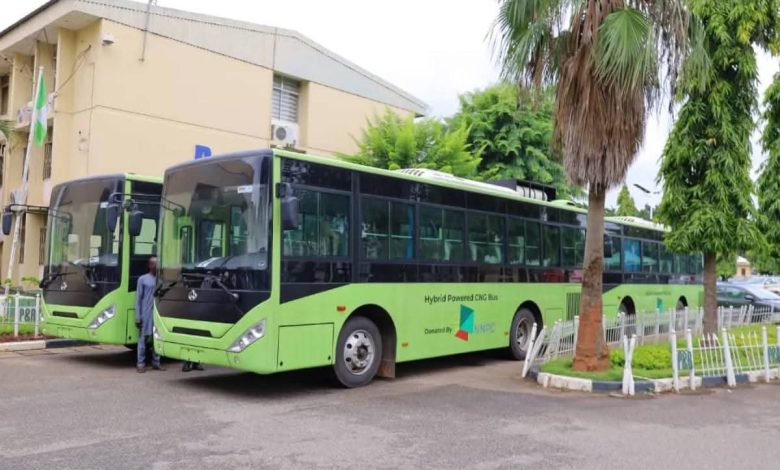
Minister of the Federal Capital Territory (FCT), Nyesom Wike, has commended the Federal Government following the delivery of four 50-seater hybrid buses from the Presidential Compressed Natural Gas Initiative (PCNGI) to boost public transportation in Abuja.
Receiving the keys on behalf of Wike, the Mandate Secretary of the Transportation Secretariat, Mr. Chinedu Elechi, applauded the Federal Government and PCNGI for fulfilling their pledge within 24 hours.
“It was just yesterday that we discussed this at the National PCNG Programme on Gas, when you said, ‘We are going to give you four super 50-seater hybrid buses that can run simultaneously on PCNG and AGO.’ I was surprised, but today, the buses are here. This is exactly what the Renewed Hope Agenda is about,” Elechi said.
He explained that the buses, with a combined capacity to carry over 200 passengers at once, would significantly improve mobility in the FCT and reduce dependence on private vehicles.
“The Honourable Minister has always said that no modern city can survive without a strong public transport network.
“This is why the FCT Administration has been building roads, bridges, and bus terminals. We recently commissioned two modern bus terminals at Mabushi and Kugbo, and these buses will complement those facilities,” Elechi added.
Programme Director and Chief Executive of the PCNGI, Mr. Michael Oluwagbemi, said the FCT was selected as a key beneficiary due to the Minister’s commitment to developing the transportation sector, demonstrated through investments in infrastructure.
“We identified the FCT as a major beneficiary because it has shown great innovation by investing not just in roads but in terminals. Yesterday, I called the Mandate Secretary and asked if we could deliver the buses in the next 24 hours. He said it was doable, and here we are today. At PCNGI, our philosophy is to talk and do,” Oluwagbemi stated.
He described the buses as “foundation assets” for the operation of the new terminals. He expressed optimism that within the next two to three years, Abuja residents would prefer public transport over private cars, as seen in developed countries.
Oluwagbemi also praised Abuja as “Nigeria’s most important physical achievement since independence,” noting its transformation over the past four decades and expressing confidence that CNG-powered transportation would become a national reality.
“We just left the FRSC, and they informed us they will launch new plate number formats for both CNG and electric vehicles in September. The FRSC received one bus, but you are getting four because you are one of our biggest supporters. This is a presidential initiative, and Mr. President wants to see Nigerians move around cheaper, safer, and more reliably,” he said.
The hybrid buses can operate on both CNG and diesel (AGO), ensuring uninterrupted service even when the CNG supply is unavailable.
For many Abuja residents, who have long endured a lack of cheap and reliable public transport, this development is a welcome relief.
Until now, most commuters have relied on private car owners offering rides to and from work—an arrangement that has often exposed passengers to “one chance” criminal gangs.