By our reporter
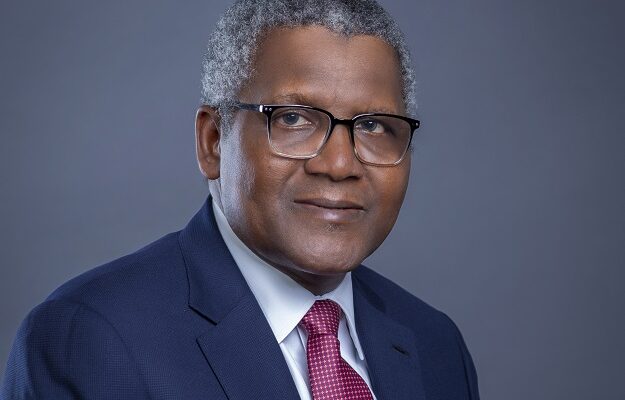
President and Chief Executive of Dangote Industries Limited, Alhaji Aliko Dangote, yesterday said the Nigerian National Petroleum Company Limited (NNPCL) had reduced its investment in the Dangote Petroleum Refinery and Petrochemicals from 20 per cent to 7.2 per cent.
Dangote said NNPCL’s stake dropped to 7.2 per cent over the company’s failure to pay the balance of their share, which was due in June.
He stated this yesterday after a guided tour with senior journalists of the sprawling 650,000 barrels per day (bpd) crude oil refinery with 838 KTPA polypropylene plant which covers an area of approximately 2,635 hectares located at the Dangote Industries Free Zone in lbeju-Lekki, Lagos State.
In September 2021, NNPCL acquired a 20 per cent stake in the Dangote Refinery for $2.76bn.
NNPC had initially financed the 20 per cent stake through a $1.036bn funding from Lekki Refinery Funding Limited, of which $1bn was paid to Dangote Refinery and $36m was for transaction costs.
The remaining $1.76bn was to be paid through a combination of a $2.5/barrel discount on 300,000 barrels per day of crude oil supplied to the refinery, and 100 per cent of NNPC’s portion of any dividends declared by the refinery.
However, Dangote said, “The agreement was 20 per cent we had with NNPC and they did not pay the money they were to pay. Last year we gave them an extension up to June this year but they said they will remain with the stake they have which is 7.2 per cent. It is okay, they only have 7.2 per cent.
*Resolves crude oil supply challenges, set to roll out PMS in August
He also disclosed that the refinery was now set to roll out its petrol in August 2024, having resolved its crude oil supply issues through the help of the NNPCL and the Federal Government.
Last week, the Nigerian Upstream Regulatory Commission (NUPRC), which regulates the industry segment focusing on exploration and production, announced it had entered an agreement with producers to ease supply to local refineries.
“We will never allow price strangulation to disincentivise our domestic refining capacity optimisation,” NUPRC’s CEO Gbenga Komolafe said after meeting with the members of the Oil Producers Trade Section, a group of domestic and international producers.
Komolafe assured that his agency would discourage “crude supply profiteering.”
His remark followed an allegation by Dangote Group that international oil companies are standing in the way of the smooth running of the plant by offering crude oil to the refiner at a cost above the market price.
Vice President of Oil & Gas at Dangote Industries, Devakumar Edwin, said in June, “The IOCs are deliberately and wilfully frustrating our efforts to buy the local crude. They are either asking for ridiculous/humongous premium(s), or they simply state that crude is unavailable.”
Speaking on the storage capacity of the refinery, Edwin said, “The refinery has a total storage capacity of 4.5 billion litres that can cover 20 days crude requirement. The product storage for 15 days of Nigeria’s gasoline consumption.
“The Dangote Petroleum Refinery is an industrial plant that transforms crude oil into various usable petroleum products such as diesel, gasoline (petrol), jet 1 fuel, and kerosene. The refinery produces Euro-V quality gasoline and diesel, as well as jet fuel and polypropylene.
The refinery is designed to process a large variety of crudes including many of the African Crudes, some of the Middle Eastern crudes, and the US light oil.”
Beyond resolving the crude supply issues and announcing plans to roll out petrol in August, Dangote also told journalists that the refinery’s fertiliser unit would resume production in two weeks.
This would give farmers more access to fertiliser for their farm products.
The refinery aims to become Africa’s largest oil refinery and the world’s biggest single-train facility.
It is expected to generate 9,500 direct jobs and an additional 25,000 indirect jobs, providing a substantial economic boost to the region.
When fully operational, the refinery will produce approximately 50 million litres of petrol and 15 million litres of diesel daily, equating to 10.4 million tonnes of petroleum products annually.
It will also yield 4.6 million tonnes of diesel and four million tonnes of jet fuel per year. Moreover, the facility includes a fertiliser plant that will utilise by-products from the refinery as raw materials, further enhancing its economic and environmental impact.