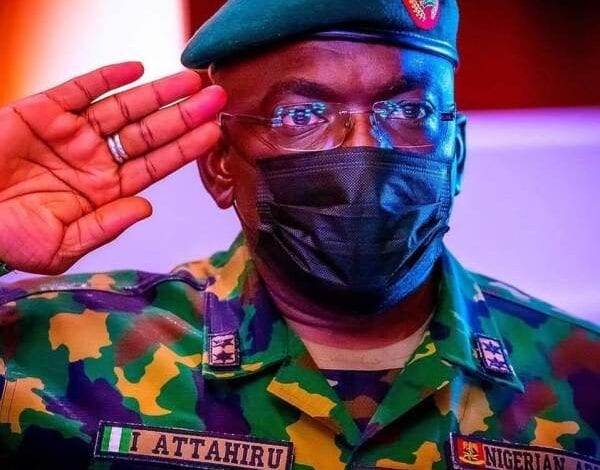
- General Attahiru’s unfulfilled dream
- His stint at Brigade of Guards under IBB and Abacha
- Why General Buratai withdrew him as Lafiya Dole Commander
By Mudiaga Affe, Kassim Omomia, Andy Asemota and Ben Ogbemudia
It sneaked in like a thief in the night. However, its impact was devastating. A crash. Deaths. Grief.
Since Friday when the news broke, that Chief of Army Staff, Lt.-Gen. Ibrahim Attahiru had died in a military aircraft crash, it has been a torrent of tears.
Reason: He was a competent and fine officer; indeed, one of Nigeria’s best. He was also seen as the hope of advancing the battle to ending insurgency and other criminalities ravaging the country.
Attahiru and 10 others, including three generals died in a Beechcraft 350 aircraft that crashed at the Kaduna International Airport.
The other military officers that died alongside Attahiru were Chief of Staff to the CoAS, Brig.-Gen. Idris Abdulkadir, Chief of Military Intelligence, Brig.-Gen. Abdurrahman Kuliya, Provost Marshal (Army), Brig.-Gen. O.L Olayinka, and Aide de Camp to CoAS, Major L.A Hayat. Others are the Finance Officer, Major A. Hamza, and the Orderly to CoAS, Sergeant Saidu Umar.
The flight crew members of the ill-fated plane were Flt. Lt. Taiwo Asaniyi, who was the pilot; his co-pilot, Flt. Lt. A.A Olufade; Sergeant Adesina and ACM Oyedepo.
Unfortunately, the tenure of the 54-year-old and the country’s 21st army chief lasted for only four months and 25 days, having been appointed by President Muhammadu Buhari last January 26.
His regrets
If there is one regret the late General would have carried to his grave, it will be a perennial struggle to equip the military.
Competent sources told this newspaper that he was not pleased that despite the huge resources budgeted for arms and ammunition in the fight against Boko Haram and insurgency, not much was on the ground.
“That was one reason he appeared to snap at the presentation in the National Assembly. He asked the lawmakers to direct the enquiries on how the $1bn dollars was expended to those who superintended over the funds. The truth is, he wasn’t too pleased,” sources confided in this newspaper.
Another of his unfulfilled dreams was the total defeat of Boko Haram insurgents.
A charismatic officer, Gen. Attahiru believed it was a question of time before the enemy was crushed.
A military insider told ThisNigeria, “The battle would have been decisively concluded before the end of this year with the way the late CoAS was going. Despite the shortfall in ammunition, he had raw courage and was focused. He motivated his officers and men. He was one officer who led from the front. He wasn’t an armchair officer.”
“As Theatre Commander of Operation Lafiya Dole, he was effective. He was picked by powerful forces outside the army to lead it, but somehow his predecessor, Gen. Buratai wasn’t quite happy with him. So all kinds of stories were cooked up to portray him as incompetent. He was withdrawn and sent to TRADOC in Minna and later moved to Abuja. It was all military politics. But, he was a thoroughbred infantryman who yearned for action. You can see what he has achieved in his short-lived stint as army chief.”
Indeed, Gen.Attahiru had leadership capability. He was a professional soldier. He was knowledgeable. Above all, he was competent. President Muhammadu Buhari confirmed these as much. The President, represented by the Minister of Defence, Gen. Bashir Magashi,(retd), at the funeral on Saturday described Attahiru and his late colleagues as “icons of professionalism”. They were glorious and served the country gloriously, Buhari added.
The President noted particularly that Attahiru was a courageous man and a source of inspiration to officers and men and will always be remembered as an epitome of Nigeria’s hope in the military. The President had earlier in a statement by his media adviser, Femi Adesina, said he was saddened by the death, describing him and the other late officers as heroes who paid the supreme price.
“This crash is one mortal blow to our underbelly; at a time, our armed forces are poised to end security challenges facing the country’’. “I am deeply saddened by the air crash. All of them are heroes who paid the ultimate price for peace and security in the land’’ Buhari said.
The Chief of Defence Staff, Gen. Lucky Irabor, at the funeral, noted that the late Army Chief died for the love of country Irabor said, “The day was a very sad day for the armed forces and the country. I received it with shock the death of Attahiru and others’’
“As we mourn, a dependable colleague, we remain undaunted, unmovable, the war against insecurity must be won. Just pray for us. The death of our colleagues is not in vain’’, Irabor assured, adding the late Chief of Army Staff died when he was most needed.
Also, the Speaker, House of Representatives, Femi Gbajabiamila, described the death as shocking, saying the unfortunate incident came at a time that the military was finding solutions to the country’s security challenges. Having taken over from the immediate past Chief of Army Staff, Lt. Gen. Tukur Buratai, a few months ago, the speaker said Attahiru had shown a lot of commitment to tackling the country’s security challenges. Gbajabiamila added that the late army chief was a core professional officer. He said the military, especially the Nigeria Army, has lost a dedicated and committed senior officer whose services to fatherland will be sorely missed.
Maj.-Gen Lawrence Ngubane (retd) summed up Attahiru’s life and times thus: “The late army chief spoke eloquently on the importance of command and leadership in achieving any assigned mission. “He was passionate and confident that the armed forces in collaboration with other security agencies of Nigeria were capable of stemming the tide of security challenges in the country if only, command and leadership qualities were applied at all levels. He had a vision, and wanted to realise it by leading from the front”.
The Secretary to the Government of the Federation, Boss Mustapha, described the death of Attahiru and 10 others as “a very dark moment for Nigeria”.
Military plane crash: Osinbajo mourns Attahiru, others
An impactful tenure
Although Attahiru served as the CoAS for a few months, his impact will continue to resonate for years to come.
This is so because from the moment he mounted the saddle as the army chief, he had a burning desire to deal with the Boko Haram insurgency that has taken its toll on the North-East and other parts of the country. His tragic death may shock many as his career trajectory moved in and out of the epi-centre of the war against Boko Haram and other insurgents in North-East, where he was first appointed the Theatre Commander of the joint task force assigned in July 2017 to deal with the leader of the Boko Haram terrorist group, Abubakar Shekau.
Attahiru had also on assumption of office said he would not allow those trying to break out of Nigeria to succeed. He said the Nigerian Army had resolved to deal with secessionists who were threatening the peace of the country. No group has succeeded in seceding and it is believed that Attahiru’s wish would be sustained by security forces.
Indeed, of the three things that define a fine soldier-leadership, doctrine and equipment, ThisNigeria gathered, that the late army chief possessed the first two comfortably and abundantly. What he lacked within the short period he was in the saddle, public commentators say, was equipment. Attahiru, an infantry soldier, had a stint at the army’s elite corps, Brigade of Guards, during the reigns of former military Heads of State, Generals Ibrahim Babangida and Sani Abacha. He was described by his colleagues who served with him at the Guards Brigade as, “professional and competent. He had no time for frivolities. He was a devout Muslim. If you check his forehead, you will readily see his commitment to keeping his religious obligations.” The Presidential Guards Brigade is an elite corps of the army responsible for protecting the president and his guests, as well as performing ceremonial duties at the nation’s seat of government.
His controversies
He had also recently told the House of Representatives Ad Hoc Committee probing the Purchase, Use and Control of Arms, Ammunition and Related Hardware by Military, Paramilitary and Other Law Enforcement Agencies in Nigeria to invite his predecessors to shed more light on the arms procurement.
Although he did not mention any name, his predecessors during the year under review included, Lt. Gen. Azubuike Ihejirika (retd.) who was the CoAS between September 2010 and January 2014; Lt-Gen Kenneth Minimah (retd.), who was the CoAS between January 2014 and July 2015 and Lt-Gen Tukur Buratai (retd), who served from July 2015 to January 2021. The actual probe of the past CoAS by the lawmakers had yet to commence.
Attahiru’s profile
Born on August 10, 1966, in Doko Kaduna North Local Government Area of Kaduna State, Attahiru, commenced cadets training in January 1984 and was commissioned into the rank of Second Lieutenant in December 1986 as an Infantry Officer.
He obtained a Master’s degree in Strategic Management and Policy Studies from the Nigerian Defence Academy.
The late CoAS has held several appointments on the staff, instructional, and in command during his military career. For instance, he had a tour of duty with the United Nations in Sierra Leone as a Military Observer, where he facilitated United Kingdom military engagement, Operation BARASS in September 2000. He was an Operations Officer and later Company Commander in NIBATT 19 ECOMOG Operations in Liberia. He also had the privilege of having commanded with distinction all through the chain of command in the Nigerian Army.
Prominent among these appointments is Commanding Officer 146 Battalion Nigerian Army (Operation HARMONY IV) in the Bakassi Peninsula, Commander 13 Brigade Nigerian Army (Operation PULO SHIELD), General Officer Commanding 82 Division Nigerian Army. He was a one-time Theatre Commander Operation LAFIYA DOLE. He is survived by a wife and three children.
Other CoAS tenure that was short-lived
Attahiru’s few months in office was the second shortest stint as the country’s army chief after the three months stewardship of Lt. Gen. Aliyu Gusau between September and November 1993.
The shortest stint before him in the democratic era was Gen. Andrew Azazi who served for 11 months before he was promoted to the post of Chief of Defence Staff.
Attahiru was appointed Army Chief last January 26, when President Buhari made a sweeping change of the service chiefs following years of mounting criticisms over violence perpetrated by Islamist insurgents and other armed gangs that have displaced more than two million people and killed over 30,000.
Gbajabiamila mourns Army Chief, Attahiru
Details of the other officers that died with Attahiru were sketchy, but it was learnt that one of the flight crew members, Flt. Lt. Asaniyi, who was the pilot of the flight, was preparing for his wedding. He was said to have done his introduction in March. Following his tragic death, his family in Ibadan, Oyo State is said to be devastated by the loss of their shining star.
A family member, Deacon Adeleke, had while receiving the Nigerian Air Force delegation that had come to console the aged parents of the deceased in Ibadan, pleaded for immortalisation of all the deceased. He advised that the government should always remember the deceased families. It was learnt that the man who is supposed to be his best man on the wedding day has remained inconsolable. Also, the co-pilot Flt. Lt. Olufade, is survived by his new wife, who, according to relatives got married two months ago.
Litany of crashes in three months
No fewer than 20 military officers have lost their lives in the last three months in three crashes involving Nigerian Air Force jets.
Last February 21, seven NAF officers died on board a Beechcraft King Air B350i aircraft when the jet crashed in Abuja.
Similarly, last March 31, 2021, the spokesman for the Nigerian Air Force, Air Cmdr Edward Gabkwet, disclosed that an Alpha-Jet aircraft that was involved in the anti-terror war against Boko Haram and Islamic State West Africa Province lost radar contact in Borno State.
The whereabouts of the two airmen who were on board the missing jet which was later declared crashed were still unknown to date.
Burial rites
The remains of the General were interred in the military cemetery in the Federal Capital Territory (FCT) Abuja on Saturday. Before then, the remains of Attahiru, his Chief of Staff, Brig.-Gen. Idris Abdulkadir, Chief of Military Intelligence, Brig.-Gen. Abdurrahman Kuliya and ADC to CoAS, Maj. L.A Hayat, Finance Officer, Major A. Hamza, and the Orderly to CoAS, Sergeant Saidu Umar were taken to the mosque.
While the remains of the Provost Marshal (Army), Brig.-Gen. O.L Olayinka and crew members, Flt.-Lt. T.O Osaniyi, Flt.-Lt. A.A Olufade, Sergeant Adesina, and ACM Oyedepo were taken to the church for the funeral.
All the bodies were interred at the Military Cemetery along Airport road after 21 gun salutes for the fallen heroes.
The CoAS’s wife, Mrs Fati Attahiru, and the wives of the other officers were said to have witnessed the burial rites.
Meanwhile, some top military officers, who spoke on the condition of anonymity, during the funeral on Saturday, called on President Buhari to appoint a successor to Attahiru from within the 36th regular course. The officers, who spoke to one of our correspondents on the sidelines, said the call was necessary to sustain the tempo and high morale already set for the army by Attahiru. The officers noted that the determination to bring radical changes in the force and end the security challenges had already been introduced into the system by the late General. ‘’The tempo should not die, and one way is for Mr President to immediately look within 36th regular course to find a suitable replacement’’
Military officers’ wives lament
In another development, wives of military officers have lamented the frequent deaths of their spouses in military plane crashes.
‘’This year alone, we have been to this military cemetery many times to bury our loved husbands’’, a woman, dressed in army officers’ wives association attire, said.
‘’The aircraft should always be maintained and serviced as of when due. If the equipment were updated, the pilot would have detected that the weather was not favourable and do the needful promptly”, another said. They, therefore, called on the authorities to take immediate steps to maintain and service military aircraft that convey their husbands and loved ones on military duties.
Also, an Army Captain said Attahiru had introduced measures that have moved the army to the next level. “We were very sure of his promises. And he was very ready to change the narrative of the security problems in Nigeria.
“You hardly see him resting. He worked from home and anywhere to ensure he achieved his goal. The few months he piloted as Chief of Army Staff, there was a tremendous boost in the morale of the rank and file. He will be missed by all’’. The funeral expectedly brought Abuja to its knees as activities in the city were low keyed, especially around the Area 8, Army headquarters.
Also, economic activities were virtually grounded around Area 8, 10, Central Mosque and Airport road axis as relatives and friends paid their last respects to the victims.
The Nigerian Airforce and Beechcraft King Air 350i
ThisNigeria gathered that the Nigerian Airforce took delivery of three new Beechcraft King Air 350i in August 2014. These aircraft are reportedly operated by the NAF’s 209 Executive Airlift Group (EAG), based at the Nnamdi Azikiwe International Airport, Abuja. However, there has been speculation from some quarters that they might have been converted for intelligence, surveillance and reconnaissance (ISR) operations.
This was confirmed with the mishap last February 21, where a Nigerian Air Force (NAF) Beechcraft King Air 350i crashed near Nnamdi Azikiwe International Airport, Abuja, killing all seven people on board. According to Scramble Magazine, the NAF operates four Beechcraft 350i King Airs with the 209th EAG. The serials of these aircraft are Beechcraft 350i King Air: NAF201 (c/n FL-585), NAF202 (c/n FL-890), NAF203 (c/n FL-891) and NAF204 (c/n FL-902).
The Nigerian Airforce has lost two of these aircraft in three months. The first, NAF 201, last February 21, and the second, NAF 203, three days ago, precisely on May 21. Curiously, commentators are wondering why the frequent mishaps associated with the aircraft in the country.
The Beechcraft King Air 350i is being used by over 42 countries’ Air Force. The last time a King Air belonging a country’s Airforce was involved in a crash was in 2015.
However, there was a United States Army Aircraft FL-751 crash in Iraq in 2016, just as the Pakistan Army Aviation Corps recorded a mishap in July 2019.