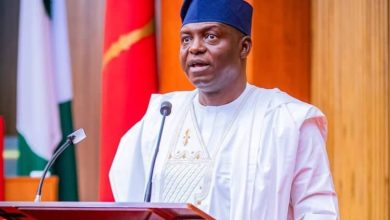
By Seyi Odewale
Ekiti State Governor, Mr Biodun Oyebanji, has warned that rising political bitterness and intolerance pose serious threats to Nigeria’s democratic stability, urging political actors to embrace inclusion, consensus and peaceful engagement ahead of forthcoming elections.
Speaking at the Faculty of Arts Distinguished Alumni Lecture of the Obafemi Awolowo University (OAU), Ile-Ife, Oyebanji said Nigeria must move away from confrontational politics if democracy is to deepen and deliver good governance to citizens.
With Ekiti preparing for its governorship election in June and the country heading towards the 2027 general elections, the governor cautioned against turning electoral contests into political warfare, stressing that the winner-takes-all mentality was damaging to national cohesion.
According to him, democracy thrives not on raw power but on cooperation, mutual respect and the ability to manage political differences without resorting to hostility.
Chairing the lecture titled “How to Make a Democrat”, delivered by Chairman of the Editorial Board of The Nation newspapers, Mr Sam Omatseye, Oyebanji said his administration had adopted a politics of inclusion, which he claimed had contributed to relative political stability in Ekiti State.
Drawing from over three decades of political experience, Oyebanji argued that exclusionary politics breeds instability, while inclusive governance promotes peace and development.
“Election does not have to be war, and winners do not have to take all. Politics of exclusion and intolerance is a recipe for rancour and instability,” he said, adding that his decision to engage both opposition and intra-party stakeholders was deliberate.
He noted that although democracy is inherently competitive and often chaotic, the real test of democratic maturity lies in the ability of leaders and citizens to manage differences constructively.
Oyebanji also advocated the revival of the Omoluabi ethos, which he described as a value system rooted in respect, moderation and civic responsibility, warning that extreme political positions only deepen divisions and slow development.
In his lecture, Omatseye examined the philosophical foundations of democracy, arguing that many countries merely claim to practise democracy while failing to adhere to its principles.
He maintained that democracy remains largely aspirational, noting that even advanced nations often fall short of democratic ideals.
Omatseye further distinguished between a republic and democracy, describing democracy as an ideal that societies continuously strive to achieve rather than a perfect system already attained.
The lecture was attended by political leaders, academics and students, including Osun State Governor, Senator Ademola Adeleke, who was represented by the Commissioner for Education, Mr Dipo Eluwole.
Adeleke commended the initiative and reaffirmed Osun State’s commitment to education as a foundation for democratic and national development.