Climate change negatively affecting food security – Rufus Ebebga

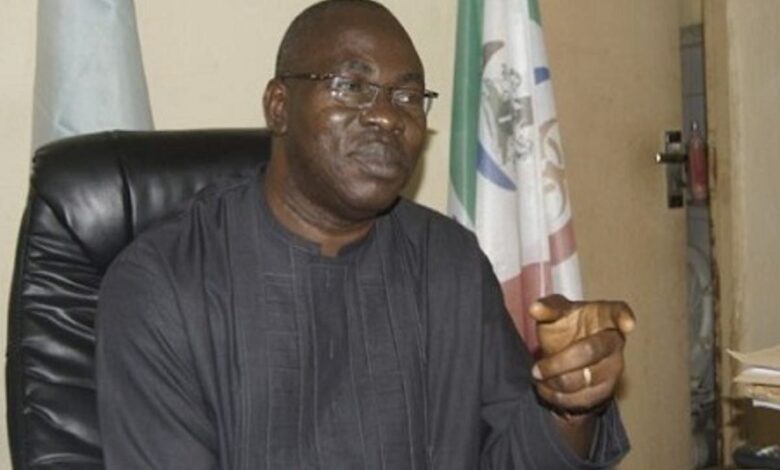
To boost food production, the Federal Government recently approved Ahmadu Bello University, Zaria, to conduct research on the production of a Genetically Modified Organism (GMO) teller maize. In this interview with Jude Idu, Director-General of the National Biosafety Management Agency (NBSMA), Rufus Ebebga, talks on Genetically Modified Foods, and food insecurity, among others
Can we confidently say that the products approved by the Presidency were under your supervision and approval?
The approval that was granted to the applicant, and was the Department of Agricultural Research, on teller maize that can tolerate drought and insect resistance. It was granted by the National Biosafety Management Agency (NBSMA) on behalf of the Federal Government. We received an application for commercialisation of the teller maize months ago, and the agency commenced the process, given the application. Before now, the institute had applied for the confined phase trial of the same maize, which was granted.
The confined phase trial is a process of modification to find out if the GMO of the maize was efficacious and that is if the purpose with which it was modified was successful. That was done before it was now brought to the natural environment to find out its true performance, to determine whether the product itself will have this drought and insect resistance. So, at that phase, that was determined before the institute applied for environmental and full commercial release to the public.
What this means is that the product can now be released for commercial consumption, planting, processing, and also for general consumption. So, when we got the application for the commercial release of the product, we had to commence the process of the review. What we do normally on receipt of the application is to look at the application to make sure that all that is required are fully attached.
And the process is that, when we are sure of that, we always advertise it in three national dailies, informing the general public according to the Act, that there is an application for a release of the genetically modified product, and the application form is always attached alongside the risk assessment form that was carried out. We also do that in our websites for the Nigerian public and the world to be well notified, and also with the demand of anyone who has an opinion or idea to make or impute to make before the final release.
While that was still being awaited, we constituted two committees, which were National Biosafety Committee and National Biosafety Technical Sub-committee. These committees were set to have in-depth knowledge of all the applications that were submitted in this regard. These committees were made up of nine ministries and agencies.
Also inclusive are experts from the university environment and others from the stakeholders. That was done, and the two committees recommended to the National Biosafety Management Agency that the product is safe for commercial consumption. However, normally, we continue to monitor the product and make sure that there are no negative manifestations wherever it is planted. So, that was our role, and now that the product is approved, they may see it to meet other necessary government requirements, particularly in the area of environmental release, unless they have to plant it again for demonstration, for the safety of it.
I think there will be no more need for laboratory tests of the product because all assessments had been carried by the committee, unless at the agro-technological level on any crop to which anyone is going to be subjected, and that is part of the committee’s recommendation.
Concerning the maize in question, what is the level of acceptance, both locally and internationally?
You see, when we talk of international acceptance, all over the world, GMOs always have their phases of controversy. It is not related to the world trade order, but it is associated with technologies and agrochemical companies.
With these now, it means that the chemical component is reduced, and the maize is capable of protecting itself from the tambura insect and armyworm, which means less chemical will be used, and there shall be no more rejections at the international market. Let me tell you something, why some Nigerian agro products were rejected, or are being rejected abroad, was not because of bad packaging. It is because of chemical residue found in these products such as preservatives and other insecticides of control, which our farmers in peasantry apply to crops. So, with these innovations, fewer chemicals will be used.
Nigerian products will be more acceptable internationally, and with this, we are making sure that we limit the use of chemicals in our crops when they are sent to the international market. So, I do not have any doubt that the product will not be accepted when the farmers mass produce in commercial quantities, especially when we have similar products already in the international market.
How far have you raised the level of public enlightenment for the product, particularly on local acceptance? This is because the market for commercial use lies with the masses?
You see, before this, we had a 21-day public notice published in different Nigerian dailies, and that was done according to the law to know whether any member of the public was going to come up with any objection against the product professionally.
We did not receive anything on this particular product. Secondly, our rules as a regulatory agency of biosafety products, if we are convinced that a certain product is safe for human consumption, then we approve. So, it is not our duty to spotlight the product or to market it. The marketing aspect lies with the permit holders and distributors of such products. If the public decided not to accept the products, that is not our problem.
Our problem is that the product is good and safe for consumption. And with the fact that the permit holder had assured the qualities of the product, our jobs end there with the monitoring of such qualities. Then, these concerns. And once such is assured then we approve, it is now left with the permit holder to go ahead and market the product.
Whichever strategy he uses to get his product across to the consumers is left for him. So, our interest is in the quality of the products, just like for the judges, interest is justice, and not according to social status.
Having approved this product, may we know the targeted economic value considering the population of Nigeria?
In this product, there is a chain value, and I can tell you that there is this much gain, such as reducing capital flight. And how do I mean?
You will agree with me that with this, that food importation will reduce, and this is where the government spends much of our money. Millions of naira can be saved, and if we go on and improve on other crops, we can reduce the importation of different kinds of crops, which alternatively, we can mass-produce in Nigeria. I will also generate external revenue after serving the population of Nigeria.
We can export to other parts of Africa and the world. There are other benefits, such as safety to human health and the environment, as well as to the socio-economy of the nation. Another economic benefit is that this product is going to yield over 40 per cent over and above its normal yields. Another side of its economic value is that, as I said before, farmers won’t spend much on buying chemicals for pesticides, or preservatives, and on the other hand, farmers will no longer be exposed to the danger of the chemicals.
And to the environment, these chemicals, when they break down, they form substances, gasses that contribute to the depletion of the ozone layer. When they form this ozone layer, that is climate change, and that is what contributes to this global warming.
It will enhance the environment; it will enhance the farmers’ work. It will enhance the use of chemicals responsibly. And now that you have come, I am telling you the economic benefits. It is going to be on the websites of the World Health Organisation (WHO) and other international agencies. I can tell you that the permit holder is already celebrating because they have already put that in the media; that they have gotten the permit.
But I can tell you that other African players in this industry, especially the African Union (AU), have commended Nigeria on the bold step it has taken to see she uses biosafety technology application, perhaps to increase food and agricultural activities.
Now that Nigeria can boast of teller maize GMO, what other products are in the process of approval?
Let me tell you one thing, the Bible says that a prophet is not recognised and celebrated in his country. Now, I can tell you what the Biosafety Technology Management Agency is; we are an agency serving the masses for safety, and also as an economic enabler. We are creating an enabling environment to diversify its agriculture, and for economic growth so that farmers can live like you and me.
We know that GMOs are served to Nigerians at various hotels they lodge in abroad. The question is, have they died out of it? Even if any of them have died, was it discovered that GMOs were the cause of the death?
I can tell you that most of the foods we eat overseas are made out of GMOs because it has existed there years before now. We can only say that what they are doing is right when it is discovered that GMOs have started killing people.
You see, the World Health Organisation (WHO) has a stand on this. The European Union (EU) has a position, and other world food organisations and safety have their positions here. So far, GMOs are highly regulated, and as long as we go through the due process of safety, the products are safe, and I tell you that I stand on the words I have spoken over the safety of GMOs.
I can repeatedly tell Nigerians to eat, buy sleep, sell GMO products, make money and live a normal life.