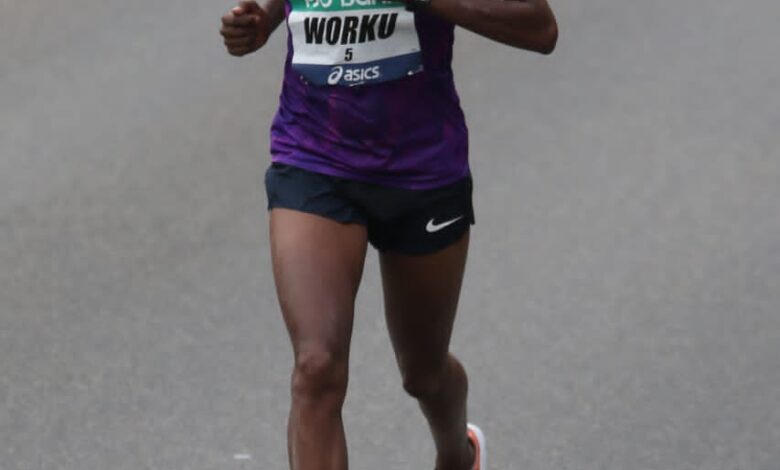
Ethiopia’s Hayla Bazu Worku, will be leading the team of foreign worldclass runners that will compete at the Gold-Label 8th Access Bank Lagos City Marathon on Saturday, February 4th.
Worku, is one of the fastest full marathon runners in the world, having ran six World class marathons in less than 2hours 9 minutes.
The 2014 Houston Marathon winner, ran his fastest time of 2:05:25 when he finished third place at the Berlin Marathon in 2010. He ran a time of 2:06:16 when he finished second place at the Paris Marathon in 2009, ran 2:06:47 when he placed 6th at the Zurich Marathon in 2020. Ran 2:07:09 at the Dubai Standard Chartered Marathon in 2015 where he placed 6th. In 2014 ran 2:07:32 at the Houston Marathon where he was champion in 2014. And 2:08:48 at the Praha Marathon in 2017 where he finished second place.
Another worldclass foreign runner ready to burn the route at the February 4 Gold-Label Access Bank Lagos City Marathon is Kenya’s John Komen, a 2019 Athens Marathon winner at a time of 2:16:34. The 42 years old Komen had recorded better time in past races; 2:07:13 in 2011 when he won the La Rochelle Marathon, 2:08:06 in 2008 at Reims Marathon, 2:08:12 at Paris Marathon and 2:08:13 when he won the Vanezia Marathon in 2009.
Anti open grazing law won’t be repealed – Ortom
Kenya’s Barmasai David is another worldclass foreign runner with the biggest chances to prove a point at the Gold-Label 8th Access Bank Lagos City Marathon.
David, has a personal best of 2:07:18 when he won the 2011 Dubai Marathon, the same year he placed fifth at the World Marathon Championships.
The 2020 Access Bank Lagos City Marathon winner has a very rich resume and the brightest opportunity to stay tops following his familiarity with the Lagos City Marathon route, having won the 2020 race at 2:10:23 and placed second in 2022, at the 7th edition of the Access Bank Lagos City Marathon at 2:13:37. Its the same route and same weather.
David is also a winner of the 2010 Kenyan Standard Chartered Marathon where he ran 2:10:31.
In the women class, the top leading worldclass foreign runners include; Tinbit Didey, former champion of the Marrakesh Marathon, Esther Macharia, a former winner of Graz Marathon and winner of Bregenz Marathon. She has a personal best of 2:27:15 recorded in 2022 at the Grandma’s Marathon in USA.
Kenya’s Mercy Jerop Kwambai, is yet another worldclass runner, with the most recent performances that may change some expectations at the Gold-Label 8th Access Bank Lagos City Marathon.
Mercy Jerop in the last two years has been hot in her races across the world; at the Asics Firenze Marathon in 2021 she ran 2:27:32 and placed 3rd. In 2022, at the Sparkasse 3-Lander Marathon, she finished second place at 2:30:15 and 3rd place also at the 2022 Adidas
Stockholm Marathon at 2:33:43.
A total of 76 foreign runners were invited by the organisers, Nilayo Sports Management Limited, for the Gold-Label 8th Access Bank Lagos City Marathon, made up of 47 men and 29 women worldclass runners.
In the men’s class include; Julius Tuwei, Japhet Kosgei, Edwin Kibet Koech, Kiprotich Justus Kipkoech, Ezekiel Koech and Cosmas Kiplimo. Others include Francis Cheruiyot, Bernard Sang and Kibiwot Stephen Kipkoech among others.
For the women’s class, we have Jackline Chelai, Naomi Maiyo, Kebene Chala and Catherine Jerotich.
The foreign Elite athletes are from 22 countries from across the world and a total 50,000 runners in all will be running in the Gold-Label 8th Access Bank Lagos City Marathon on Saturday, February 4.