By Cross Udo, Abuja
The federal government, yesterday, gave assurances that the Second Niger Bridge, and the Lagos-Ibadan Expressway, would be delivered this year.
Minister of Works and Housing, Mr Babatunde Fashola, gave the assurance while featuring on the weekly Ministerial Briefing, organised by the Presidential Communication Team, at the Presidential Villa, Abuja.
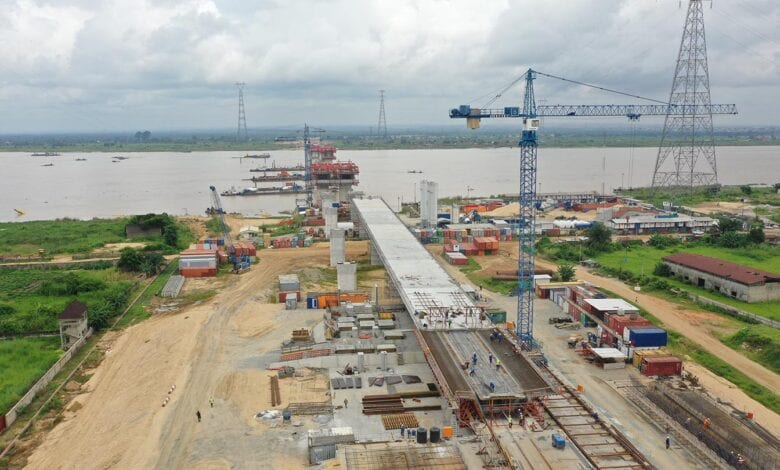
The Minister explained that the initial February completion date projection for the Second Niger Bridge failed due to the impacts of the COVID-19 lockdown and EndSARS protests, adding that the project is already at 91% completion stage.
The briefing was to enable him provided further updates on key collaborations between the Federal Government and the State Governments in the implementation of some of the major reforms being executed by the Ministry and the Presidential Infrastructure Development Fund (PIDF).
According to him, 1,486 people have been directly employed for the Second Niger Bridge while another 8,110 indirect jobs have been created.
He puts the cost of three major PIDF projects at N1.3 trillion. The projects are Abuja-Kaduna-Zaria-Kano Expressway (375km): N797 billion, Second Niger Bridge (11.59km): N206 billion and Lagos-Ibadan Expressway (127km): N310 billion.
On when the projects will be completed, Fashola said that Lagos Ibadan Express Way and Second Niger Bridge are on course to be completed this year 2022, while the main Carriageway of Abuja-Kaduna-Zaria-Kano expressway is scheduled for completion by Q2 2023, adding that ancillary works will be completed later.
He listed the 2nd Niger Bridge, Lagos-Ibadan and the Abuja-Kaduna-Zaria expressways as the main projects being executed through the PIDF. He said two of the projects would be completed this year while the Abuja to Kano Road would be completed next year.
“The Lagos-Ibadan expressway will be delivered this year, subject to how we navigate the pricing issues. Second Niger Bridge also this year, while the main carriageway of Abuja-Kaduna-Zaria-Kano expressway is scheduled for completion by the second quarter of 2023 before the President leaves office at the end of his tenure.”
He said the Abuja to Kano Road has ancillary works that cannot be finished next year.
“There is ancillary work that cannot be finished next year; the service lanes and truck parks, toll plazas, but that will continue because the funding is properly structured and the NSI is trying to mobilize some private capital now into the project,” he said.
According to the Works Minister, thousands of jobs have been created through the execution of the three projects, as he highlighted the economic benefits of the three.
“The three projects have been able to collectively create 5,246 direct jobs and 13,998 indirect jobs. This is a major link chain of the economic agenda of this country because right now people are getting something to do. If you analyse the GDP results sectorally, you will see that mining is thriving, you will see that the construction sector is booming, you will see petroleum products also booming, this is part of the reason why.
“And then you see the food vendors also making money because at each construction site, people must eat twice a day. A plate of food was N250 before the cost of living started going up.
“This is a major economic driver. We focus more on the roads, but you will see the millions or hundreds of thousands of tons of cement that are churned out form the cement industry, where they are now working at full steam and many people are employed there.
“Each of these projects has a bank guarantee for the money they get and such guarantees are not given for free. The contracts also have a 7.5 percent Value Added Tax, which when collected, 85 percent of it goes to the States,” he explained.
The Minister said the three projects were chosen based on President Buhari’s priority.
“When I was first appointed Minister, one week after I was sworn-in as Minister in 2015, I got an invitation from the Villa that the President wanted to see me. On getting to his office, he said to me; Ilorin-Jebba, do you know what is going on there, I said no, then he asked me to visit there and resolve the problem. For 2nd Niger Bridge, I want a brief summary of what is happening there, it is a priority for me, I want to do it.
“He also said Lagos-Ibadan, why has it taken so long? You are from Lagos. I want a brief and I want a solution to that road. These are my priorities. Just go and give Nigerians good roads. So, the projects were the President’s directive. In the process, Abuja-Kano started deteriorating and he added it to our plate. So, these are Presidential directives and mandates,” the Minister narrated.
Fashola puts the cost of three major PIDF projects at N1.3 trillion; Abuja-Kaduna-Zaria-Kano Expressway (375km): N797 billion, Second Niger Bridge (11.59km): N206 billion and Lagos-Ibadan Expressway (127km): N310 billion.
The Minister also spoke about the challenges of government in executing the three projects.
“On the second Niger bridge, one of the challenges we are facing on the Anambra side of the project is the stay-at-home order on Mondays and every day we don’t work there is time lost.
Programme for APC’s Saturday National Convention
“On the 2nd Niger Bridge, we are going to shut down the power supply from one of the power plants for maintenance. On Abuja-Kano Road, we must relocate transmission lines; we have to move people who have set up markets along the roads and so on.
“So, these are some of the challenges we are facing and then there are compensation issues, and we are working with Governors, who control land in their states to help us overcome these local issues,” he said.
Meanwhile, the Minister has warned motorists to shelve the temptation to exceed 100km/h on completed roads, to avoid crashes.
He said the warning became necessary when he got messages from some of the road users commending the quality of work done, who said they were doing 150-km/h due to the smoothness of the roads.
He also decried the sale of Premium Motor Spirit (PMS), also known as petrol, and other petroleum products on the roads, saying they deteriorate the roads faster.