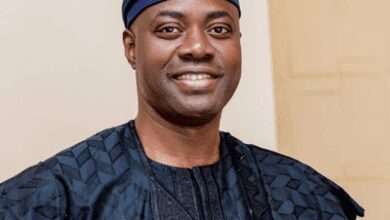
1999 Constitution is a big fraud – Opadokun

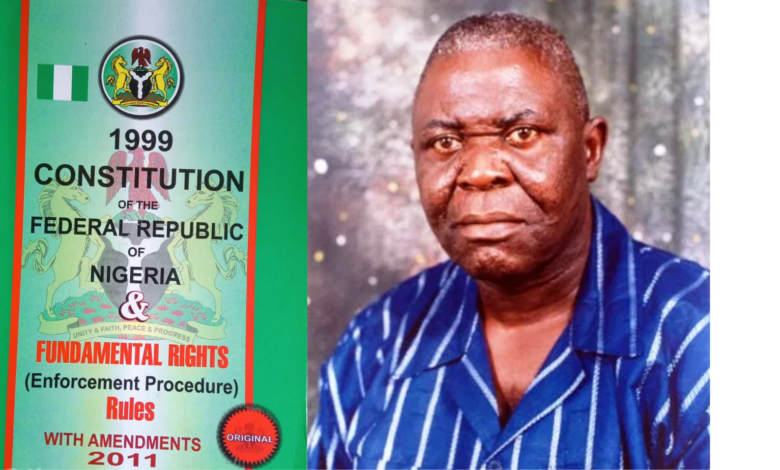
A former Secretary, National Democratic Coalition and Convener, Coalition of Democrats for Electoral Reforms, Chief Ayo Opadokun, talks on the country’s 22 years of democratic experience, the ongoing Constitution debate, among other sundry issues in this interview with Mudiga Affe
How far have we fared in the last 22 years of democracy?
Unfortunately, we have not fared well. It is a great pity because most of us who laid down our lives, who lost our sweats and blood and got battered in the process, thought that after we had succeeded in getting the military to return to the barracks, those who emerged in government will ensure quantitative, qualitative improvement in the living condition of our people because the people have suffered untold hardship in the last 40 years.
There had been so much unbelievable level of poverty and misery among our people, so, we thought that those who emerged as political operators will turn things around in all ways. Unfortunately, that is not what we got since then. First, the military big wigs, retired ones, felt because of the evils they have done in the office, they brought their former leader, Gen. Olusegun Obasanjo (retd.) to lead us. They put undue pressure on Gen Abdulsalami Abubakar (retd.) to release Obasanjo from prison and grant him pardon to contest the 1998 election.
They imposed Obasanjo on us through the so-called perverted and compromised election. He (Obasanjo) did not exhibit at any time his love for the ordinary man or the improvement of the life of the ordinary man. He has an ego problem. It is Obasanjo first, Obasanjo second, and Obasanjo third. He did not understand that public office is supposed to be used to advance the best interest of the ordinary man. As he failed to build a better economy since 1999 in his political policy agenda, Obasanjo never took any decision to consolidate, popularise, defend or sustain democracy and democratisation.
Council polls: Lagos PDP concludes primaries
He was still in his old garment of military strongmen so much that what he got was wasteful expenditure and policies that never made lives easier for the ordinary man. During the eight-year sojourn of Obasanjo as President, he increased the price of fuel seven different times to make life worse for the ordinary man. He allegedly spent a humongous sum of money to generate power in a country of over 150 million people. With the volume of money Nigeria has received from crude oil exports, it is unbelievably difficult to imagine that the country will be in a state of such decayed infrastructure, grossly inadequate social services, failing educational and medical services, inadequate food for the common man, and accommodation, and inefficient transportation system, among others in a country that is among the biggest exporter of petroleum products for many years.
For over two decades, Nigeria’s crude oil exports were on average two million barrels per day at an average cost of £100 per barrel. Where is such a huge sum in the lives of our people today? Again, at the expiration of his tenure, Obasanjo also did not want to leave. He tried his luck with the third term bid which failed and when the pressure was too much on him he sought for somebody he knew had terminal ailment to take over from him.
Come to think of it, his junior, Maj-Gen. Muhammadu Buhari (retd.), who is now in office, has not done anything since he came into office. In his manifesto, before he came into office, Buhari said he would secure the country and turn around the economy as well as the fight against corruption. Those three things were very key, but what has he done concerning them?
With the interviews he granted then, he had the content of what was going on. He promised to quickly dispense with Boko Haram and we thought that as a former military Head of State, that would be easy for him. But Nigeria today is a failed or failing state because the country has not been able to fulfil its primary objective. The primary purpose of existence is the security of lives and property.
Under the United Nations Human Rights Convention that was pronounced in 1948, Article 3, 6, and 12 as well as the African Peoples Charter on Peoples Rights and Convention, Articles 6, 10, 20, and 22. Even the unacceptable, dubious, and militarily-imposed 1999 Constitution, in its chapter 2 dealing with fundamental objectives and directives of state policy, 14 (2) states that the security of lives and property will be the primary purpose of governance.
Look at where we are now, non-state actors are taking over our land. The non-state actors have superior weapons and they have become much more dominant and assertive. They attack soft targets who are civilians and attack military convoys at will. The Nigerian state has not been able to do much till date. So, that is the experience and if you ask me, I will say it has not been good. It is a different expectation from what we had when we were doing all the yeoman’s job, which was risky. We faced the most violent military dictator like the late Gen. Sani Abacha.
You were at the forefront of the NADECO/June 12 struggle which is believed to have given room to the emergence of the Fourth Republic, is there a correlation between the democratic ideals of M.K.O. Abiola, who was the winner of the election, and what is being practised in the Fourth Republic?
There is no correlation. The late Abiola’s manifesto was titled “Farewell to Poverty”. It was crafted for him under the leadership of Prof. Sam Aluko. I was the one who was instructed to be the one to draft that policy and Prof. Aluko did what he was told to do. It was a wonderful government policy thrust that would have transformed the country. This was because Abiola had seen poverty at the worst level before he became wealthy, so, he knew where the shoe was pinching Nigerians.
But come to think of it, he won the election and the military had great contempt for the popular will of the Nigerian people. They did not allow that popular will to materialise. They did not allow the popular will of the Nigerian people to be effected and so they annulled the election, arrested Abiola, and killed him.
There have been calls for the replacement of the 1999 Constitution. While a school of thought believes that the 1963 Republican Constitution should be adopted and group feels that report of the 2014 National Conference should be revisited, what are your views in all these?
The first thing that we must remind ourselves of is this: Nigerians secured their independence in 1960 on federal constitutional governance and that was the 1960 Independence Constitution. It was later amended to become a Republic Constitution in 1963- that was what Nigerians negotiated and subscribed to as their constitution.
A federal Constitution accepts the fact that Nigeria is a heterogeneous society composed of well over 350 ethnic groups with different languages; different religions and traditions; different customs, artefacts, folk laws, and morals. So, these component units will exist with their differences but are coordinated at the centre.
Nigerians have not at one time changed their mind as to what they wanted. The military violently staged their insurrection on January 15, 1966, to supplant, suspend, and abrogated that negotiated federal constitutional governance and substituted it with a series of decrees which militarised and centralised the governance of Nigeria. The consequences of centralisation and militarisation had been very dear.
It had occasioned injustice, unfairness, inequity, and total disregard and respect for the preservation, consolidation, and defence of the Rule of Law. So much that today, nepotism is a public thrust of this government. Those who have captured power constituted themselves as the “owners”, while they turn the rest of us into spectators in a place that ordinarily ought to be owned by the commonwealth for all of us.
So, all that the military had done since 1966 to date, remain illegal. All the institutions that they have established under their different decrees are illegal because they were not approved by us and they were not the product of our collective resolution. We have not abandoned federal constitutional governance in which we subscribed before the military staged their insurrection against the government of the late Alhaji Tafawa Balewa.
The idea of the 1999 Constitution also, came from that mind-set of their imposition. They imposed what they wanted on us at all times. The 1979 Constitution was an imposition by the military under the Murtala Mohammed/Olusegun Obasanjo government. When their acolytes/surrogates were chosen as draftsmen in the so-called Constituent Assembly. Even when the Constituent Assembly gave their recommendation, about 17 different matters were added outside the discussion of the Constituent Assembly by the Obasanjo’s government.
So, it was not our constitution. The current constitution was because Gen. Abdulsalami Abubakar had never taken part in any political office, until the sudden death of Abacha. He (Abubakar) was not also willing to stay in the office for too long. We (NADECO) took a memo to him and we recommended that he should form a Government of National Unity whose first duty will be the convocation of a Sovereign National Conference to discuss the national question, but instead of that, he brought some of their friends together, including Justice Ayo Irikefe, who packaged something together.
When people were contesting for election to offices in 1998/1999, they never saw the constitution upon which they would govern. The so-called constitution was not brought into the light until the inauguration of Obasanjo. So, people ran for election blankly before the 1999 Constitution was brought into effect by Decree 24. And the so-called constitution lied against itself when it said, “We, the people of Nigeria.” Where were the people? We never participated in it and that is why it is not a constitution made by Nigerians and it is a forgery of a type. All institutions established under it, therefore, constitute illegality and it is not acceptable.
The National Assembly has come out to say that they cannot replace the 1999 Constitution, as representatives of the people are these lawmakers speaking the minds of their constituents?
They know they are not speaking the minds of the people and they are overreaching themselves. Who are they to say that it is not possible to write a news constitution? I am sorry to say this, a few decent lawmakers in the National Assembly have an idea of what they are supposed to do there. It is not the business of the parliament to write a constitution. They can only do amendments. Nigerians are not ready for amendments, they want a new constitution. The so-called parliament is one of the subject matters that Nigerians will have to decide upon. Do we want a unicameral or bicameral system of legislation? Do you want a Parliamentary or an Executive Presidential System?
So, they cannot be judges in their matter. It is within the province of the Nigerian people and they must understand that as contained in chapter 2 of the Constitution that stipulates that sovereignty belongs to the people from which government derives its powers and authority. Our sovereignty remains with us. When we elect any person, we confer on such persons a part of that our right for the period he is in the Assembly, but the sovereignty remains and that is why we have the right of recall of any legislature.
Do you think the proposals that came out of the 2014 Confab should be considered for a new Constitution?
I do not know what is contained in it and for that reason, I cannot comment on it. But from all intents and purposes, there was the Babangida’s conference, Abacha’s conference before Jonathan’s conference, but the promoters of those conferences did not want a new constitution for the country. So, my answer is no with certainty. The composition of their various conferences exposed the underbelly of their intentions. It was self-service; a ruse; a gimmick and to deceive the people that they were doing something just because they dreaded to service the people.
In 2015, the South-West was instrumental in the emergence of President Buhari during the election, but lately, leaders of the region are the ones complaining the most, why?
One thing with the typical average Yoruba man is that he is traditionally fair-minded but very demanding. When there is a leader that acts his talks, the Yoruba man is most likely going to follow him. But where you do not act your talk, you will soon get into trouble with the Yoruba nation.
President Goodluck Jonathan failed to retain his office, much more significantly because he ignored the Yoruba race until the last hour because he was deceived. He packed a particular section of the country into his government to the detriment of the Yoruba race. A Yoruba man will hardly want to beg for what belongs to him. They are of the view that this lopsided, warped and skewed national structure cannot last. That is what any decent Yoruba man will work upon to ensure, in collaborated other like minds in the country that we return to constitutional governance.
It is not the idea of seeking offices for some fringe elements in Yoruba land- of what use is that to the generality of the people? Those of them who had been in offices, what did they do other than that they stole for themselves and their families. The key things affecting the Yoruba nation are the restoration to the federal constitution and governance wherein we will be talking about fiscal federalism, the legality that is conferred on the parliament, and the right to establish state police.
Could this be the reason why Sunday Igboho is agitating for the Oduduwa Republic?
I do not know him. But note that government actions will lead to reactions. So, it is not for people like me to comment on the activities of Igboho, but when government fails to listen to the popular will of the people, it will generate a reaction. I was stunned to read a newspaper on Thursday where the police paraded so many suspects including two people, one from North-Central and the other from the South-East who were manufacturers of guns. They were manufacturing AK47 and the Force Public Relations Officer, Frank Mba, was saying it will be difficult to find the difference between the locally produced AK47 from the imported ones.
The manufacturers said they have produced at least 100 pieces of the weapons that they sold for about N80, 000 per unit. This is to teach the political operators a lesson that they are not in control of the instrument of cohesion any longer. To continue to trivialise and oppress because you are in control of the state’s coercive instruments will no longer solve the problem. We have passed that stage. They did that to us during the NADECO days where we were hounded and molested.
In an obvious reference to the rising spate of insecurity in the South-East, the President recently said he would deal with those fomenting trouble in the language they will understand, what is your perception of that comment?
Well, I do not know what that statement means, but let us see how he will deal with them. Let him act his talk and we will know what he means. He was referring to some people and of course, they are already replying to his comment. Times have changed. Let me say this for the umpteenth time, all nations’ states that have been packaged together by colonial masters through false instruments did not last. Today, we no longer have the Union of Soviet Socialist Republics (USSR), what we have today is Russia. We also no longer have Yugoslavia on the world map. What we use to know as Ethiopia under Haile Selassie has been balkanised into Eritrea and Tigre. Even the colonial master, the United Kingdom, which virtually administered over 50 per cent of the entire world before, was the first to concede some freedom of liberty to the Welch, Scots, and Ire-landers.
To subjugate people and imagine that they will remain silent forever, you must be a joke. The kind of nepotism that is being exhibited in the Nigerian setting today cannot lead to any peace or unity. The others who have been turned to spectators, will not just be watching. So, the challenge is on the political operators to do the right thing. Let us go back to the constitution that our people subscribed to. We have never subscribed to any other thing since then. We never disowned the 1963 Republican Constitution and that is what we want. The fact remains that the military had no mandate of the Nigerian people to do what they had done. To be asking what we do not want in the constitution to the National Assembly is wrong because the present National Assembly is an instrument under the disputed 1999 Constitution. We would not probate and reprobate at the same time. We regard the 1999 Constitution as a forgery, so, asking the people to go and bow down to such a body is a misnomer. They will not find serious-minded people doing that.
2023 is almost here, where do you think the presidency should go?
For me, I believe that those who are running the rat race for election are not thinking. If they are, I am sorry to say, they should be re-examined. Those who need the survival of this country should join hands together to insist on the restoration of Nigeria to federal constitution governance before any election, nothing contrary.
Ask yourself, what are the tangible gains Nigerians have got from the different elections since 1999? Apart from religion in Nigeria, politics is the next most lucrative business and that is why they want to make money and remain in positions. For us, self-determination is the anthem of this millennium.