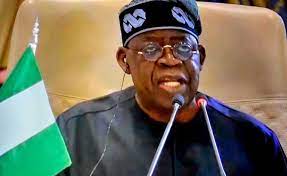
The signing ceremony, which took place at the Presidential Villa in Abuja around 5 pm, was attended by principal officers of the National Assembly and senior government officials.
The presidential assent came barely days after the Independent National Electoral Commission (INEC) released the timetable for the 2027 general elections and less than 24 hours after the National Assembly passed the amendment bill.
Speaking shortly after signing the bill, President Tinubu commended the lawmakers for what he described as a patriotic and painstaking effort to strengthen Nigeria’s democracy and prevent voter disenfranchisement.
“I followed keenly what you were doing. The essence of democracy is to have very solid brainstorming discussions committed to national development and nation-building and the stability of the nation,” Tinubu said.
“What is crucial is that you manage the process to the extent that there will be no confusion and no disenfranchisement of Nigerians, and we are all going to see democracy flourish.”
The President stressed that while technology plays an important role in elections, human management remains central to the credibility of the process.
“No matter how good a system is, it is managed by people, promoted by people and finalised by people. You are not going to be talking to a computer; you are going to be talking to human beings who announce the results,” he stated.
“Essentially, what we are looking at is the transmission of manual results, and we must avoid glitches. Nigeria will flourish and continue to nurture this democracy for prosperity and stability.”
The amendment has been widely debated, particularly over provisions on the electronic transmission of results, with civil society organisations and opposition figures pushing for mandatory real-time transmission from polling units.
*Amendment balances technology with Nigeria’s realities- Akpabio
However, supporters of the law argue that it adopts a pragmatic approach that accounts for Nigeria’s infrastructure realities.
President of the Senate, Godswill Akpabio, said the new law was designed to reflect public expectations while accommodating operational challenges.
“A lot of provisions in the new law will definitely make Nigerians very happy. We did a very thorough and painstaking job, taking cognisance of the peculiarities of our country,” Akpabio said.
“At the end, we believe strongly that what the President has just assented to reflects the yearnings of Nigerians and will make for better elections in the future.”
On electronic transmission, Akpabio explained that the law permits the upload of polling unit results, while recognising that connectivity challenges persist in some parts of the country.
“All Nigerians wanted was to see polling unit results transmitted electronically, and we have included that. But we also recognised that there are areas without network coverage,” he said.
“The signed polling unit result sheet remains the primary document, and once officials move to areas with connectivity, the results will still upload for public viewing.”
He added that the law would enhance transparency by enabling citizens to verify results independently, while also strengthening internal democracy within political parties and reducing ambiguities that previously led to electoral disputes.
*Signed law risks chaos, manipulation, says Igini, ex-INEC REC
However, former INEC Resident Electoral Commissioner, Mike Igini, strongly criticised the law, warning that its provisions could undermine the credibility of future elections.
Igini, who had earlier urged President Tinubu not to sign the bill, said during an Arise TV programme on Wednesday that the law creates loopholes that could be exploited to manipulate election results.
“With the bill, the 2027 election is already in danger,” Igini said during an interview on ARISE Television.
“There is danger already at the polling units. Corps members will be killed.”
He warned that allowing alternative procedures in areas without network coverage could be deliberately abused.
“If you make a provision for an alternative in case of no network, then there will be no network. The network will be blocked,” he said.
“In the 2023 election, a particular state jammed the entire system, and there was no network.”
Igini cited past experiences to illustrate how politicians could exploit loopholes.
“INEC introduced fingerprint capturing machines for voting and accreditation, and at the same time made provision for people without fingers,” he said.
“All of a sudden, an entire ward, nobody had fingers, and they all used incident forms. That will tell you the extent politicians will go to compromise the system.”
He described the law as dangerous and warned that it could trigger serious electoral crises.
“The Act is a recipe for chaos,” Igini declared.
The former electoral commissioner also blamed the judiciary for weakening INEC’s ability to conduct credible elections.
“There was an instance where INEC disowned the result of an election, but the judiciary went ahead to uphold it,” he said.
“The judiciary should stand tall in defence of democracy.”
Despite the criticisms, political observers say the early passage and signing of the law gives INEC sufficient time to align its regulations and deploy necessary technology ahead of the 2027 elections.
The general elections are scheduled for February 20, 2027, for the presidential and National Assembly polls, and for March 6, 2027, for the governorship and state assembly elections.