By Vincent Egunyanga and Nathaniel Zaccheaus, Abuja
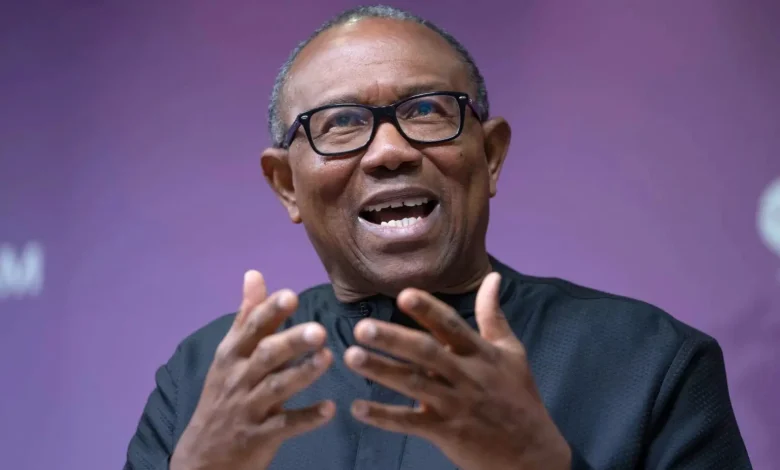
Nigeria’s opposition coalition plunged deeper into crisis on Sunday after former Labour Party presidential candidate Peter Obi formally dumped the African Democratic Congress (ADC) and joined the Nigeria Democratic Congress (NDC), dramatically reshaping political alliances ahead of the 2027 presidential election.
Obi’s exit, alongside former Kano State governor Rabiu Kwankwaso, marks one of the most significant opposition realignments since the conclusion of the 2023 general elections and signals growing instability within efforts to forge a united front against President Bola Tinubu and the ruling All Progressives Congress (APC).
The development followed a decisive closed-door political meeting at the Abuja residence of former Bayelsa State governor and NDC National Leader, Senator Seriake Dickson, where Obi and Kwankwaso finalised negotiations with NDC leaders before formally receiving membership cards.
The move effectively ends weeks of speculation over their political future and delivers a major blow to the ADC’s ambition of serving as the principal coalition platform for opposition heavyweights.
Obi, in a statement, cited internal divisions, persistent legal disputes and growing infiltration by destabilising interests as major reasons for abandoning the ADC.
He lamented that rather than confronting Nigeria’s deepening economic hardship, insecurity and governance failures, political actors within opposition circles were increasingly consumed by struggles for control and exclusion.
“However, the same Nigerian state and its agents that created unnecessary crises and hostility within the Labour Party that forced me to leave, now appear to be finding their way into the ADC, with endless court cases, internal battles, suspicion, and division, instead of focusing on deeper national problems and playing politics built more on control and exclusion than on service and nation-building,” Obi said.
He stressed that his political ambition was not driven by desperation for office but by his desire to build a just, compassionate and functioning Nigeria.
“Let me assure all that I am not desperate to be President, Vice President, or Senate President,” Obi stated.
Kwankwaso, speaking after his formal entry into the NDC, described the alliance as a strategic convergence of leaders committed to rescuing Nigeria from worsening socio-economic decline.
“At this point, we call on all Nigerians who believe in peace and progress to join us. Nigeria will be okay,” Kwankwaso said.
He explained that consultations with NDC stakeholders revealed a broad consensus on national priorities, particularly education, youth empowerment, national unity and security.
Kwankwaso added that the NDC offered a credible platform capable of mobilising Nigerians across regional, ethnic and political divides.
Obi echoed similar sentiments, describing the NDC as a viable structure for rebuilding public trust in governance.
“We are here to be part of a family committed to building a united, secure and prosperous Nigeria that works for everyone,” Obi declared.
He further warned against the destructive consequences of endless political litigations, saying opposition parties must prioritise national transformation over internal sabotage.
*Atiku, Amaechi battle for ticket
The exits of Obi and Kwankwaso have now intensified political pressure on the ADC, where former vice president, Atiku Abubakar, and former Rivers State governor, Rotimi Amaechi, are increasingly positioned as the dominant contenders for the party’s 2027 presidential ticket.
The rivalry between Atiku and Amaechi has become one of the defining tensions within the coalition, with both leaders commanding significant political machinery, national recognition and strategic influence.
Atiku, who has maintained a strong influence over coalition negotiations, is widely believed to still be pursuing another presidential bid, while Amaechi’s growing political calculations have further complicated internal consensus.
The struggle for control of ADC’s presidential structure is now seen as a critical factor that may determine whether the party survives as a united platform or descends into deeper fragmentation.
*Lukman blasts Kwankwaso, says ‘you can’t run away from yourself’
Meanwhile, a former APC National Vice Chairman (North-West), Salihu Lukman, delivered one of the sharpest reactions to Kwankwaso’s departure, accusing him of undermining years of painstaking coalition-building efforts.
In an open letter on Sunday, Lukman argued that ADC was selected after prolonged consultations among major opposition leaders, including Obi and Atiku, as the most practical vehicle for democratic consolidation.
“To argue that ADC has been forced into externally influenced legal problems is to attempt to run away from the problem. You can’t run away from yourself,” Lukman declared.
He maintained that legal troubles were not unique to ADC and warned that similar structural challenges could easily emerge within the NDC or any alternative political vehicle.
Lukman accused top opposition figures of repeatedly subordinating collective democratic goals to personal presidential ambitions.
He argued that Nigeria’s democratic future depends less on changing party platforms and more on building transparent internal political processes.
*Onanuga ridicules Obi as ‘political nomad’ fleeing tough contest
Presidential spokesman Bayo Onanuga also weighed in aggressively, using Obi’s defection to reinforce the ruling party’s criticism of opposition instability.
“We told you so. The political nomad is on the move again,” Onanuga wrote on his X handle.
“Ignore all those puerile reasons he gave in these illogical musings, a self-serving letter to his mob. Peter Obi is a politician made of jelly, an opportunistic fellow.”
“He can’t fight Atiku or Amaechi for the ticket of ADC. He pursues the easy road, which will only lead him to doom, like in 2023.”
“He always blames the government without doing a soul-searching of himself. Welcome, Peter, to the 2027 race.”
Onanuga’s remarks reflect the APC’s broader effort to portray the opposition as deeply fragmented, ideologically unstable and incapable of sustaining long-term political unity.
The formal migration of Obi and Kwankwaso into the NDC has significantly elevated the party’s national profile, positioning it as an emerging political force with broad appeal across multiple voter blocs, particularly youths, urban reform-minded voters and northern grassroots constituencies.
For the ADC, however, the departure of two of its most influential coalition figures raises fresh questions over its future cohesion, electoral viability and capacity to withstand escalating internal competition.
With Atiku and Amaechi now left to navigate an increasingly tense presidential contest within ADC, and the NDC rapidly consolidating around Obi and Kwankwaso, Nigeria’s opposition landscape appears more fragmented yet more dynamic than at any point since 2023.
As political permutations intensify, Sunday’s developments have set the stage for a fierce struggle over coalition supremacy, party survival and presidential positioning in the long march toward 2027.