By Nathaniel Zaccheaus, Abuja
The Southern and Middle Belt Leaders Forum (SMBLF) on Tuesday declared that it would mobilise Nigerians to support only a presidential candidate committed to delivering a new constitution founded on true federalism, making constitutional restructuring a key condition for its backing ahead of the 2027 general election.
The influential regional coalition also reaffirmed its demand that the presidency should remain in Southern Nigeria after the 2027 polls, insisting that retaining power in the South for another four years was necessary to preserve national political stability and strengthen the country’s unity.
The resolutions were contained in a communiqué issued at the end of the forum’s regular general meeting held in Abuja, where leaders also canvassed constitutional amendments to allow independent candidacy, condemned what they described as the collapse of internal democracy within political parties and renewed their advocacy for true federalism and state policing.
The meeting brought together delegates from the forum’s four constituent organisations—Afenifere, Ohanaeze Ndigbo Worldwide, the Middle Belt Forum (MBF) and the Pan Niger Delta Forum (PANDEF)—underscoring a united regional position on the country’s political future.
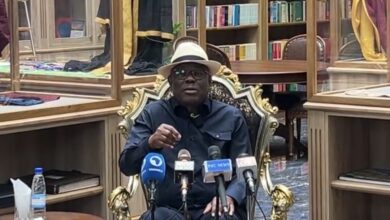
Reading the communiqué, Chairman of the Forum and Leader of Afenifere, Chief Oladipo Olaitan, said the existing constitutional framework had failed to address Nigeria’s structural and governance challenges, stressing that the country required a new constitution that genuinely reflected the principles of federalism.
“SMBLF insists on a new Constitution that reflects true federalism and shall mobilise the people to vote for a presidential candidate that will give the people of Nigeria a new Constitution.”
The declaration effectively places constitutional reform at the heart of the forum’s 2027 political agenda, signalling that support for any presidential aspirant would depend on a clear commitment to restructuring rather than party affiliation or regional considerations alone.
On the zoning of the presidency, the forum reaffirmed its earlier position that the office of the President should remain in the South beyond President Bola Tinubu’s first term, arguing that such an arrangement would promote political balance and national cohesion.
“SMBLF reiterates its earlier resolution that the position of the President of the Federal Republic of Nigeria shall remain in the southern region in the next four years consequent on the 2027 general elections in the interest of national political stability.”
The regional leaders also took a swipe at Nigeria’s political parties, accusing them of undermining democracy through the imposition of candidates and manipulation of party nomination processes.
According to the forum, democracy can only thrive where citizens are free to choose their leaders without undue influence from political godfathers or party elites.
It consequently called for constitutional reforms that would legalise independent candidacy while preserving Nigeria’s multi-party democratic system.
“The essence of democracy is the freedom of citizens to choose their leaders. Allowing one individual or a few powerful persons to determine party candidates undermines democratic governance and national development.”
On security, the forum commended the armed forces for recent operational successes against criminal elements in Oyo, Zamfara and Borno states but urged the Federal Government to intensify military operations in Benue, Plateau, Kaduna, Kwara and Kogi states, where insecurity continues to threaten lives and livelihoods.
It also called for stronger collaboration with neighbouring countries and the international community to tackle cross-border crimes and other transnational security threats.
Reaffirming its long-standing advocacy for state policing, the forum argued that any decentralised policing arrangement must be rooted in the principles of true federalism.
According to the communiqué, state governors should exercise authority over their Commissioners of Police similar to the powers currently vested in the President over the Inspector-General of Police.
The forum further urged the judiciary to remain independent and courageous in interpreting the law without fear or favour, warning that the survival of Nigeria’s democracy depends largely on an impartial justice system.
It also challenged the media to continue playing its constitutional role as the Fourth Estate by defending democracy, promoting accountability and protecting the public interest.
On electoral reforms, the regional leaders maintained that the Independent National Electoral Commission (INEC) must bear the responsibility of proving the credibility of elections conducted under its supervision.
“INEC should carry the burden of demonstrating that elections conducted in Nigeria are free, fair and credible.”
The meeting was held at the Abuja liaison office of PANDEF and was attended by several prominent leaders, including former Akwa Ibom State Governor, Obong Victor Attah; former President-General of Ohanaeze Ndigbo, Chief Nnia Nwodo; former Nigerian High Commissioner to Ghana, Ambassador Godknows Igali; and National President of the Middle Belt Forum, Dr Bitrus Pogu, among others.
The resolutions are expected to shape the forum’s engagement with political parties and presidential aspirants as consultations and alignments ahead of the 2027 general election gather momentum.