By Seyi Odewale
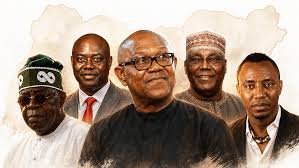
As presidential primaries of major political parties ended on Saturday, paving the way for a fierce political battle ahead of the 2027 general election, President Bola Tinubu, former Vice President Atiku Abubakar, Mr Peter Obi, Senator Sandy Onor, Governor Seyi Makinde, Mr Omoyele Sowore and other contenders emerged flag bearers of their various political parties.
The primaries have been punctuated by intense lobbying, strategic alliances, defections and internal party manoeuvres, effectively opening what many experts regard as a decisive war for Nigeria’s political and economic future.
Political watchers believe the presence of the leading competitors has turned the upcoming election into not only a battle for power but also a referendum on governance, economic management, national unity, and public trust in leadership.
President Tinubu, candidate of the ruling All Progressives Congress (APC) and former Vice President Atiku Abubakar won the ticket of the African Democratic Congress (ADC).
The presidential ticket of the National Democratic Congress (NDC) was picked by Peter Obi, the Peoples Democratic Party (PDP) group backed by the Minister of the Federal Capital Territory, Nyesom Wike, produced Senator Sandy Onor, and Oyo State Governor Seyi Makinde picked the ticket of the relative unknown Allied Peoples Movement, while Omoyele Sowore also emerged on the platform of the African Action Congress, AAC.
Further complicating the emerging political struggle is the position of former President Goodluck Jonathan, who has been endorsed as the preferred presidential candidate by the Turaki faction of the PDP.
But Jonathan has not officially expressed interest in the campaign nor publicly accepted the support, sparking much political conjecture across the country and within opposition ranks.
For millions of ordinary Nigerians suffering rising hardship, insecurity and unemployment, the election may ultimately be about survival, economic recovery and public trust in leadership, observers say.
Tinubu is the incumbent President and possibly the contender with the greatest political machinery in the country.
His supporters say that the economic changes, tax restructuring, infrastructure drive, and budgetary policies of his administration need to continue to produce long-term outcomes.
Supporters of the President also cite continuing road and rail projects, revisions to local government autonomy, improved income collection, student loan initiatives and measures to stabilise public finances as evidence the administration is building the framework for economic recovery.
The APC is also expected to rely on its nationwide structure, incumbency advantage, and control of numerous state governments to enhance Tinubu’s re-election bid.
*Main issues for voters: Economy, insecurity, jobs
But critics say the hard economic impact of subsidy elimination, inflation and falling buying power might be serious election headaches for the ruling party.
The worsening security situation in sections of the North-West, North-East and Middle Belt is also expected to be a prominent issue during campaigns, especially with the frequent attacks by bandits, kidnappers and insurgent groups.
On the other hand, Atiku is expected to use his extensive political network, northern influence, and long-standing national exposure to mount a serious challenge against the ruling party.
Political commentators say the former vice president is counting heavily on northern numerical strength and growing economic unhappiness to take on a southern incumbent president.
But his agenda may be resisted by some sectors of the electorate who believe that power should remain in the South for eight consecutive years after the eight years of former President Muhammadu Buhari from the north.
That emotion, observers say, could become one of the defining political and moral disputes of the election season.
But Atiku’s supporters contend that the country’s economic and security concerns are too serious to be reduced to zoning considerations, saying ability and expertise should prevail above regional calculations.
But worries about his multiple presidential bids, age and the difficulties of a fragmented opposition may continue to plague his campaign.
Peter Obi is still a prominent player in the race, especially among young urban professionals and first-time voters. His rise as the NDC candidate alongside his running mate, Rabiu Kwankwaso, has further redefined opposition politics and added fresh energy into the political discussion.
Obi’s image as a wise manager of resources and supporter of fiscal discipline continues to resonate with many Nigerians dissatisfied with conventional politics and perceived elite luxury.
But political observers say Obi’s greatest challenge is still to broaden his support base beyond urban centres and social media enthusiasm to wider grassroots political organisations nationally.
Questions also hang on the NDC’s ability to build a national electoral machine capable of competing with the dominance of older political parties with greater grassroots penetration.
Makinde’s entry has added another dimension to the campaign, with supporters seeing him as a somewhat younger, governance-focused option who can attract moderates across regional and party boundaries.
The Oyo governor might draw on his administrative record and his growing prominence among younger politicians, analysts said. Still, doubts remain about the national spread of his political organisation and his capacity to compete against more established national players.
Senator Onor, of the PDP, emerged from the Wike and the National Working Committee (NWC)-backed group.
Observers believe Onor’s candidature would enhance South-South political discussions, but they remain sceptical that the splintered PDP can come together nationwide.
The ambiguity over the Turaki faction’s endorsement of former President Jonathan has further complicated the PDP’s internal politics and raised concerns about the likelihood of new alignments before the official start of campaigns.
Sowore is likely to continue appealing to radical youngsters, civil society groups, and activists disenchanted with mainstream politics. His anti-establishment rhetoric and uncompromising posture could galvanise parts of the younger electorate, but analysts doubt his movement has the statewide structure to translate action into a widespread political triumph.
However, political watchers say that, beyond personalities, coalition building, regional alliances, religion, ethnicity, campaign money, voter turnout, and the integrity of the electoral process, these factors will be major determinants of the election’s outcome.
Analysts say social media campaigns, the roles of young people and the economy closer to election time may also greatly change political considerations.
“The election will test the maturity of Nigeria’s democracy and political parties’ ability to engage voters on issues rather than on sentiment,” said political scientist Professor Adele Jinadu.
“Nigerians are more politically aware now. “People want security, competence and economic relief,” he remarked.
Economic hardship and insecurity may outweigh ethnic and religious factors during the campaigns, according to Prof Bola Akinterinwa, former Director-General of the Nigerian Institute of International Affairs (NIIA).
“When citizens no longer can afford to meet their basic needs, obviously the issue of governance performance becomes the key issue,” he said.
Former Commonwealth Secretary-General, Chief Emeka Anyaoku, cautioned political leaders not to ignore the rising popular dissatisfaction with hardship and insecurity.
He said the country needs leadership that can restore national confidence, improve institutions and restore hope in the economy.
Public affairs specialist, Dr Hakeem Baba-Ahmed, also said unemployment and poverty among youths might go a long way toward determining voter behaviour in 2027.
“Economic realities will probably decide the next election more than traditional political calculations,” he stated.
Development economist, Dr Muda Yusuf, said campaign discussions will most likely be dominated by inflation, currency rate volatility and falling buying power.
“Citizens are looking for answers to inflation, unemployment and insecurity. “These are the issues that are likely to determine how people vote,” he said.
Labour leaders and civil society organisations have also increased calls for issue-based campaigns on job creation, industrial growth, electricity supply, food security and poverty reduction.
Many Nigerians are also calling for reforms in education, healthcare, and the security architecture as part of broader discussions about governance and national stability.
As political parties gear up for campaigns across the country, the dividing lines are slowly becoming clear.
From Abuja to Lagos, Kano to Port Harcourt, Enugu to Kaduna, the talk has shifted from speculation to passionate arguments over governance, economic survival, and national direction.
Political observers say the election may ultimately be decided by which candidate Nigerians believe has the competence and political will to handle the country’s increasing challenges.
With the big gladiators now firmly in the arena, Nigeria appears poised for another historic and violently contested presidential election, one that many feel might determine the country’s political and economic future for years to come.