By Our Correspondent
Twenty-five years after establishing operations in Nigeria, the International Organisation for Migration (IOM) is confronting a migration landscape that has become more complex, more interconnected and increasingly shaped by insecurity, economic pressures and climate change.
From irregular migration and human trafficking to internal displacement, return and reintegration, the organisation’s work in Nigeria has expanded alongside the changing reasons why millions of people move.
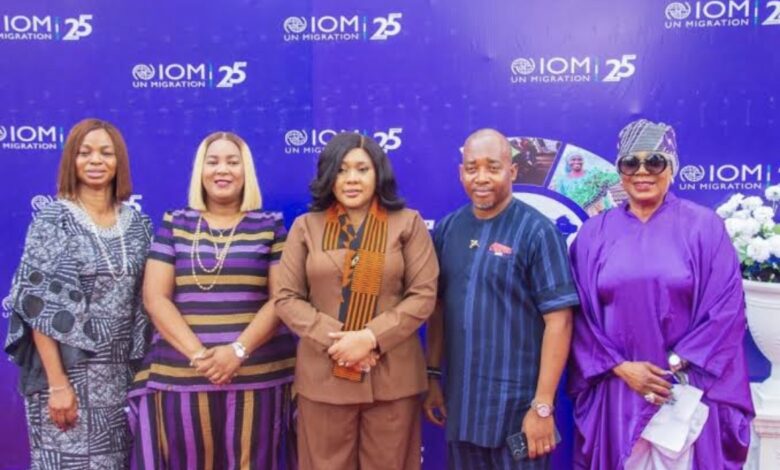
The anniversary, marked in Edo and Benue states last week, therefore offers more than an opportunity to celebrate IOM’s achievements.
It provides a window into a country where migration is now closely linked to security, development, employment, humanitarian response, climate resilience and the future of vulnerable communities.
The organisation’s 2026–2028 Nigeria Crisis Response Plan estimates that 5.9 million people are in need of assistance, with 612,200 targeted for support.
IOM says it requires $47.3 million to implement the three-year response, which focuses increasingly on durable solutions, resilience, climate adaptation and stronger local capacities.
When IOM began operations in Nigeria in 2001, migration management was largely associated with mobility, documentation, protection and assistance to migrants.
Today, the picture is considerably broader.
Conflict, banditry, communal violence, flooding and other climate-related shocks are forcing people from their homes, particularly across the North-East, North-Central and North-West.
IOM’s current assessment describes Nigeria as facing a severe humanitarian and protection crisis, with millions affected by prolonged displacement and recurring emergencies.
In Benue, where IOM marked its anniversary on October 22, the organisation says it has supported thousands of displaced families since major displacement challenges intensified in 2018.
Its interventions have included shelter, protection, water and sanitation, livelihood assistance, camp coordination and flood response across communities including Daudu, Abagena, Yelewata, Ortese, Gbajimba, Ichwa, Uikpam, Agagbe and Naka.
But the scale of the challenge remains substantial.
IOM’s Benue Officer-in-Charge, Francis Ukonu, said significant humanitarian needs persist across Agatu, Apa, Ohimini, Otukpo, Kwande, Ukum, Logo and Katsina-Ala.
Families in those communities continue to face displacement, climate shocks, livelihood difficulties and limited access to essential services.
That reality is forcing a rethink of what migration intervention should mean.
For years, humanitarian assistance focused heavily on immediate needs — shelter, food, water, protection and emergency services.
Increasingly, the emphasis is shifting towards what happens after the emergency.
In Benue, the state government used IOM’s anniversary to call for stronger partnerships that would move displaced people from emergency assistance towards sustainable resettlement and livelihoods.
Secretary to the State Government, Deborah Aber, said humanitarian assistance must extend beyond emergency relief to include sustainable resettlement and access to essential services and livelihoods.
The message is significant because displacement can become self-perpetuating when families remain in camps or host communities without the means to rebuild their lives.
For IOM, therefore, the challenge is no longer simply helping people survive displacement, but supporting conditions under which they can safely return, integrate or rebuild.
The issue takes a different form in Edo, where IOM’s 25th anniversary celebration focused heavily on safe migration and the reintegration of Nigerians returning from difficult migration journeys.
IOM’s Benin City office, which began operations in 2017, has supported returnees through livelihood assistance, referrals, follow-up services and other reintegration interventions.
Head of Office Aigbeze Uhimwen said the experience had demonstrated that successful reintegration required sustained support, community acceptance and access to opportunities.
“Behind every reintegration intervention is a person, a family and a story of hope,” Uhimwen said.
The statement captures a crucial shift in migration policy: returning a migrant home is only the beginning.
The harder task is helping that person regain economic independence, rebuild relationships and become part of the community again.
IOM said more than 60,000 Nigerian migrants had been assisted to return home as of March 2026, including more than 9,000 from Edo.
The organisation also said more than 8,000 Edo returnees had received reintegration support, while over 1,100 trafficking victims had received assistance.
But the continuing flow of Nigerians seeking opportunities abroad raises a fundamental question: can awareness campaigns alone change migration decisions?
Edo government representative Edesili Okpebholo Anani argued that the answer lies partly in creating opportunities at home.
“When our young people can access meaningful opportunities at home, they are better positioned to make informed choices about their future rather than risk their lives in pursuit of uncertain promises abroad,” she said.
That argument places migration squarely within Nigeria’s broader development challenge.
Employment, skills development, education, social protection and economic opportunity can influence whether migration becomes a voluntary choice or a desperate search for survival.
IOM’s current strategy similarly places greater emphasis on regular migration pathways, documentation, skills recognition and access to protection-sensitive mobility opportunities.
Another challenge changing Nigeria’s migration story is climate-related displacement.
Flooding, drought, environmental degradation and competition over land and water are increasingly interacting with existing security and livelihood pressures.
IOM’s current Nigeria plan therefore incorporates disaster-risk management, climate adaptation and climate mobility into its response.
The organisation says its goal is to help communities stay safely where possible, move safely when necessary and rebuild sustainable livelihoods after displacement.
In Benue, the connection is already evident.
IOM’s anniversary activities included a tree-planting exercise at the Yelewata Resettlement Housing Site, presented as a symbol of environmental sustainability and community renewal.
One of IOM’s less visible but important contributions to Nigeria’s migration response has been the generation of data.
Through its Displacement Tracking Matrix, the organisation tracks displaced populations, returnees, movement patterns and humanitarian needs.
That information helps governments and humanitarian organisations determine where assistance is required and how displacement is evolving.
In a country where displacement can shift rapidly because of conflict, flooding or communal tensions, reliable data can determine whether interventions reach communities before crises deepen.
What comes after 25 years?
The anniversary celebrations in Edo and Benue reveal two sides of Nigeria’s migration reality.
In Edo, the priority is making migration safer and helping returnees rebuild their lives.
In Benue, the challenge is moving displaced families from emergency assistance towards durable solutions.
Both point to the same conclusion: migration can no longer be treated as a narrow humanitarian or border-management issue.
It is now deeply connected to Nigeria’s economic prospects, national security, climate resilience, social protection and development ambitions.
After 25 years, IOM’s next challenge may therefore be less about expanding its footprint and more about deepening partnerships that enable Nigerian institutions and communities to manage migration sustainably.
For IOM, the future will demand more than responding when people move.
It will require helping create conditions in which Nigerians can move safely when they choose, return with dignity when they must, and remain at home when that is the choice they want to make.