By Vincent Egunyanga, Nathaniel Zaccheaus, David Lawani, Ben Adoga, and Anthony Otaru
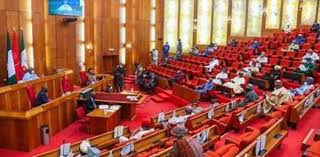
The Senate on Thursday approved President Bola Tinubu’s request for a fresh $516.33m external loan, triggering a wave of intense debate across political, economic, and civil society spaces over the country’s rising debt burden and the transparency of large-scale infrastructure financing.
The approval, which followed an expedited legislative process led by Senate President Godswill Akpabio, is aimed at funding critical segments of the ambitious Sokoto–Badagry Superhighway—a flagship project under the administration’s Renewed Hope Agenda.
While lawmakers backing the move described it as a necessary step toward economic transformation, critics argue it reflects a troubling pattern of unchecked borrowing with insufficient accountability.
The Senate’s decision came after it considered the president’s formal request seeking legislative backing for the loan facility, in line with provisions of the Debt Management Office Act.
The approved financing package, arranged through Deutsche Bank, will fund Sections 1, 1A, and 1B of the proposed superhighway, which spans approximately 1,000 kilometres from Illela in Sokoto State to Badagry in Lagos State.
The highway is expected to traverse Kebbi, Niger, Kwara, Oyo, and Ogun states, forming what government officials describe as a strategic economic corridor linking the North-West to the South-West.
According to details presented to lawmakers, the loan has a 9-year term, including a 3-year grace period, with interest pegged to the Secured Overnight Financing Rate (SOFR) plus 5.3 per cent annually.
It is also backed by a partial risk guarantee from the Islamic Corporation for the Insurance of Investment and Export Credit.
The Federal Government is expected to provide counterpart funding of N265.54 billion to cover land acquisition, compensation, and supporting infrastructure.
*Senate justifies fast-tracked approval
Defending the Senate’s swift approval, Akpabio described the project as “an economic game changer” capable of unlocking productivity, saving lives, and strengthening national cohesion.
“Borrowing for critical infrastructure is not a liability when it is tied to measurable economic returns,” he argued during plenary, adding that the highway would significantly enhance Nigeria’s capacity to generate revenue and repay its obligations.
Similarly, Senator Adamu Aliero threw his weight behind the project, noting that it had remained on the drawing board for decades.
“This is not just a road—it is a long-overdue national investment,” he said, adding that parts of the highway were already under construction using reinforced concrete and solar-powered lighting systems.
He further claimed that the project could reduce travel time between Sokoto and Lagos from about 13 hours to roughly six, describing the potential impact on trade and logistics as “transformational.”
In his communication to the Senate, Tinubu framed the project as a cornerstone of national development, emphasising its potential to boost trade, reduce transportation costs, improve road safety, and strengthen food security.
“The project will connect production centres to markets and ports, facilitating the movement of goods and people while promoting national integration,” the president stated.
He also highlighted provisions for future rail integration and utility corridors, suggesting that the highway could serve as a multi-modal infrastructure backbone for decades to come.
*Atiku, opposition figures fault borrowing plan
Despite the Senate’s endorsement, the loan approval has drawn strong criticism from opposition figures, led by former vice president, Atiku Abubakar.
In a statement yesterday, Atiku warned that the move raises “profound questions about prudence and accountability,” especially given Nigeria’s already high debt profile.
“At a time when Nigeria is groaning under unsustainable debt, resorting to another foreign loan without transparent terms and a credible repayment framework is deeply concerning,” he said.
He stressed that while infrastructure development is essential, it must not come at the cost of fiscal responsibility.
“Nigeria must build, but must not borrow blindly. Development must not become a euphemism for deepening debt traps,” Atiku added.
The former vice president also referenced past controversies surrounding infrastructure contracts, cautioning against opaque procurement processes and urging strict adherence to due process.
*Civil society groups accuse the Senate of rubber-stamping
Civil society organisations have been even more scathing in their assessment, accusing the National Assembly of failing in its constitutional oversight duty.
Eze Onyekpere, lead director of the Centre for Social Justice, described the current Senate as lacking independence and accountability.
“The legislature has become an appendage of the executive instead of serving as a check on excesses,” he said, questioning whether proper scrutiny was applied before approving the loan.
He argued that key sectors such as education, health, security, and power—areas with direct impact on citizens—remain underfunded, raising doubts about the prioritisation of large-scale borrowing for infrastructure.
“Loans must be based on necessity, transparency, and clear repayment plans. These are the questions lawmakers should be asking,” Onyekpere insisted.
*Economists warn of long-term risks
Adding to the criticism, renowned economist Prof Sheriffdeen Tella expressed concern over Nigeria’s growing debt burden and the sustainability of its borrowing strategy.
“I am worried that many of these loans are not properly scrutinised and could end up being mismanaged or inflated,” he said.
He questioned why the government continues to rely heavily on external borrowing despite claims of improved revenue performance.
“Does it mean Nigeria can no longer execute projects without foreign loans? What exactly is wrong with our fiscal management?” he asked.
Tella also warned that future generations could bear the consequences of what he described as a “borrowing spree.”
Public reaction to the loan approval has been sharply divided, reflecting broader national anxieties about development priorities and fiscal discipline.
Hajiya Fatima Maimamri, a veteran broadcaster, welcomed the project, describing it as a long-awaited initiative that could transform economic connectivity.
“This is not just a road—it is a bridge between regions, markets, and opportunities,” she said, noting that the idea dates back to the 1980s.
She argued that the highway could help revitalise economically challenged regions, particularly in the North, where insecurity has hampered development.
However, civil society activist Boniface Kassam expressed caution, warning that the project could have unintended consequences.
“While the economic benefits are clear, we must also consider security risks and the cost implications,” he said.
He questioned the feasibility of repaying the loan and warned that political considerations should not drive infrastructure development.
Other critics, including development expert Okon Edet, dismissed the project as politically motivated.
“This is another grand project that may never be fully realised,” he said, drawing parallels with other incomplete or controversial infrastructure initiatives.
He expressed concern that certain regions could be prioritised while others remain neglected, citing the long-standing issues surrounding the East-West Road.
“Loan after loan, and yet we see little accountability. It is future generations that will pay the price,” he added.
*Supporters defend project as economic catalyst
Despite the backlash, supporters of the loan insist that the project represents a bold step toward economic revitalisation.
Paul Johnson Afegase, an APC chieftain, praised both Tinubu and the Senate for what he described as decisive leadership.
“The economic potential of this highway cannot be overstated. It will drive trade, create jobs, and attract investment,” he said.
Afegase argued that infrastructure of this scale requires significant capital and that borrowing is justified if it delivers long-term benefits.
“This is a lifetime project that will benefit generations,” he added.