By Babs Oyetoro
The Federal Government has stepped up diplomatic efforts to protect Nigerians affected by the escalating anti-migrant campaign in South Africa, demanding justice for citizens forced to abandon businesses and properties as another 271 evacuees returned to the country on Tuesday.
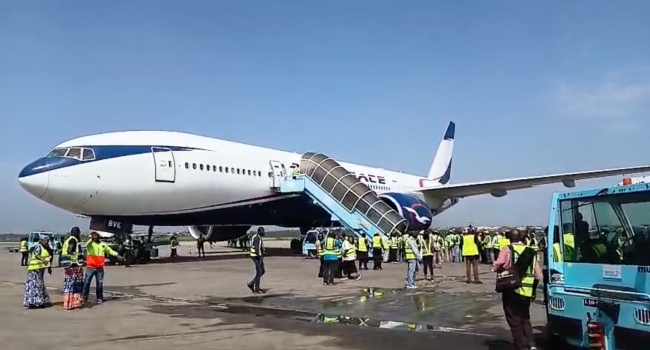
The latest returnees arrived at the Murtala Muhammed International Airport, Lagos, aboard an Air Peace flight under the Federal Government’s voluntary evacuation programme, as anti-immigrant protests swept major South African cities following an ultimatum issued by groups demanding that undocumented foreign nationals leave the country.
The returnees are among Nigerians who opted to leave South Africa ahead of the latest wave of demonstrations, which have heightened fears of attacks on foreign nationals.
As the evacuation continues, the Federal Government has shifted its focus to securing compensation for Nigerians who left behind businesses, vehicles, and other valuable assets during the unrest.
Acting Nigerian High Commissioner to South Africa, Alexander Ajayi, said Abuja had commenced documentation of abandoned businesses and properties as part of plans to engage the South African government on compensation.
According to him, the evacuation exercise goes beyond bringing stranded Nigerians home, and the government will pursue justice for citizens who lost investments built over many years.
“This repatriation will not end with simply bringing our people back to Nigeria. We have directed those returning to accurately document the businesses, vehicles, shops and other movable and immovable properties they are leaving behind so that we can formally engage the South African government on possible compensation,” Ajayi said during an appearance on Channels Television’s The Morning Brief.
He disclosed that discussions had already begun with South African officials, including the country’s Deputy Minister of Finance, on the next phase of the process.
“We will not allow the labour and investments our people have built over the years to simply go down the drain or be taken over by others. Once the documentation is completed, we will work with the South African authorities to verify the properties and seek appropriate redress,” he added.
Ajayi also rejected claims that most Nigerians caught in the crisis were undocumented migrants, insisting that they entered South Africa legally but became victims of prolonged delays in the renewal of their immigration documents.
He blamed the situation on administrative backlogs at South Africa’s Department of Home Affairs rather than any violation of immigration laws by Nigerian nationals.
“It is incorrect to describe most of them as undocumented. They entered South Africa legally but got trapped in years of delays while trying to renew their immigration papers. That administrative failure should not be used against them,” he said.
Tuesday’s evacuation coincided with nationwide anti-migrant protests across Johannesburg, Durban and Cape Town, where thousands of demonstrators demanded the removal of undocumented foreigners.
Commercial activities were disrupted in parts of Johannesburg as many businesses remained shut while heavily armed police officers patrolled the streets to prevent violence.
In Durban, protesters dressed in traditional Zulu attire marched through the city carrying sticks, shields and spears while chanting “Abahambe”—meaning “Let them go.”
The demonstrations, organised by a coalition of small political parties and citizen-led vigilante groups, followed an unofficial June 30 deadline issued for undocumented migrants to leave South Africa.
There were isolated incidents of looting, stone-throwing and confrontations in some areas, particularly around Johannesburg, where police escorted foreign nationals away from angry protesters.
Officials of the National Emergency Management Agency (NEMA), the Nigeria Immigration Service (NIS), and the Nigerians in Diaspora Commission (NiDCOM) received the latest batch of evacuees upon their arrival in Lagos.
President Bola Tinubu approved the ongoing evacuation programme after rising tensions prompted hundreds of Nigerians to indicate their willingness to return home voluntarily.
Earlier this month, the Ministry of Foreign Affairs announced that five Air Peace evacuation flights had been approved after more than 500 Nigerians registered for repatriation.
Before Tuesday’s operation, 328 Nigerians had already been evacuated in two batches—262 on June 11 and 66 on June 25.
With the arrival of the latest batch, the total number of Nigerians evacuated under the exercise has risen to 599.
The Federal Government said evacuation flights would continue for all registered Nigerians willing to return home, while diplomatic engagements with Pretoria intensify to ensure that affected citizens receive justice and appropriate compensation for their losses.
The latest developments have heightened diplomatic concern over the safety of Nigerians in South Africa, even as anti-immigrant sentiments continue to dominate public discourse in Africa’s most industrialised nation.