Don’t grant amnesty to criminals Bishop Obinna tells FG

How is the Catholic Archdiocese of Owerri coping with the second wave of COVID-19 pandemic?
Well, we do not know where to draw the line between the first wave and the second wave, the only thing we realise is that people are now observing the COVID-19 measures a little more strictly than at first.
We had a panicky approach initially because of global anxiety about the pandemic which led to the temporary closure of churches but that closure lasted for only three or four weeks and we’ve gone back to celebrating Holy Mass normally and we continue to receive Holy Communion on the tongue as we have been doing.
Here we are observing the directives quite well. Only a few days ago, there was an update on the Owerri Archdiocesan directives in view of Lent and Easter celebration. We are taking the matter seriously. For example the number one directive is a repeat of an earlier one, because initially, we were not emphasising the wearing of face masks; we were emphasising more of social distancing.
I can say we have kind of upgraded our attention towards this matter by the measures that we are taking. And today at the celebration of Mass, we insisted that people should sit only in threes on the long pews and two on the shorter pews. So all in all, we can say that we are doing quite well in terms of respecting the COVID-19 directives in the church but not outside, in the market, it is a different world.
What is the rate of death of Catholics resulting from COVID-19 within the Archdiocese, is it high?
But I hear that even when a person dies of COVID-19, there is a way of packaging and the person can still be brought to the church and that happened recently. A religious died in another state, not Imo. She died from COVID-19 in Lagos and she was well packaged and the remains were brought into the church but not opened for viewing by people. So we have only had apparently one clear case of COVID-19 death among us that I have been closely involved in. Within the lay people we haven’t had much really.
Last December, gunmen abducted the Auxiliary Bishop of Owerri Catholic Archdiocese, Most Rev. Moses Chikwe. Although he was rescued five days later, the abduction, no doubt, caused a stir in the polity. What is your take on the current dreadful security situation in the country? How do you think it can be resolved?
First of all, the fact that the bishop was kidnapped was big news because the bishops in our country have not been generally kidnapped but priests have been kidnapped, so the addition of the bishop to it means that nobody is being respected whether bishop or priest. Reverend sisters have been kidnapped too, so it is a signal to us in the country that really nobody is safe.
Why did the leaders at the time disregard the Aburi Accord worked out in Ghana that was meant to bring about peace among Nigerians sometime in 1967 shortly before the war broke out the same year? The failure to implement that accord led Nigeria to the brink of war.
The actual war took place between Nigeria and Biafra and lasted for three years. And with that violence was officially commissioned into Nigeria and since that time violence has not left us. Even when Gen. Yakubu Gowon declared at the end, ‘no victor, no vanquished’, that there will be reconciliation, rehabilitation, reconstruction, all we have seen is more and more of discrimination, hatred, killing, nepotism and all kinds of ethnophobic and ethnocentric pressures in the land. So things have not just fallen apart but have fallen to pieces because of what Chinua Achebe called the failure of the leadership. Both the military and civilians have failed us so our help is in name of the Lord who made heaven and earth; that is where we are.
Violence is on the ascendancy in Nigeria and you can experience it anywhere and in every part of the country. I can’t travel easily now, well, maybe I can travel more within Igbo land but then one is not sure if the kidnap will take place even in my own locality so, that is where we are.
The conflict between the herdsmen and farmers has continued to persist with increasing loss of lives and property. What do you think are the causes and the social, religious and political effects on community and national development? Please make recommendations on resolution of this issue that has become a threat to peace and safety in our communities?
We are back to a fundamental reason, there is no sense of united purpose in Nigeria. There is more of mutual hatred of one another because the leadership has allowed hatred to become a national pastime. The leaders go to the National Assembly or the House of Representatives, they get their money, they fight a few times but they are not really concerned with administering this country with any sense of common purpose for the good of all.
Yes, we need the cattle, we need the milk but then is it at the expense of the crops, the yams, the vegetables that are planted?
We need the herders, we need the farmers but then it requires more respectable handling of their needs and their concerns without allowing them, particularly allowing the herders to create a situation of rampage. They feel that anywhere they see food whether they cultivated it or not that the cattle has priority over the farmer. That is the problem. Nigeria is a problem to itself.
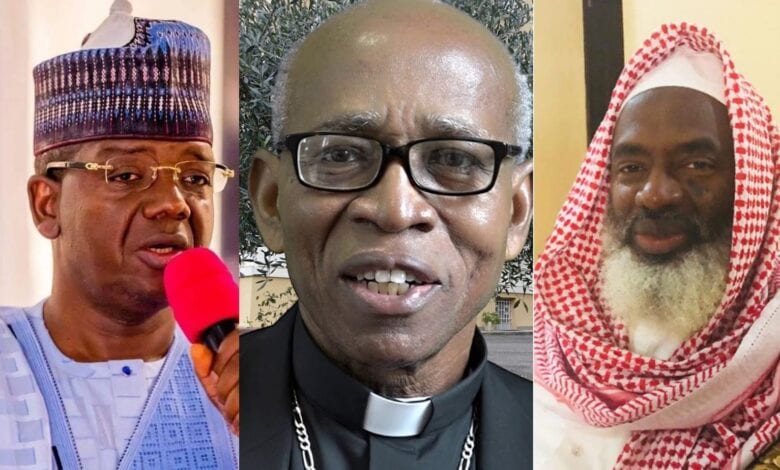
Recently, Zamfara State Governor, Bello Matawalle, said negotiating with bandits had significantly reduced the frequency of their bloody attacks in the state. Islamic Scholar Sheikh Ahmad Gumi visited some bandits in Zamfara forests and declared that negotiating with bandits was the best thing that would happen to this country. Wouldn’t such negotiations fuel more banditry? What is your advice to government in addressing this?
You don’t make friends with evil, you don’t legitimize evil because evil will only have more room for rampage. Evil is to be restrained, good is to be promoted. You don’t go to congratulate bandits, negotiate with them, you are legitimizing evil.
Take Saul, Saul was a criminal, he was a murderer, he converted and we can see the positive fruit of his conversion. Over the years, up till today we read of St. Paul because there was a radical transformation.
We will like you to recommend some solutions on how the banditry issues can be resolved in Nigeria.
In the past, we used to talk about reformatory, there were reformatories in the past in Nigeria apart from prisons, created with a view to spiritual, social, mental, professional reorientation and equipment. These are the things that would help the bandits but treating them with kid gloves would only postpone the day for further rampage.
I believe that reformatory should be re-established where these bandits can be trained into more useful citizens with the military and the police if they are honest and patriotic guiding them until they are able to be responsible citizens again.
Some Nigerians see the controversial Water Resources Bill as an attempt to reintroduce the rejected RUGA policy. What do you think?
Since Nigeria operates on a deceptive note as official policy, people are bound to see all these attempts to establish riverine routes for cattle or what you call RUGA settlements, as attempts to appropriate water courses, water zones that belong legitimately to other people who need the water either for their livelihood or their farms or for other reasons. So it has been proposed that the cattle needs water, they need vegetable but there is a modern way in which the cattle are treated.
This is from where we draw our inspiration. We don’t draw our inspiration from Nigeria, Nigeria doesn’t give you reason to be proud of it, but we are ready to serve Nigeria and Nigerians like I do here. I do whatever I do for the good of Nigeria not because of Nigeria but because God has placed me here to help the people located in this geographical place.
President Muhammadu Buhari’s nomination of the immediate past service chiefs for ambassadorial appointment has attracted a huge debate with majority alleging that their nomination is a plot by the Presidency and APC to shield them from investigation over the alleged crimes against humanity? What is your take?
Well, talking about Nigeria whose system of appointment has been flawed in many ways because of nepotism or because of certain sectional advantages, appointing these service chiefs raises questions. Are there no other persons who are qualified to do this service? Must it be these ex-service chiefs who have already played their parts for better or for worse in Nigeria?