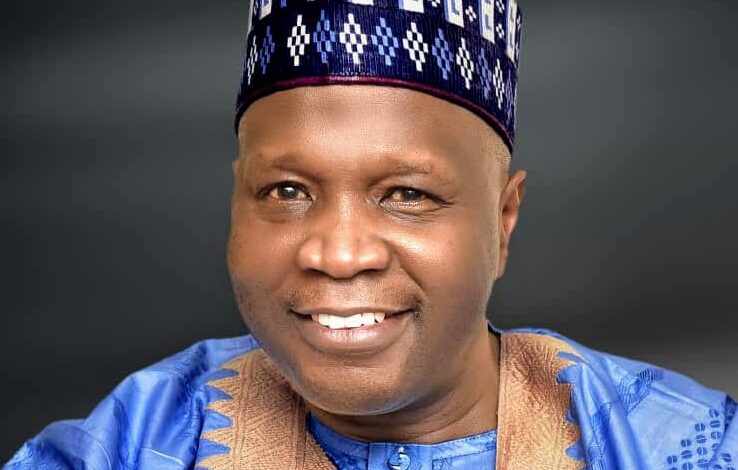
Gov. Inuwa Yahaya of Gombe says the state had made a case for an upward review of statutory allocations to States and Local governments in the country to enable them to meet the ever-expanding challenges of social-economic human and infrastructural development.
He stated this on Tuesday, in Gombe, while flagging off a nationwide sensitization on the Review of Existing Revenue Allocation Formula, by the Revenue Mobilization Allocation and Fiscal Commission (RMAFC).
The Governor explained that as the sole revenue allocation agency, RMAFC was charged with the periodic review of Nigeria’s revenue allocation formula, in line with current realities.
“The last time such review was successfully conducted was in 1992, some 29 years ago.
“ Since then, a lot of changes have taken place across our social, political, and economic spheres, thus, necessitating a review, in order to ensure a fairer and more equitable allocation formula that is compatible with our current realities.
He further said: “ I understand that this first phase of the review will focus on the vertical allocation; that is, how revenue is shared among the three tiers of government (FG, States, and LGAs).
“In the existing formula, all the 36 states only collect a paltry of 26.72% while our 774 LGAs collect 20.60% of all the accruals from the federation account, leaving the Federal Government with a lion share of 52.8% over the past decades.
According to him, governments had expanded while their revenue allocation had remained the same, states have been forced to deal with emerging challenges like insecurity, environmental degradation, decaying infrastructure, inadequate funding for primary healthcare and basic education.
“As the roles of states keep expanding, there’s the need for a proper review of the allocation formula to ensure they get the required resources, to be able to deliver on new and existing responsibilities”, the governor said.
He revealed that the race for fiscal efficiency in Gombe state began as soon as he took over the mantle of leadership, stressing that having inherited a state in dire financial straits, fiscal discipline became the mantra of his administration.
“We ensured the robust implementation of the Treasury Single Account, deployed technology-driven tools to eliminate absenteeism.
“ Redundancies and inefficiencies within the civil service and ensure transparency in government business through the more robust implementation of key metrics under the State Fiscal Transparency, Accountability and Sustainability (SFTAS) Initiative.
”As a result of that, we were able to save many of our local governments from financial collapse, enabling them to meet their financial obligations”, he said.
Yahay said the revenue mobilization drive also received a huge boost, as the State had surpassed previous years’ records achieved through sustained engagement and trust-building between government and various economic stakeholders.
The governor also observed that the State was among those at bottom of the federal allocation ladder, but the fact that his administration was able to achieve far more than even the richest states attested to its remarkable level of financial efficiency and prudence.
He expressed optimism that the outcome of the sensitization across the country would lead to a fairer and more equitable revenue allocation formula for the country, one that is compatible with the prevailing economic, social and economic realities.
Alh. Kabiru Kukandaka, Commissioner representing Gombe State on the RMAFC, said the objective of the sensitization was to enlighten stakeholders on the need to participate and make relevant contributions to the review process in order to assist the commission come up with a fair, just, equitable and acceptable revenue formula for the country.
He said as a constitutional mandate, the RMAFC was saddled with the responsibility of periodically reviewing the revenue allocation formula and principles in operation, to ensure conformity with changing realities.
“In 1992 the vertical share of revenue to be allocated to the three tiers of government as proposed by the RMAFC was as follows: Federal Government 48.5 percent, States 24.0, Local Governments 20.0 percent, stabilization 0.5, derivation 1 percent FCT 1 percent, development of mineral resource areas 3 percent and ecology 2 percent,” he said
Lagos Exams Support: Ibijoke Sanwo-Olu presnts bank drafts to 90 beneficiaries of 2021 edition
He said in spite of the upward review of the vertical formula by the Obasanjo administration to meet with current realities, the horizontal sharing formula which takes care of States and Local Government Areas in the country was anchored on equality, population, landmass, social development factors, and Internally Generated Revenue IGR.
Kukandaka said in 2014 the RMAFC reviewed the sharing formula, but its final report submitted to the President for action was yet to see the light of the day, expressing the hope that this exercise will produce the desired results.