By Anthony Otaru, Abuja
Six men accused of plotting to overthrow President Bola Ahmed Tinubu were on Wednesday arraigned before the Federal High Court in Abuja, where they pleaded not guilty and were ordered remanded in the custody of the Department of State Services (DSS) pending trial.
The defendants were brought before Justice Joyce Abdulmalik on a 13-count charge bordering on treason, terrorism, and terrorism financing, in a case prosecutors say exposes a coordinated attempt to undermine Nigeria’s constitutional order.
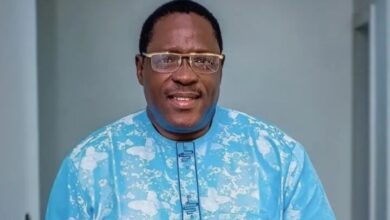
Listed in the charge but absent in court was former Minister of Petroleum, Timipre Sylva, who is believed to be at large.
The prosecution, led by the Attorney-General of the Federation and Minister of Justice, Lateef Fagbemi, opened proceedings by outlining the gravity of the allegations, insisting on the need for swift judicial action.
Among those docked was retired Major General Ibrahim Gana, who appeared in a wheelchair, alongside other defendants, including a retired naval captain, a police inspector, and several civilians accused of links to the plot.
Proceedings were briefly stalled after counsel to Sheikh Abdulkadir Sanni informed the court that his client “understands only Hausa and Arabic,” prompting the court to provide an interpreter before the charges could be read.
When the charges were eventually taken, all six defendants pleaded not guilty.
Following the plea, Fagbemi urged the court to remand the accused into DSS custody and to fast-track the trial, stressing the case’s sensitivity.
“I am glad we are all on the same page regarding speedy trial,” he said, while also assuring the court that “the right of counsel to access their clients will not be denied.”
Counsel to the first defendant, Mohammed Ndayako, had earlier sought unhindered access to the accused persons, arguing that such access was essential to prepare their defence adequately.
Ruling on the applications, Justice Abdulmalik ordered that the defendants be remanded in DSS custody and directed that the trial proceed on an accelerated basis. The matter was adjourned to April 27.
According to the charge, filed by the Office of the Attorney-General and signed by Director of Public Prosecutions, Rotimi Oyedepo (SAN), the defendants allegedly conspired in 2025 “to levy war against the state to overpower the President of the Federal Republic of Nigeria.”
They were further accused of having prior knowledge of a planned coup involving one Colonel Mohammed Alhassan Ma’aji and others, but “failed to disclose such information to relevant authorities,” as required by law.
Prosecutors also alleged that the defendants “did not take reasonable steps to prevent the commission of the offence,” and were involved in acts linked to terrorism under the Terrorism (Prevention and Prohibition) Act, 2022.
Two of the accused—Inspector Ahmed Ibrahim and Zekeri Umoru—were specifically alleged to have attended meetings connected to the plot “to advance a political ideology capable of destabilising Nigeria’s constitutional order.”
The charge sheet further claimed that the defendants “knowingly and indirectly rendered support” to terrorist activities and suppressed intelligence that could have foiled the alleged plan. Some were also linked to funds suspected of being tied to terrorism financing.
The case adds a judicial dimension to earlier security concerns that surfaced in late 2025, when speculation over a possible coup attempt followed the abrupt cancellation of Nigeria’s 65th Independence Day parade.
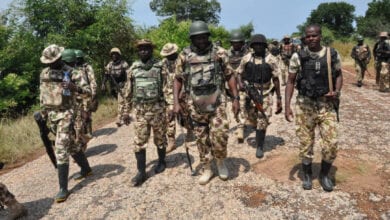
Although the Defence Headquarters initially dismissed those reports, it later confirmed in January 2026 that a plot to overthrow the government had been uncovered, with several military personnel detained for their alleged roles.
As the trial opens, attention is expected to focus not only on the fate of the defendants but also on the broader implications for Nigeria’s security architecture and civil-military relations.