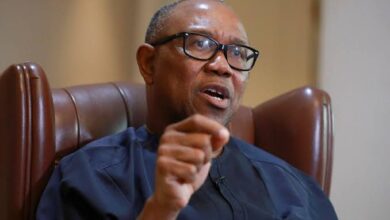
Amidst ineptitude, Nigerian leaders don’t resign – Ajobena, security expert


A security expert, Flight Lt. Terry Ajobena (retd.), speaks in this interview with DEBORAH ONYOFUFEKE on the challenges of insecurity and other safekeeping issues.
With the heightened insecurity situation in the country and the fear of not being safe, especially on Nigerian roads, how can the Federal Government tackle this?
A lot needs to be done. Firstly, the Federal Government needs to demonstrate that it has the will to go after these criminals and terrorists. Many are beginning to question the government’s sincerity in addressing this problem. Next, the current strategy needs to be reviewed because it is not working. The Armed Forces are supposed to be our last line of defence, but what we have now is the Army being called in to do what the Police and the DSS are supposed to do. Yes, the military trains for Internal Security (IS) situations but that should ideally be the last resort and even at that, it must still be with the collaboration of other law enforcement agencies. The police, the DSS, and other law enforcement agencies need to step up their constitutional responsibilities. The intelligence community should do their bit while the response elements do theirs. Also, the populace needs to be co-opted into the fight- this is the real community policing we all clamour for. There is a lot they can do beyond the vigilante, civilian JTF approach which is good. I know our military, particularly, is not lacking in capacity. They are well-trained and have been known to excel even in foreign countries and missions. So, it leaves many of us puzzled and embarrassed when we see them being trounced like this. The current task forces set up to deal with some of these crises appear to be very military-centric, particularly Army heavy. Other critical stakeholders are absent leaving gaps in the operational failures we seem to be recording. This is my theory as an observer anyway. The other thing, when the Mr President issued mandates to the leadership of our security forces, they should be followed through even if it means firing or relieving some of these commanders of their duties. These are just a few things I see that need to be done.
The Kuje jailbreak and the attack on the presidential guards as well as the incessant kidnappings in the country may have indicted the Nigerian intelligence service, what do you think is happening?
For someone who has had experience working in intelligence circles, I won’t be quick to say they are incompetent. For instance, I read somewhere that the DSS issued several alerts on the Kuje jailbreak. If true, then we cannot dismiss them as being incompetent. As I alluded to earlier, it is one thing to get the intelligence, but another thing for those who are to act on it to do so. The intelligence services or agencies are limited in the interventions they can make. It is the relevant security forces with statutory mandates that are now supposed to take the necessary measures. There is a lot that goes on at that level that you and I are not privy to. We are all victims to a great extent. Notwithstanding, someone or some people have been dropping the ball with such unacceptable frequency. I think Mr President should be able to shake things up to get the concerned security agencies to sit up.
Obaseki’s defection to PDP caused crisis in the party – Urhoghide
Do you agree that heads should have rolled after the Kuje jailbreak or that the NSA should have been sacked for the death and the attack on the presidential guards?
It used to be in those days that when the rainmaker failed to stop the rain on the day the gods were to be celebrated, his head would be demanded by the king. Yes, heads ought to have rolled; that is what I expected from the Commander-in-Chief. When you have major failings like the jailbreak, train, and church attacks, you, would have heads lined up on the chopping block and not reward them with another minute, talk less of months- in office. It is partly why a lot of Nigerians hold this common notion that the leadership is uncaring or even complicit in the goings-on. They have lost trust in the government’s endless affirmations of their protection. However, I expected to see some resignations. This is where I will not pull any punches. Generally, our people, not just leaders, have this entrenched sit-tight culture wherein they insist on holding on to power even when their poor performance makes their position untenable. It does not matter to them that their failure in office has cost the lives and livelihood of innocent people, children, families, citizens, or comrades in battle; it is shameful. If we lived in a society where honour was esteemed and men were held accountable for their ineptitude, the chief executives of the police, Correctional Services, and those directly tasked to oversee the security of that facility and its environs, even the Minister for Interior, should have tendered their resignations. Such nobility and virtue are not a staple of our people. Sad.
Do you think there’s an explanation to why a BBC journalist can find his way to Zamfara forest and have an interview with the bandits’ lord (head of the bandits) and the Nigerian security personnel are unable to find their hideout or rescue the Abuja-Kaduna train victims who have been at the mercy of their abductors for over four months now?
That interview embarrassed the government for the very reasons your question suggests. What possible excuse could any right-thinking government have for not locating such an enemy and taking the battle to their doorstep after such a revelation? That said, I doubt that our law enforcement agencies lack knowledge of the whereabouts of these guys. Even the Presidency has said this much that they know their locations but are constrained to strike due to the possible collateral losses that such actions may incur. You know, the proverbial fly that perched on a man’s scrotum. Regardless, I think there are options we are not exploring or are unwilling to consider. For example, I am aware that all our three armed services have trained special operations personnel who train for these types of scenarios. Some of these elite forces have received training outside our shores and are equally equipped for such interventions. Why can’t we use them? There are other out-of-the-box interventions we can consider to both rescues the victims and possibly take out these bandit and terror cells. If you and your child go to the farm to fetch water and you see a crocodile stealthily grab hold of that child, you do not fold your arms helplessly, you do what you must do to rescue that child. But beyond all of this, what are the preventive measures we can take to protect our citizens and stop these attacks? This to me is my challenge because you and I could very well be the next victim of these animals.
At this point, do you think Nigeria needs to seek the help of other developed nations to tackle the insecurity in the country?
There is something called national pride which would typically constrain any sovereign state to go begging for assistance to tackle internal matters of insecurity. However, there are ways we can persuade and co-opt our neighbours and allies to help us in this fight. In the North East, we have the multi-national collaborative initiative which was intended to encircle the insurgents and suffocate them to submission. It has had its successes even though our neighbours have not shown the same level of commitment to the pact. That is one option. The previous government resorted to hiring special private security companies/experts (we don’t like to use the word mercenaries) who in the brief time they spent were very effective in the North-East. I am personally not averse to such extraordinary measures and approaches. Whichever way, there are long-term consequences to seeking any foreign assistance of the sort you are suggesting. We must weigh the options and do what is ultimately in our country’s interest. My worry now is I am not seeing that protective instinct that will cause a mother hen to fight off any animal that threatens her chick in this government. The government should not be shy to do everything in its power to bring this insecurity to an end, even if that means
Obaseki’s defection to PDP caused crisis in the party – Urhoghide
Do you agree that state or community police is what Nigeria needs to fight insecurity?
Most people tend to conflate state police with community policing. They are two entirely different things. Community Policing (CP) on one hand is a policing concept centred on communities where the members work together with law enforcement as stakeholders to ensure the security of lives and properties in those communities. It does not concern itself with the structural, administrative, or organizational arrangements wherein the police force is structured. So, you can have federal police like ours adopt the community policing approach (in fact our police force claims to be operating this concept). However, some argue that for CP to be effective, it must draw its mandate and legitimacy from the people (community), which lends credence and makes the case for state police. The idea is that the more the community can influence the charge of the police force the more accountable and effective they are likely to be. Other cases for state police include the rationale of compacting the police along manageable governance and jurisdictional lines.
I support both ideas and have constantly called for a complete reimagining, review, reform, and re-orientation of our police. This model we are running has remained mostly unchanged since colonial times. We are talking over 100 years of doing the same thing over and over and we expect alternative results. In colonial times, the police traditionally focused on defending colonial interests. Today, that same focus has shifted to protecting the society’s elite. Truth is, times are rapidly changing, threats are taking new forms, and political, economic, cultural, and social realities are evolving with such rapidity that we must adapt our policing to not just current threats but future ones as well. We must be dynamic. This shift in the paradigm I am advocating is necessary if we are to actualise our aspirations for a functional policing system.
With your experience as a security expert, what else would you like to add?
In addition to my earlier suggestions, the citizens need to start taking ownership of their security. I am not advocating anarchy, but security cannot be left in the hands of the government, it is everybody’s business. The world over, the popular slogan for law enforcement is to serve and protect. This must be imbibed by all our security forces. This is where training and reorientation come in. They must be properly incentivised and motivated. We must start to plan as a people for situations like this. Having attended elementary school abroad as a child, we were trained on various emergency responses like tornadoes, hurricanes, etc. Today, kids in the US are trained in dealing with lone shooter situations. A culture of security awareness needs to be birthed, nurtured, and sustained. But in all of this and most importantly, we must answer this question of nationhood. A deeply divided nation like ours is less likely to self-heal and more likely to self-destruct. We are lacerating ourselves and if not careful, may die the death of a thousand knife wounds including the self-inflicted ones.
“If we lived in a society where honour was esteemed and men were held accountable for their ineptitude, the chief executives of the police, Correctional Services, and those directly tasked to oversee the security of that facility and its environs, even the Minister for Interior, should have tendered their resignations