By Cajetan Mmuta, Awka
The Anambra State Government says it is losing about ₦8 billion every Monday due to the sit-at-home order imposed by non-state actors, as traders in Onitsha on Tuesday staged protests against Governor Chukwuma Soludo’s directive shutting the primary market for one week.
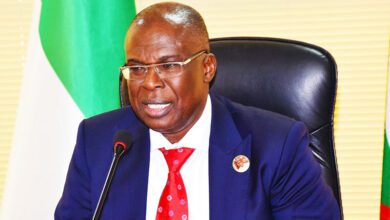
The Commissioner for Information, Dr Law Mefor, disclosed the figure during an interview on Channels Television’s The Morning Brief, describing the sit-at-home as a significant threat to the state’s economy.
“Statistics have it that Anambra is losing an average of ₦8 billion every Monday that markets are shut,” Mefor said. “This is seriously affecting the socio-economic life of the state.”
*Onitsha traders defy Soludo as protests rock Onitsha primary market
His remarks came amid rising tension in the commercial city of Onitsha, where hundreds of traders converged at the Onitsha International Main Market to protest the governor’s order to close the market after traders failed to open their shops on Monday.
The protesters were seen chanting and demanding the immediate reopening of the market, while some pledged allegiance to the Indigenous People of Biafra (IPOB), which enforces the weekly sit-at-home across parts of the South-East.
There were also reports of sporadic gunshots by unidentified persons in the early hours, prompting the deployment of armed anti-riot police and other security agencies to the area.
Addressing the protesters, the Anambra State Police Command assured them that their shops and goods would be protected during the closure period.
Police Public Relations Officer, SP Tochukwu Ikenga, said security had been beefed up to prevent any breakdown of law and order.
“In furtherance of the directive, adequate security has been deployed in and around the market and other strategic locations in Onitsha to maintain law and order,” Ikenga said.
“Traders seen gathered around the market were addressed and sensitised on the need to cooperate with government directives in the interest of public safety, security and economic stability,” he added.
Reacting to the protests, Mefor said the closure was a deliberate policy move aimed at ending what the government described as economic sabotage.
“Those who are opposing this are simply being mischievous. That is why the governor rightly called it economic sabotage,” he said.
He explained that the decision to shut the market was taken by the state government as a whole, not by the governor alone.
“It is not as if the governor just woke up and shut down Onitsha Main Market. This decision is the product of the state’s Executive Council. They met in a retreat two Mondays ago and resolved that the sit-at-home must end,” Mefor said.
According to him, the enforcement would extend beyond Onitsha to other markets across the state.
“All the over 150 markets in Anambra State will be visited. Any market found shut on a Monday will receive the same treatment. It is inevitable for now,” he said.
Mefor also noted that the sit-at-home order was officially abolished four years ago, but compliance remains weak.
“If you calculate 56 Mondays in a year, multiply by four years and then by ₦8 billion, what we have lost is in excess of a trillion naira. This has to stop,” he said.
Governor Soludo has also dismissed threats by IPOB to resist the closure, insisting that the Onitsha Main Market belongs to the Anambra State Government.
“We tried dialogue. We had several meetings with market leaders, and they kept making promises but failed to keep them. Government had to take a firm decision,” Mefor said.
“Onitsha Main Market is government property, and it is good that we start with our own before moving to other markets,” he added.
The state government said the market would reopen on Monday, but warned that sanctions would be imposed on traders who fail to resume business.
“When the market reopens, we have put mechanisms in place to monitor those who do not open their shops,” Mefor said.
Meanwhile, the Igbo Community in the Federal Capital Territory (FCT) commended Soludo for confronting economic sabotage but urged caution, warning that prolonged closure could escalate tension.
“The people want their markets back; they belong to them,” the group said in a statement, calling on the governor to temper firmness with dialogue.
Similarly, the Association of Non-Indigenes in Anambra State advised its members to remain law-abiding and avoid protests that could disrupt peace.
“Anyone who defies government directives will face the full consequences of the law,” said its President, Prince Chigozie Nweke.
He urged non-indigenes to engage lawfully and avoid actions that could jeopardise peace and security in the state.