

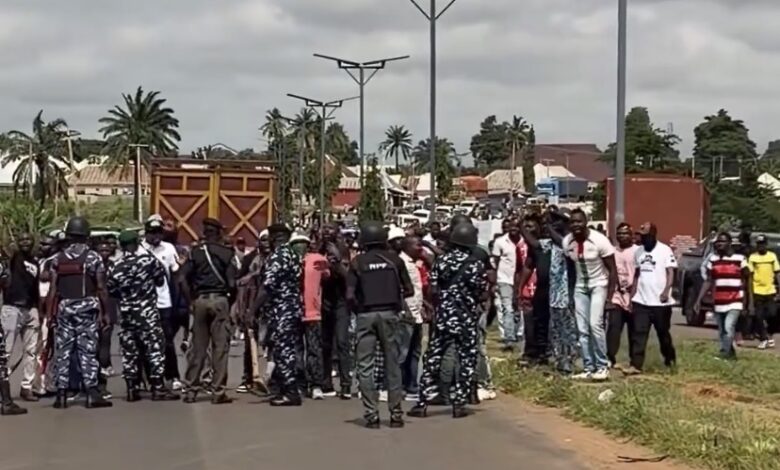
The African Democratic Congress presidential candidate, Atiku Abubakar, and the Minister of Aviation and Aerospace Development, Festus Keyamo, have condemned the disruption of the convoy of the Nigeria Democratic Congress presidential candidate, Peter Obi, during his visit to Benue State.
While Atiku described the incident as “unacceptable, anti-democratic and deeply shameful,” Keyamo also condemned the obstruction but used the incident to challenge what he described as partisan coverage of confrontations involving political candidates.
Obi’s convoy was reportedly stopped on Tuesday by suspected thugs while he was on his way to Yelwata, where he had planned to visit families affected by the deadly attacks in the community.
In a statement issued on Wednesday by his campaign spokesperson, Kenneth Okonkwo, Atiku said Obi was prevented from reaching bereaved families whom he intended to visit to express his condolences over the attacks.
Atiku called for an urgent investigation into the incident and prosecution of those found responsible, while urging security agencies to ensure that political leaders are able to move freely and carry out their lawful activities without intimidation.
“HE Atiku Abubakar strongly condemns the violent attack on Peter Obi, who was brutally prevented from reaching bereaved families of Yelwata, Benue State, to offer his condolences over the persistent terrorist attacks on them,” Okonkwo said.
He added, “Such acts are unacceptable, anti-democratic, and deeply shameful.”
The former Vice President further urged the authorities to “investigate urgently, hold those responsible accountable, and ensure the safety and freedom of all leaders to carry out their duties without intimidation.”
Keyamo, in a statement posted on X on Wednesday, condemned the incident while calling for what he described as consistency in the manner the media reports confrontations involving political candidates.
The APC chieftain said reports that angry protesters prevented Obi from reaching the venue of his visit should be condemned, regardless of the circumstances surrounding the incident.
He said the confrontation should not be accepted as part of democratic politics, whether it resulted from what the Benue State Government described as internal disagreements within the NDC or from alleged sponsorship by rival political interests.
“Whether the protest was as a result of internal squabbles within the NDC (as posited by the Benue State Government) or sponsored by the APC or any other rival party, this should not be part of our democracy,” Keyamo said.
He also rejected the argument that Obi’s planned visit to Yelwata, more than a year after the killings, could justify preventing him from proceeding to the community.
Keyamo said some people had accused Obi of attempting to revive emotions surrounding the killings for political reasons, but stressed that such allegations could not justify interference with his movement.
“That is still not acceptable; everyone should be allowed to move about freely and play their politics without such crude interference,” he said.
The minister, however, shifted attention to the media’s treatment of similar incidents involving candidates of the ruling All Progressives Congress and opposition parties.
According to him, confrontations involving APC candidates are sometimes reported by what he called the “partisan Press” as evidence of public rejection, while similar incidents involving opposition politicians are described as attacks allegedly carried out by sponsored thugs or hoodlums.
“Many a time when an angry crowd confronts or molests an APC candidate at any level, the partisan Press shamelessly dubs or spins it as ‘rejection’ by ‘Nigerians’. When it concerns the opposition, then it is ‘attack’ by ‘sponsored thugs’ or ‘hoodlums’,” he said.
Keyamo also criticised political actors whom he said openly encouraged hostility towards APC candidates in certain parts of the country, arguing that such statements should attract the same scrutiny as acts of violence against opposition politicians.
He called on the media to avoid partisanship in its reporting of political confrontations and urged political actors and their supporters to channel their grievances through lawful democratic processes.
“Whoever is angry at any candidate of any political party should display the anger with the ballot paper on voting day by a simple thumbprint, not by violent acts during campaigns,” he said.


