By Taiye Agbaje
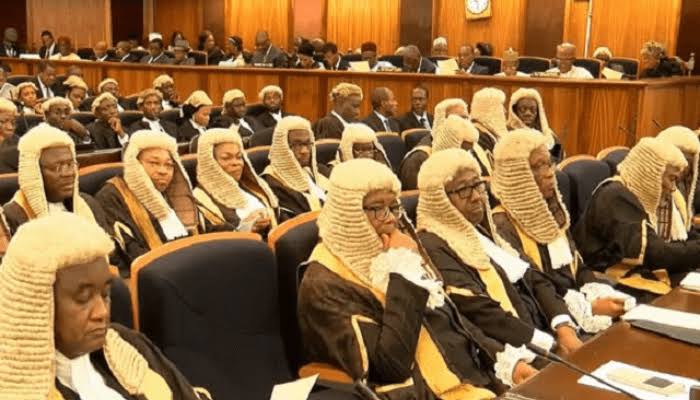
The Coordinator of the Rule of Law Development Foundation, Mr Joseph Daudu (SAN), yesterday disagreed with critics of the Minister of Federal Capital Territory, Nyesom Wike, over the construction of houses for judges in Abuja.
Daudu, the Coordinator of the Rule of Law Development Foundation, made this known at the opening of the foundation’s 6th Annual Criminal Law Review Conference in Abuja.
The five-day event is titled: Optimising the Administration of Criminal Justice in Nigeria: How to Navigate Emerging and Systemic Challenges of Insecurity and Economic Hardship.
He said the allegation that the renovation of courts and provision of houses for judges amounted to inducement was untrue and only to portray the judiciary in a bad light.
The senior lawyer said the constitution allows the overlap of functions between the three arms of government: the executive, legislature, and judiciary.
“Thus, in the regular democratic system of government, it is not unusual to see the executive exercise legislative powers by making executive orders or exercise judicial powers by making subsidiary legislation to authorise its agencies to impose fines on transgressors of the law.
“Also, as stated above, it is not unusual to find the legislature authorised by the constitution to exercise judicial powers in the course of its oversight functions either by committing members of the public for contempt of the parliament or sitting and conducting hearings, inviting witnesses to testify before it as if it is a court of law.
“The judiciary, on the other hand, also exercises executive and, at times, legislative functions. Judges propound and make law within the body of their judgments. They award contracts within their domestic responsibilities. Many other numerous examples abound.
“One other vital point to note in this matter of the construction of houses for judges within the FCT is that it is not a personal bonanza of the Minister of the FCT but an appropriated project in the budget which received the assent of the President of the Federal Republic of Nigeria.
“Consequently, the way and manner the said critics have been going about it is as if the Minister of the FCT is constructing the buildings out of his purse and in his capacity, which is unfortunate.
“Once this distinction is recognised, it becomes clear that the hallowed office of a judge cannot be corrupted by merely giving them their entitlement or accoutrement of their office,” he said.
According to the lawyer, providing accommodation for judges and/or judicial officers dates back to colonial times.
“We are privy to the knowledge and official records and documentation showing that judges have been provided housing by the executive arm of government since colonial times in the Government Reservation Areas of virtually all our urban centres/cities in Nigeria.
“This practice stopped around 2007 when it became government policy to monetize housing and other perquisites of office under the guise that the government would save more money when it pays rent for housing and buys vehicles for its staff across the three arms of government.
“The judiciary was the first to back out of this arrangement because it soon discovered that withdrawal of accommodation from judges, exceptionally newly appointed judges, exposed them to danger as having to rent accommodation in anyhow areas of the town, which exposed them and their families to grave danger.
“Thus, now that this service is being reinstated by the executive, which is the appropriate agency to carry out such works, some people are losing sight of the big picture and have reduced the matter to one of party politics without considering the overall benefit of the provision of housing by the executive to the safety, independence, and impartiality of the judges in question,” he said.
Daudu said it was time for Nigerians to know that the three arms of government worked in tandem and coordinated.
“They do not work at cross purposes. Thus, the constitution expressly vests the function of submitting budgets, executing laws, and planning for the legislature and the judiciary on the executive arm of government.
“Moreover, judges are sworn on the Holy Books, the Bible, and the Quran to dispense justice without fear, favour, ill-will, or malice to anyone.
“One will be thinking very low of our judicial officers if it is thought that their judicial oaths do not count for anything,” he said.