Controversy as stakeholders differ on more private universities

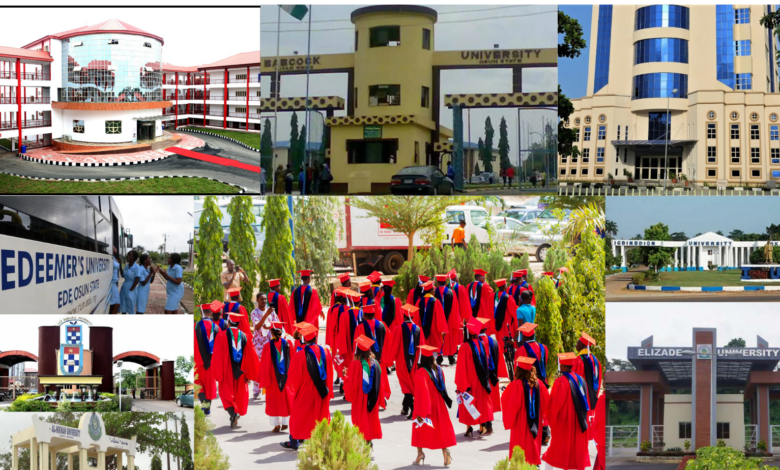
The Federal Government has approved more private universities despite the fact that only a few candidates are seeking admission to such ivory towers, Idu Jude and Niyi Maraiyesa report
Twenty-four-year old Kingsley Igwebuike looked worried as he appraised his life journey so far, the other day. The young man, who has good health and a good West African Senior School Certificate Examination result in his coffer, believes he has yet to attain his best in life. The fact that he has yet to secure admission to the university almost six years after completing post-primary education is more than enough worry occupying his inner recess.
He says, “I am really not happy with what is happening to me in terms of education. Five years after completing my secondary school education, I have yet to gain admission to the university. It is not as if I don’t usually do fairly well in the Unified Tertiary Matriculation Examination but the fact is that I am always denied a place in many of the public universities that I have sought admission to. Of course, this is not because of poor WASSCE result. By the way, I have a good certificate at that level.
“The challenge: it is either that I narrowly missed the cut-off mark in one year or I am totally off the mark in another year. My brother, that has been my fate in trying to secure admission to the University of Nigeria, Nsukka to study medicine. You know UNN like other public universities are very cheap. A poor widow can easily pay the tuition of her children in any of the nation’s public universities. You see, because of the cheapness of tuition in public universities virtually everyone is seeking admission to them.
“The next option for me would have been to seek a place in any of the private universities in the country but I am handicapped. My parents do not have the wherewithal to foot my bill in the private university. So, I am not contemplating going to any such private ivory towers.”
Igwebuike is not alone in the community of youngsters, who are not thinking of seeking admission to the nation’s private universities. In fact, there are hundreds of other Nigerians, who are hungry for higher education but are not considering the private institutions. Reason: tuition in many private universities in the country ranges between N500,000 and N2million annually.
ThisNigeria findings show that despite the challenges facing public universities in terms of academic stability and infrastructure, many candidates still prefer them to the privately-owned ones. For instance, a data obtained from the Joint Admissions and Matriculation Board shows that in 2014, only about 18,667 of the over 1.6 million candidates who applied for the UTME that year sought admission to the nation’s private universities.
This figure shows that over 98 per cent of candidates prefer the public universities to the private ones. Of the 18,667 candidates, the Covenant University, Ota, Ogun State, owned by the Living Faith Church worldwide, had the highest number of applicants with 3, 315 candidates while two other private schools–the Obong University, Obong, Ntak, Akwa Ibom State and the Southwestern University, Okun-Owa, Ogun State, had the least number of applicants with only four candidates seeking placement in each of the institutions.
Yearly, no fewer than 1.5 million candidates sit for UTME considered to be the gateway to the nation’s ivory towers.
It is therefore not surprising that education stakeholders are worried with the Federal Executive Council pronouncement the other day approving 20 more private universities in the country.
With the new schools, the country now has 190 universities. Of this number, 99 of them are privately-owned while 43 belong to the federal government. The other 48 ivory towers belong to the states.
For these stakeholders, how would these private universities cope with challenges as inadequate funding, poor student enrolment as well as infrastructure, among others.
But while some of them hail the private sector initiative, saying that it would greatly help to alter the face of higher education in the country, others frown on it. For the latter school of thought, the federal government has no other intent but to jettison public education.
Appraising the development, the President, Academic Staff Union of Universities, Prof. Biodun Ogunyemi, says the undercurrent of the government move is to deter the poor ones from accessing higher education.
He notes, “The issue is that the government is trying to privatise the universities which ASUU would not allow, because the gap between the rich and the poor will be too wide.
“We have turned ourselves to be the watchdog of the system. It is not a palatable job but the moment we turn our back, the government will abandon the public universities.
“Let me also tell you that before ASUU’s interventions, our universities were almost going into oblivion. Over 90 per cent of capital development projects going on in public universities today are TETFUND initiatives. ASUU because of its involvement and struggle contributed to this. So, I wonder when people say ASUU strikes have produced nothing. If not for our consistent engagement with the government, trying to hold the government down, our public universities today would have been a shadow of themselves.”
Even as ASUU through its president holds this view, the Head of Department, Communication at the Baze University, Abuja (a private university), Prof. Biodun Adeniyi, looks at the issue from a different perspective. In his thinking, the licensing of 20 more universities is a welcome development.
Adeniyi declares, “The federal government’s move to give licenses to 20 private universities out of over 300 applications is a welcome development. The government is responding to the growth of students that desire to further their education.
“We have more population which requires provisions of higher institutions. The gesture should not be taken as having ulterior motives. If you look at the spread of the 20 newly approved universities, you will see that they are spread across the country. Look at the youth population also, it is increasing. The ability to fund the public universities is reducing and university requires noble call”.
According to the academic, a country cannot survive without the great input of the private sector, which private universities are part of the system.
Adeniyi adds, “Nigeria should have more universities, both private and public to allow for choice and healthy competitions among them. The federal and state governments should ensure proper funding of education. The 26 per cent budgetary allocations to education recommended by the world body, the United Nations Educational Scientific and Cultural Organisation, UNESCO, must be respected if we want education to be in good shape”.
Noting that the current less than 10 per cent budgetary allocation to the sector is not acceptable, he urges the federal government to endeavour to raise the bar so that the country could compete at the global arena.
He says, “If you look at the United Kingdom, the Prime Minister said the priority is education, education, and education. The same applies to the United States, among other countries. Quality education is the key a committed leadership will need to transform the sector and by extension the country”.
Contributing, a public affairs analyst, Osaro Odemwingie, who does not take exception to licensing of the new schools, however, says that the need for quality education should occupy the minds of stakeholders.
Odemwingie, a former Chief of Party, Centre for Public and Media Research, adds, “Although, if you take a look at the rate of the population increase you will agree with the federal government in licensing the 20 private universities. But to me, quality is the watch word. The public universities in Nigeria should be well funded, such that they can be problems solvers rather than being glorified secondary schools.
“The private universities are seen by the public as having the capacity to deliver better standards than the public universities. University education should be a social responsibility not for making huge gains which some investors have turned it into. Government should regulate through the National Universities Commission to ensure that schooling in private universities is not at a cut-throat price.
“However, my fear remains that the public universities are being abandoned by the federal and state government thereby making the private universities attractive to citizens. But unfortunately, it is only few Nigerians that can afford the private universities.”
Like Adeniyi, a lecturer at the department of Language Arts, University of Ibadan, Dr Babatunde Ojegbuyi, who welcomes the licensing of the new institutions, expresses reservations about the survival of the nation’s public universities.
He says, “Definitely, the license granted to the new private universities is a welcome development because the population of the country is increasing. There is the need to have more universities, but my fear is that the people that are involved in policy decisions in the system are making policies that will crumble the public universities so that the private universities will be more attractive.
“I foresee doom in the public universities because, the TETFUND that ASUU fought for to assist in funding of the public universities may be hijacked by the private universities by 80 per cent and the public universities left with 20 per cent to fund it. In the first instance, the private universities do not have any right to TETFUND. I am seeing a calculated move to favour the private universities in this regard. The public universities are intentionally been crippled at the detriment of the private universities”.
Possibility of a New Date for 2020 Admissions – JAMB
Warning that university education is capital intensive, Ojegbuyi, charges owners of the new institutions inject enough funds in them.
Toeing the line of ASUU, Prof. Adegboyega Oyekunle of the department of Philosophy, National Open University Nigeria, says the fresh move is a deliberate attempt by the government to kill the public universities. According to him, many of the proprietors of the private universities are former civil servants, politicians or agents fronting for them.
Unlike missionaries with the conviction to grow education, he explains that many owners of private universities are merely seeking to hide their ‘stolen’ wealth even as they want to divide the citizenry.
“Their owners are corrupt politicians, former civil servants with questionable wealth and are seeking for places to lump their money. They are the people investing now in the private universities in the country. It is a way of the continuation of class system in the society. How many Nigerians can afford to train their children in private universities, and after their children have been trained, the class structure continues in the society.
“For me, any day, anytime, public universities have the manpower compared to the private universities. My experience in private university was not good enough. I took a course in Philosophy and 70 per cent of the students failed the course. The authorities approached me to reverse it, but I told them that I would not. They said they paid like oN1 million and as such the students must pass, and I refused.”
For the NUC Public Affairs Director, Ibrahim Yakasai, the commission remains committed to producing quality university education in the country.
He states, “Even with the new ones, we still do not have enough. Our population is growing, and more candidates need to access university education. some parents are even taking their children to neighbouring countries to access university education. How do you also compare a class of 1,000 persons with 30 persons? We do not discriminate when it comes to quality assurance”.
Yakasai, who insists that the commission is strict with its licensing model, notes also that the motive for the new institutions is not to make profit.
The NUC image maker says, “No country is as stringent as the National Universities Commission. We sanction not only private universities but also public universities.
Again, 99 per cent of the investors of the universities are not doing it for profit-making. Many of them are for legacies. They want to give back to the society.”