By Idu Jude
Sugar is supposed to be sweet, but for two Nigerian business gladiators, it’s a bitter war for business space.
And even though both of them hail from the same enterprising city of Kano, they are busy feuding over two sugar plants in Port Harcourt, Rivers State and Lafiagi in Kwara State.
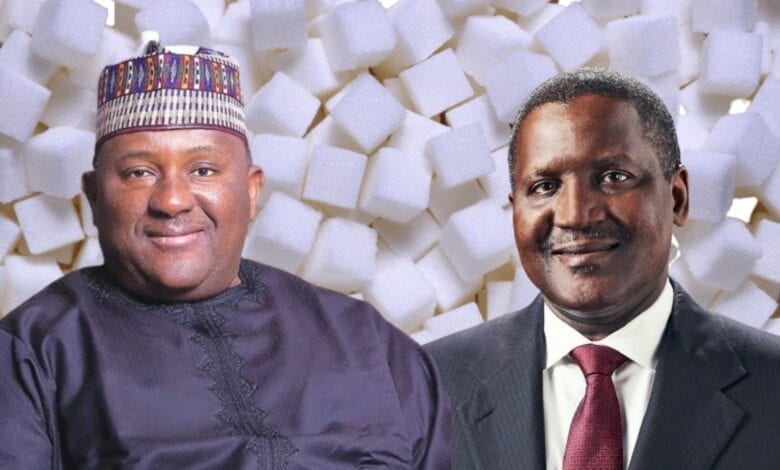
Aliko Dangote of the Dangote Plc and Abdul Samad Rabiu of BUA Group have always found themselves in different corners of the corporate boxing ring in the course of doing their businesses and now the war is getting tougher.
The face-off has taken a new twist after Dangote, in January, petitioned the Federal Government through the Ministry of Trade and Investment, asking the ministry to shut down BUA Group’s Sugar Refinery located in Port Harcourt and Lafiagi.
Insecurity: We need peace for jobs to be created, Dangote warns
The BUA Sugar Refinery, which was already producing for export to other countries, was accused by Dangote of ‘operating with impunity’.
Dangote alleged that BUA was contravening the laws as laid down in the National Sugar Policy, stating that the company was not permitted to sell its products locally.
Available records at the Ministry of Trade and Investment, show that the agreement signed between the Federal Government and BUA in 2008, acquiring Lafiagi Sugar Company, was with the promise to build a refinery.
The agreement also provided that the company should conclude plans to make Nigeria a sugar producing hub, because 23 years before the transaction, the facility had been in the hands of Mehta Group of India, which, like BUA, defaulted in the agreement entered into with the government.
Dangote also alleged that, for many years, BUA did not develop the nursery, nor did it have plans to establish plantations or invest in backward intervention projects from where it would source its raw sugar.
In the petition before the Ministry of Trade and Investment, Dangote did indicate that BUA’s plans focused on importation of raw sugar and refining it to make a huge profit, while leaving the nation continuously dependent on Brazil and other countries for raw sugar.
But a former Minister of Trade and Investment, Olusegun Aganga, having seen the potential of BUA on the development of sugar master plan, put pen to paper.
According to Aganga, the BUA was expected to chart the cause for the Nigerian sugar master plan. His words: “The estimated plan was that Nigeria’s demand for sugar would breach the 1.7 million metric tonnes mark by 2020. And to be able to satisfy this from domestic production, we will need to establish some 28 sugar factories of varying capacities and bring about 250,000 hectares of land into sugarcane cultivation, over the next 10 years.”
But BUA, with 15,000 hectares of land in Lafiagi, has done little in terms of plantation and backward integration. This has prompted the current Minister of Trade and Investment, Adeniyi Adebayo, to visit the BUA Sugar Company in Kwara State in December 2019, with promises that the company would do the needful.
However, the company started making excuses, including the issue of COVID-19 pandemic. Abdul Samad Rabiu had pleaded that the pandemic was affecting its operations.
Meanwhile, the chairman of Dangote Industries Limited, Alhaji Aliko Dangote, alongside Chairman, Flour Mills of Nigeria Plc, Mr. John Coumantaros, have said the establishment of a new sugar refinery plant in the country posed a threat to the attainment of the National Sugar Master Plan (NSMP), as well as sustainability of the country’s local sugar industry.
They argued that the country currently has enough refining capacity to meet national demand.
In a joint petition to the minister dated January 28, 2021, the duo protested the recent commissioning of a sugar refinery in Port-Harcourt, which, according to them, is owned by BUA International, one of the operators in the sugar industry.
However, in the ensuing row among the major players in the industry, the chairman of BUA Group, Alhaji Abdul Samad Rabiu, said his investment in Port Harcourt did not in any way pose a threat to the country’s sugar policy.
Rather, he said, the investment would check arbitrary price increase by the major players, among other benefits to the country.
In the letter to the minister, Dangote and Coumantaros argued that they had in 2019 warned about the risk of establishing a new refinery, saying that they got assurances that in line with the Federal Government’s policy on Backward Integration Programme (BIP), “no new refinery will be allowed to operate in Nigeria”.
They also pointed out that a tremendous amount of work was required by all stakeholders to achieve the intended objective behind the sugar policy, which is to among other things, encourage backward integration to ultimately attain self-sufficiency in local sugar production.
They recalled that under the revised guidelines released by the National Sugar Development Council (NSDC), it was made clear that the allocation of quotas henceforth shall be on quantitative and verifiable improvements in the BIP of operators in the industry.
The petitioners alleged that the mid-term assessment conducted by the NSDC had concluded that BUA had “failed to invest substantially in local production or comply with its undertakings under its BIP.’’