Death penalty for financial crimes will address corruption in Nigeria, says Obono-Obla

By Chukwudi Obasi
A former Chairman of the Special Presidential Investigation Panel for Recovery of Public Property, Chief Okoi Obono Obla, has said the only way to salvage the rising tide of corrupt practices in Nigeria is to introduce the death penalty.
Obla, who also served as Senior Special Assistant to former President Muhammadu Buhari on Prosecutions, disclosed how his panel uncovered the failure of commercial banks to remit over N38trn in stamp duties to the Federation account in 2018.
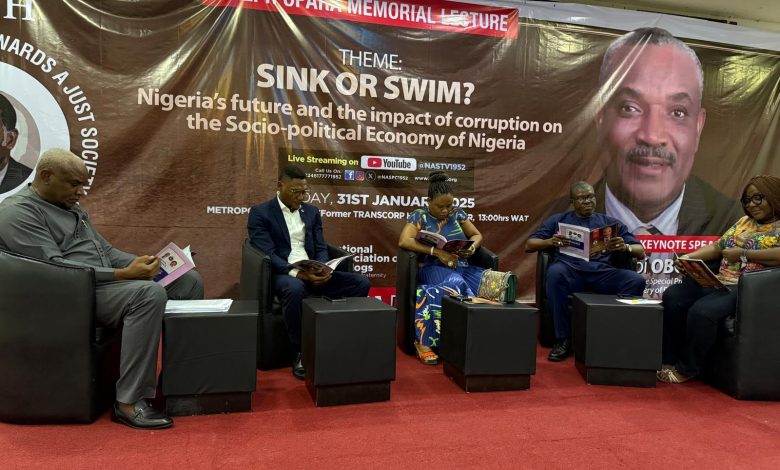
He stated this as the keynote speaker over the weekend during the 16th Ralph Opara Memorial Lecture, which was organised by the National Association of Seadogs in Calabar, Cross River State.
The lecture’s theme was “Sink or swim?” Nigeria’s future and the impact of corruption on the socio-political economy of Nigeria.
The event’s panelists included Grace Etuk, a Professor of Industrial Sociology at the University of Calabar; Enang Udah, a professor of economics at the University of Calabar; Richard Inoyo, the Country Director of Citizens Solution Network; and Mrs Eme Offiong, Chairman of the Correspondents’ Chapel of the Nigeria Union of Journalists in Cross River State.
Obono-Obla said the country must wake up from slumber and tackle corruption headlong.
“To effectively combat corruption, non-governmental organizations (NGOs) and civil society groups, such as the National Association of Seadogs, must take a proactive stance. They should be at the forefront of this fight, engaging the civil society, legislature, and government to drive meaningful change.
“One potential strategy to consider is the introduction of the death penalty for specific categories of corruption and financial crimes. This severe measure could serve as a deterrent to those who engage in corrupt practices, thereby helping to mitigate the pervasive impact of corruption on society.
“However, punitive measures alone are insufficient. A comprehensive overhaul of our cultural and attitudinal values is necessary to address the root causes of corruption. One potential strategy to consider is the introduction of the death penalty for specific categories of corruption and financial crimes.”
He decried the paradox of Nigeria, where some individuals are dedicated to protecting the country’s interests while others engage in corrupt practices.
He emphasized that Nigeria must enhance its institutions, foster transparency and accountability, and ensure that corrupt individuals face the consequences of their actions.
He stressed that NGOs, civil society groups, and the government must collaborate to create a society that values transparency, accountability, and integrity.
He said his panel uncovered the failure of commercial banks to remit over N38trn in stamp duties to the federation account in 2018.
He also chronicled several other uncovered corruption instances, including the uncovering of a $60bn illegal sale of Nigeria’s crude oil by criminal networks with the involvement of government officials and the discovery of $9bn belonging to a former National Security Adviser stashed in a US bank.
“I also investigated the misappropriation of funds, such as the $2bn and $850 gold bars recovered from the home of a minister, only to be looted by individuals within the government. Additionally, I scrutinised a former military governor, minister, and senator who possessed properties worth over £200m on a Pacific Island,” he said.
Earlier in his opening remarks, the NAS Capn, Dr Joseph Oteri, said the National Association of Seadogs instituted the lecture series in 2004 to immortalize the icon Ralph Opara.
He said they hope to keep his faith alive by providing a medium for him to express the views for which he has stood steadfastly throughout his life.
He also said through the lecture that they hope to find answers to topical issues that can potentially blight Nigeria’s future and development strides.
Oteri said, “There is no gainsaying that corruption has dealt a huge blow on Nigeria and Nigerians, negatively affecting the lives of the citizens. In concordance with the objective of the Ralph Opara Memorial Lecture series, the lecture and the 2025 series are specifically dedicated to opening discussions and finding answers to this topical socio-political and economic issue that has the potential of blighting Nigeria’s future and developmental strides.”