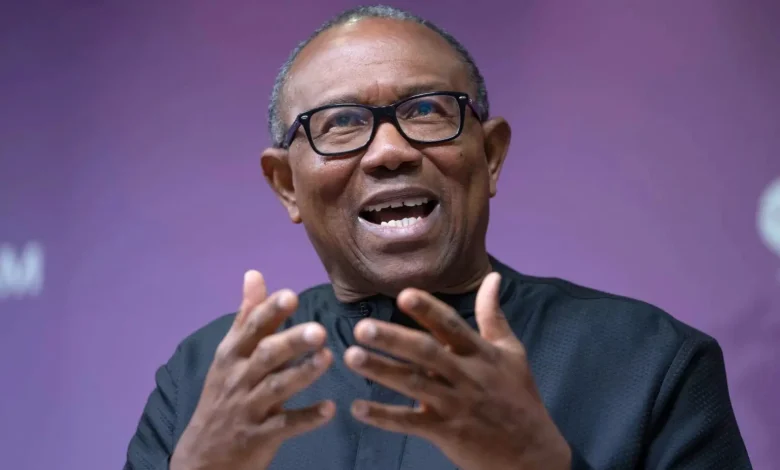
The presidential candidate of the Labour Party in the 2023 general election, Peter Obi, has faulted the Federal Government’s handling of Nigeria’s education sector, saying the country’s poor learning outcomes stem from a failure of leadership rather than flawed education policies.
Obi made the remarks in a statement issued on Friday while reacting to the Federal Government’s recent admission that the policy separating junior and senior secondary schools had failed to deliver the desired improvement in educational standards.
The former Anambra State governor said the government’s acknowledgement of the policy’s shortcomings underscored what he described as years of poor management of the education sector.
Citing recent examination results, Obi noted that only 38.32 per cent of candidates passed both English Language and Mathematics in the 2024 West African Senior School Certificate Examination, while just 32 per cent reportedly passed the computer-based examination conducted in 2025.
He argued that the declining performance reflected deeper structural challenges that could not be addressed through policy changes alone.
“The Minister’s admission reflects a broader failure of public leadership. The issue is not the JSS/SSS policy itself, but the lack of commitment to properly fund, manage and deliver quality education,” Obi said.
He described education as the foundation of human capital development and economic growth, stressing that Nigeria could not overcome poverty, unemployment and economic stagnation without making deliberate investments in education, healthcare and job creation.
According to him, countries that have achieved sustained economic growth, particularly in Asia, did so by consistently investing in quality education, curriculum development, motivated teachers and improved learning environments.
Obi also criticised the Federal Government’s budgetary allocation to education, noting that the sector received ₦3.52 trillion in the 2026 budget, representing 6.17 per cent of total expenditure, compared with 7.87 per cent in 2025.
He said the allocation remained significantly below the 15 to 20 per cent benchmark recommended by UNESCO, describing it as evidence that the government had failed to treat education as a catalyst for national development.
The former governor further expressed concern over reports that Nigeria was unable to sponsor students to international STEM and Mathematics Olympiads because of inadequate funding.
Referring to claims by education advocate Alex Onyia, Obi said it was regrettable that the country could fund foreign conferences while failing to support academically gifted students representing Nigeria on the global stage.
Highlighting his administration’s record in Anambra State, Obi said strategic investments in schools, including the provision of laptops, internet connectivity, electricity and other learning facilities, significantly improved educational outcomes.
He added that Anambra’s large-scale procurement of computers for secondary schools earned recognition from HP Africa as the largest laptop acquisition for schoolchildren by any subnational government on the continent.
Obi urged the Federal Government to prioritise education, healthcare and employment generation, insisting that sustained investment in the three sectors remained essential to securing Nigeria’s future.
“For the future of our society, we must deliberately invest in education, healthcare and job creation. As I have always said, failing to do the right things is equivalent to abusing society, and the society we abuse today will take its revenge on us and our children tomorrow,” he said.