

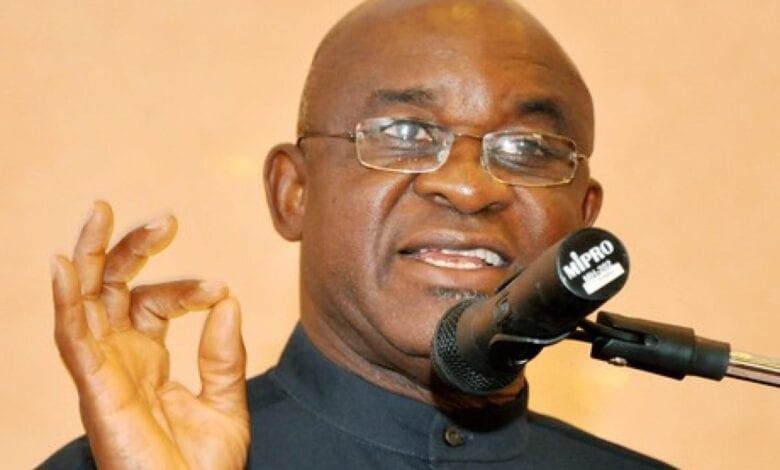
By Nathaniel Zacchaeus, Abuja
President of the Senate in the 6th and 7th National Assembly, David Mark, has a high number of standing committees recently created by both chambers of the National Assembly that would encourage legislative inefficiency.
Mark stated this in a paper he presented at the two-day retreat of principal officers of the 10th National Assembly held in Ikot Ekpene, Akwa Ibom state which ended at the weekend,
He said the number of special and standing committees in the Senate and the House of Representatives were too many and would affect productivity.
He said, “There are eight Special Committees and 63 Standing Committees in the Senate. Similarly, there are Seven Special Committees and 74 Standing Committees in the House of Representatives.
“The US Senate has a total of 24 Committees made up of four Special Committees, 16 Standing Committees, and Four Joint Committees. This is for the sake of comparison. Most of the legislative work is done in the committees.
“Therefore, it is important that the Committees are made to function properly and effectively. In the Senate Standing Orders 2022 (as amended), Order 94(2) it is stated that a Senator shall not serve in more than seven committees, which means a Senator can be in six committees. This clearly in my opinion is not a wise thing to do.
“A legislator if he is in six committees will not be able to participate effectively or efficiently in the committee assignments. Besides this, the total of 71 committees (8 plus 63) in the Senate and 81 committees (7 plus 74) in the House of Representatives, in my opinion, is unwieldy.
Read also:Hardship: Labour uncovers plot to sabotage struggle on palliatives
“You must understand that not every Senator or House member can be a chairman of a committee. A ranking member of a committee is as effective and as influential as a chairman of the committee. Creating so many committees for patronage and political expediency is counter-productive.
“In constituting the committee, it will be advisable to ensure expertise, party spread, geographical balancing, and ranking. I must emphasise the issue of ranking; it is very important in the legislature.
“Furthermore, the committees should be properly funded, staffed and encouraged to interact more with the public, and do more research.”
Mark suggested that the reduction of the committees would increase membership per committee, thus bringing in more expertise and party spread. He also said fewer committees in the parliament would improve funding and make for better meeting attendance and participation
He explained that the parliament would adequately employ qualified staff and ensure coordinated research that would avoid duplication of efforts.
Mark said the most important function of the committee was oversight adding that lawmakers should not see the exercise as a mere visit or jamboree.
“If the Executive is allowed to fund the oversight, the likelihood of compromising is increased,” He added
The former Senate President said the 10th National Assembly came into the equation at a very difficult and trying period in the history of this country.
He said, “First, problems associated with the necessary but untimely removal of the fuel subsidy without immediate palliatives and other economic programmes in place.
“This has brought untold hardship on the people. The merits and the demerits of the removal notwithstanding, it has painted politicians as insensitive, increased the crime rate, and exacerbated poverty.
“Secondly, the high level of insecurity in the years preceding your elections adversely affected the economy and prevented farmers from going to the farm. This has resulted in food scarcity.
“The Central Bank of Nigeria’s (CBN) decision to float the naira, laudable as it may be, has resulted in all sorts of hardship.
“It has reduced the spending power of the worker and the ordinary Nigerian. It has resulted in the depreciation of the Naira and also escalated the high cost of living.
Mark tasked the 10th National Assembly to prioritise its legislative agenda to address among others the controversial inconclusive elections in the future.
He listed some of the problems facing the nation including the deteriorating economic situation, high crime rate, unemployment, farmers/ herders clashes, banditry, terrorism, food shortage, insufficient and decaying infrastructure, out-of-school children, and poor health facilities among others.
He noted that although the problems were primarily not the creation of the legislators Nigerians elected them to proffer solutions.
To address the myriad of problems, he told the Akpabio-led principal officers of the National Assembly to be innovative, think, and act outside the box pointing out that “it cannot be business as usual.
He said, “You must therefore design a legislative agenda that can provide a legal and regulatory framework that will support government initiatives and policies. The agenda must show in clear and concrete terms how to address the issues facing the nation.
“It must respond to critical national issues like growing the economy, job creation, tackling insecurity, anti-corruption and show the synergy between the legislative agenda and the executive programmes.
“You must honestly debate government policies to ascertain the merits and demerits without party sentiments saying that standing committees must be properly equipped in its composition to vigorously oversight Ministries, Departments and Agencies (MDAs)”.
Mark also made reference to the 2023 general elections and submitted that the last exercise remains the most controversial election since the beginning of the 4th Republic in 1999, a development he said led to the emergence of new parties against the hitherto dominant two.
The interest and enthusiasm displayed by the youths, he stated was a direct disapproval and dissatisfaction with the old brigade insisting that Nigerians expect the 10th Assembly to legislate to ensure better or less controversial elections in the future.
Mark opined that committee systems and caucuses are essential mechanisms for balancing diversity and promoting effective representation in legislative houses.
He said, “By fostering inclusivity, encouraging dialogue, and providing platforms for diverse voices to be heard, you can strengthen legislative effectiveness and ensure that the laws and policies you make truly reflect the needs and aspirations of all citizens for the good of all.”


