By Nathaniel Zacchaeus, David Lawani and Cross Udo
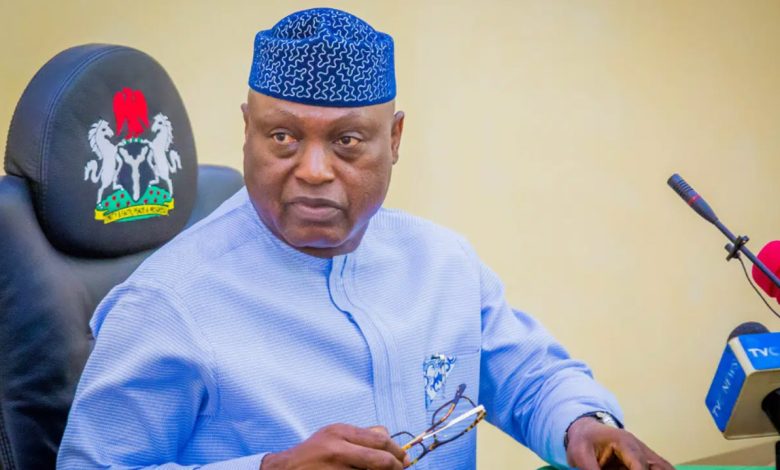
Governor Biodun Oyebanji has rewritten Ekiti State’s political history, becoming the first governor since the return of democratic rule in 1999 to secure a consecutive re-election mandate, following a landslide victory that political observers say reflects a mix of performance, political consensus, grassroots mobilisation and strategic party unity.
The victory has also strengthened the All Progressives Congress (APC) ‘s confidence ahead of the August 15 governorship election in neighbouring Osun State, with party leaders describing the outcome as a referendum on governance and continuity.
Declaring the result at about 3:13 a.m. on Sunday, the Returning Officer and Vice-Chancellor of the Federal University of Technology, Akure, Prof. Adenike Oladiji, announced that Oyebanji of the APC polled 319,224 votes to defeat the Peoples Democratic Party (PDP) candidate, Dr Oluwole Oluyede, who secured 40,543 votes, while the African Democratic Congress (ADC) candidate, Dare Bejide, garnered 12,872 votes.
According to INEC, 384,940 voters were accredited for the election, 375,777 valid votes were recorded, while 6,332 votes were rejected, bringing the total votes cast to 382,109.
Beyond the numbers, the scale of the victory was unprecedented. Oyebanji swept all 16 local government areas of the state, recording one of the widest victory margins in Ekiti’s electoral history and becoming the first incumbent governor to achieve back-to-back electoral victories since the state’s creation.
Analysts attribute the outcome to the governor’s ability to build broad political alliances, maintain cordial relationships with former governors and stakeholders, and sustain a governance model that enjoyed acceptance across party, religious and community lines.
Reacting to the outcome, Oyebanji described the result as a renewed mandate to deepen development and intensify efforts to tackle poverty and inequality in the state.
“The best has just begun,” the governor declared.
“We will rededicate ourselves even more strongly to implementing a sharp prosperity agenda. We will accelerate various ongoing projects and programmes. We will work harder and smarter to serve you better.”
He added, “We will not relent until poverty and inequality become things of the past in our land.”
The governor said the mandate would strengthen his administration’s resolve to expand investments in infrastructure, education, healthcare, agriculture, youth empowerment and economic development.
President Bola Tinubu described the outcome as a “resounding victory” and a strong endorsement of Oyebanji’s performance in office.
According to the President, the governor’s first term recorded significant progress in infrastructure development, agriculture, healthcare, education, youth employment and rural development.
“The renewed mandate is therefore a clear vote of confidence in continuity, stability, and people-centred governance,” Tinubu said.
He urged Oyebanji to remain inclusive in victory and continue carrying all segments of the state along in governance.
The APC also interpreted the outcome as validation of its governance philosophy and growing acceptance among voters.
In a statement by its National Publicity Secretary, Felix Morka, the ruling party described the victory as historic. It attributed it to Oyebanji’s “visionary leadership, people-oriented policies and unwavering commitment to the development and progress of Ekiti State.”
According to the party, the result demonstrated “the confidence and trust reposed in Governor Oyebanji by the electorate.”
The APC further argued that the renewed mandate would strengthen the implementation of President Tinubu’s Renewed Hope Agenda in the state.
For Senate Leader Opeyemi Bamidele, who chaired the APC Governorship Campaign Council, the election outcome was a direct verdict on Oyebanji’s leadership style and ability to unite political stakeholders.
“The outcome of the election perfectly reflects the confidence of the people in Oyebanji’s leadership, commitment to public governance and dedication to the welfare and prosperity of Ekiti people at large,” Bamidele said.
He noted that the governor had transformed Ekiti’s political environment from one characterised by division and rivalry into one defined by cooperation, stability and consensus-building.
“Oyebanji’s leadership has fostered peace, unity and stability in Ekiti State,” he stated.
Lagos State Governor and Chairman of the South-West Governors’ Forum, Babajide Sanwo-Olu, also described the landslide victory as a reward for performance.
“Governor Oyebanji’s victory in the governorship poll with 83.54 per cent of the total votes cast is a reward for performance and outstanding delivery of the dividends of democracy to the people of Ekiti State during his first term,” Sanwo-Olu said.
He added that the outcome was “a testament to the popularity of the Governor and the APC.”
Despite the overwhelming margin, the election was not entirely free of controversy.
*Opposition cites BVAS glitches, irregularities during poll
Before the declaration of results, PDP candidate Oluyede complained of BVAS-related challenges at his polling unit in Ikere Local Government Area and alleged that some voters were prevented from casting their ballots.
He also raised concerns about voter harassment and intimidation in parts of the state.
INEC acknowledged that although all 2,445 polling units opened for voting, 188 polling units experienced delays before accreditation and voting commenced.
Nevertheless, election observers largely described the process as peaceful, while security agencies received commendation for maintaining order throughout the exercise.