Ernest Shonekan: Goodnight to a patriot, statesman and gentleman

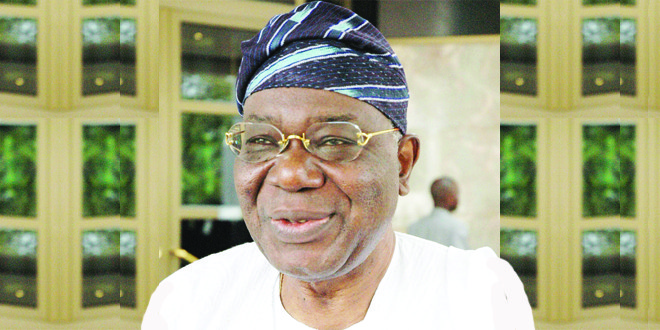
The Chief lived and served well. May God be merciful to him and console his wife, children, family, Egba land and Nigeria.
By Mathew Hassan Kukah
Our country had more to gain from him than he from the country. What did he need? Money, fame, power or what? Nigeria should thank God that men of honour like him were able to step up when it mattered. Those who criticise him accuse him of having been naïve or that he was betrayed by his military friends. Yet, every genuine, honest and trusting individual is liable to betrayal. It is the betrayer, not the betrayed, who deserves to be pitied.
Now that the great man has been laid to rest, I would like to add a tiny voice of sympathy to the immediate family of Chief Ernest Shonekan, our former Head of State, who died last month. I thought it was best to allow those who knew the man well to have their way and have their say before I wrote my own little drop to an ocean of tributes that are bound to follow his exit. I cannot claim to have known him very well. However, the little contact I had with him left me with some memories which I would like to share.
Shortly after the installation of Chief Shonekan as the Head of Interim National Government on August 26, 1993, I got a call from the then Nuncio to Nigeria, His Grace, Archbishop Carlo Mario Vigano, asking if I could join him the following day to pay a courtesy call on the new Head of State.
We arrived at the State House to a very warm reception by his Secretary, who led us into the waiting room. In less than 10 minutes, we were ushered into the Head of State’s office. He greeted the Nuncio very warmly and turned to me with a much wider smile: Fr Kukah, he said as he shook my hand; It is a great pleasure to finally meet you. I had always looked forward for a chance to meet you. Then he turned to the Nuncio and said, pointing at me as if I were an accused: This young man has done a lot for our country. He is a great man and he writes very well. I literally squirmed at the unexpected attention I was getting.
He ushered us to seats but I held back because I thought they needed privacy and, in any case, I was only a bag carrier, but he quickly said: Fr. Kukah, please sit here, as he pointed at a seat beside the Nuncio. Not feeling confident, I literally perched on the seat.
They talked for about 20 minutes. He had presence, poise and stature befitting his office. I really liked him. He wore his corporate culture well and spoke with finesse. We rose to leave and he gently lead us all the way to the exit door where we shook hands and bade goodbye. I never had any further contact with him in his very short three-month stint as Head of State. I will return to this later.
My next meeting with him was towards the end of the public sitting of the Human Rights Violation Commission, known as the Oputa Panel. As the reader might already know, our work at the Commission became very controversial when we got to the issues of the military testimonies during the public hearings. A good part of the stories and the intrigues are captured in my book, Witness to Justice. The meeting with Chief Shonekan was one of the last items in the work of the Commission. But let me digress a little.
Recently, when I saw a video of a reconciliation between the Kenyan president, Uhuru Kenyatta and Raila Odinga, his opponent, along with their deputies during a Prayer Breakfast, my mind raced back to what we had tried to do towards the end of the work of our Commission in 2001, as a way of bringing some level of closure to our situation. The video showed the men tendering apologies, hugging one another and promising to put their animosity behind them for the sake of their country. As metaphors of reconciliation go, this was impressive. I felt sad because I thought of what might have been in our dear country.
As we rounded up our work, I had suggested to Justice Oputa that we needed to develop a strategy that would make our work at reconciliation go beyond those who had petitioned the Commission and whose cases had been heard. I told him that I felt that the country was severely wounded and needed real healing. To do this, I suggested to him that we needed to bring those past leaders who were being vilified today into the loop of reconciliation. When he asked how this was to happen, I offered to send him a memo the following day.
In the two-page memo, I had suggested that despite the character assassination that had followed the testimonies of some of the military men during the public hearings, it was important that we gave the generals a chance to clear their names, in an informal sense, not through the podium. My efforts in this regard are all documented in my book. However, my proposal was to the effect that on the final day of the Commission’s sitting, we should invite all the former heads of state to come as a group to what would be like the closing ceremony of our work. Before then, we would plan private confidence building meetings, with all of them individually, to seek their wise counsel on the way forward for national reconciliation. Then, if they agreed, on live television, I proposed that we could have the Chairman deliver a short speech urging forgiveness and the need for our country to move forward.
I proposed that after the speech, General Gowon would deliver a short speech on behalf of his colleagues, former heads of state. Essentially, the speech would say that they were all thankful to God and to Nigerians that they had had a chance to govern our country. In the course, they had all done their best in running the affairs of the country. However, if in the course of doing their best, Nigerians felt their best had not been good enough and they had hurt anyone, then, he on behalf of his colleagues was requesting forgiveness from Nigerians. He would then conclude by appealing to Nigerians to unite so that we could build our dear country in a spirit of forgiveness and reconciliation. I was, as I said in my memo to Justice Oputa, convinced that Nigerians, teary-eyed, would be ready to answer this call.
One week later, Justice Oputa asked me to see him. He said, I have looked at your memo and reflected on it. I think it makes sense, but how should we proceed with it? I told him that moving forward was the easy part if he thought the memo made sense. Let me, I said, reach out to some of them, but in the end, we have to draft a letter inviting all of them and selling the idea to them. I know that they can be persuaded to see sense in this move, despite the hurt that some of them feel by the way their integrity has been publicly called to question. Once we agreed, he sold the idea to other members of the Commission during our meeting. Everyone saw sense in the decision.
We decided totake the first step by sending out letters inviting all the former heads of state to private meetings with the members of the Commission. We were to use this session to pick their brains and also build confidence in what we were trying to do by answering any questions or doubts that they may have had and finally having their buy in to the idea of ending our proceeding with a public event. All the letters went out and the first response we got was from Chief Shonekan who asked for a date, venue and time for the meeting.
On the agreed date, as I arrived at the Transcorp Hilton entrance, I saw a headline announcing our meeting boldly on the front page of ThisDay newspaper. I bought the paper, read the story but tried to ensure that Justice Oputa did not see it. Someone had leaked our letter and it was too late for us to do anything. I was in a state of shock and confusion, especially as that was the morning we had planned to receive Chief Shonekan. All of a sudden as I stood outside not knowing what to expect, there was some movement as the great man stepped out of a car. I quickly alerted the Chairman and we all received him and took him upstairs, where we had planned our private meeting in. I think Kaduna Hall. There was no media presence because we had planned this with the utmost secrecy.
He sat down and was formally welcomed by the Chairman, Justice Oputa. Chief Shonekan told us that he had decided to honour our invitation because he thought it was a good opportunity to share his experience with us. He commended our work and proceeded to regale us with some very intriguing accounts of his experiences as a Head of State. He spoke about honour, patriotism, answering the call to duty and insisted that he considered it an honour to have been asked to serve. He said he really had no regrets and had no quarrels with the military. Almost rhetorically, he asked: Have you ever seen anywhere that the victim of a coup turned around to serve those who overthrew him? I worked with General Abacha despite his having staged a coup against the government that I headed for the good of our country. He regaled us with stories but one of my favourites was the one he told about trying to order the release of the late Ransome Beko Kuti.
He said that when he became Head of State, the first thing he wanted to do was to buy a lot of good will. He said he had been following developments in the country leading to the arrest and detentions of human rights and labour activists. He decided to order the release of Beko Kuti because he knew it would excite civil society. He called the Director of the State Security Services (SSS) as they were there for a meeting. After discussing what he considered the futility of arresting activists with the Director, he ordered the immediate release of Beko because, he said, we needed the goodwill of Nigerians.
NSCDC arrests six for conveying adulterated petroleum products
Next day, he excitedly scanned through the papers over breakfast expecting to see banner headlines of the release of Beko, but there was nothing. Again, the second day, he looked through the newspapers, but found no story about Beko. He summoned the Director of the SSS immediately. When he arrived, Chief Shonekan said he asked him rather angrily why he had not effected the release of Beko as he ordered him, the Director said: You did not put it in writing Sir! That was, he said to us, his early lesson with the Nigerian civil service!