By Cajetan Mmuta, Ben Adoga, and David Lawani, with agency report
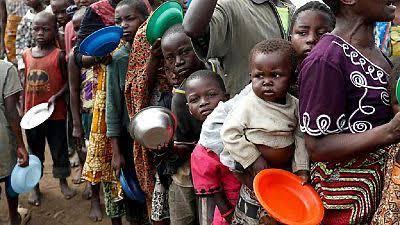
A humanitarian disaster is brewing in Nigeria’s conflict-ravaged northeast, where no fewer than 3.7 million people are facing acute food insecurity, according to the International Committee of the Red Cross (ICRC).
The crisis, which threatens the lives of millions, is being compounded by massive funding cuts to food aid and what civil society actors are calling a catastrophic failure of leadership by the Federal Government.
The dire situation is further exacerbated by the World Food Programme’s (WFP) decision to scale down its humanitarian operations in Nigeria, citing an 80 per cent funding shortfall.
The move has led to the shutdown of over 150 nutrition clinics and withdrawal of food support to hundreds of thousands of malnourished children and mothers—threatening to tip already vulnerable communities into famine-like conditions.
*Displacement, insecurity crippling food access
In a statement released Monday in Abuja, ICRC spokesperson Aliyu Dawobe explained that the worsening food crisis stems from prolonged conflict, which has displaced thousands of farmers, disrupted local food systems, and restricted access to farmland. Many of the affected were once self-sufficient agricultural producers.
“The lean season is here,” said Diana Japaridze, head of ICRC’s office in Maiduguri. “Food stocks are gone, and families who cannot grow or afford food are cutting meals drastically. Malnutrition is rising fast, especially among children, pregnant, and breastfeeding women.”
To mitigate the crisis, the ICRC has launched agricultural assistance programmes supporting over 21,000 farming households with seeds, tools, and training in sustainable practices. The initiative targets both rainy and dry season farming, aiming to increase dietary diversity and long-term resilience.
“This year alone, thousands of households received locally adapted seeds and farm tools to ease labour and improve efficiency,” Japaridze said. “We’ve also repaired a vital water source to support seed testing and greenhouse operations through the National Agricultural Seed Council.”
Despite these interventions, she warned that the lean season remains a critical hurdle, with many households still unable to produce enough food for their needs.
*Aid cuts deepen hunger crisis as CSOs, health experts blame FG’s inaction
According to the WFP, $620 million in emergency funding is required to continue its food programmes in Nigeria and across sub-Saharan Africa. The funding crisis, which analysts trace to cuts initiated under the US administration of President Donald Trump, has left aid agencies scrambling to respond.
The result: 300,000 children in Nigeria who were receiving lifesaving treatment for Severe Acute Malnutrition (SAM) have now been left without support. Thousands more risk falling into critical nutritional deficits in the coming months.
“This is not just a budget issue—it is a matter of life and death,” warned Miss Patience Anyim, a Local Government Area Facilitator. “Over one million children and 800,000 mothers are hanging by a thread. Severe Acute Malnutrition increases child mortality dramatically—even minor illnesses become fatal.”
Meanwhile, public health professionals are also raising concerns over the broader implications of the food crisis.
Mrs. Mary Lawani, a maternal and child health expert, warned that Nigeria is on the brink of a nutrition emergency that could spiral into a public health catastrophe.
“Inflation has already priced basic foods out of reach for the average family,” she said. “Without timely nutritional support, we will see a surge in marasmus, kwashiorkor, rickets, scurvy—and, tragically, child deaths.”
She explained that beyond the physical toll, malnutrition affects brain development, immunity, and future productivity.
“Malnourished children are more susceptible to infections like diarrhoea, cholera, typhoid, and even mental health disorders. Once cognitive function is impaired in early life, recovery is almost impossible to achieve. We risk losing a whole generation.”
Also, civil society organisations and rights activists have pointed fingers squarely at the Nigerian government, accusing it of gross negligence and misplaced priorities.
“It is shameful that a country blessed with arable land and resources still depends on foreign donors to feed its people,” said Bolaji Amao of the Civil Society Legislative Advocacy Centre (CISLAC). “We ignored repeated warnings and failed to prepare during the April planting season. Now we’re caught off guard, again.”
He condemned the government’s failure to support smallholder farmers with subsidies for seeds, agro-chemicals, and extension services.
“While our political elites waste billions on convoys and foreign trips, farmers in the northeast walk miles barefoot just to gather firewood for food. This is not a funding problem—it is a leadership problem.”
Echoing this stance, Comrade Emeka Umeagbalasi, Chairman of the International Society for Civil Liberties and Rule of Law (Intersociety), traced the roots of the crisis to policies under the former Buhari administration.
“The food crisis didn’t start today. The Buhari government opened Nigeria’s borders to armed foreign herders who displaced local farmers across food-producing states—Benue, Niger, Zamfara, Oyo, and Delta.”
Umeagbalasi accused the Tinubu administration of continuing Buhari’s failed security and agricultural policies, warning that until farmlands are recovered from terrorists, any solution will be short-lived.
“It’s no longer enough to talk about palliatives. We must secure farms, disarm violent groups, and rebuild rural economies. Hunger is a symptom. The disease is bad governance.”
For displaced families in communities like Dikwa, Gajibo, and Konduga, the hunger crisis is not theoretical—it’s a matter of survival on the edge.
“Right now, we face severe food shortages,” said Modu Umar, a community elder in Dikwa. “Some families walk long distances daily just to collect and sell firewood for food. Farming is the only solution, but insecurity makes it almost impossible.”
Churi Ibrahim, a 70-year-old farmer from Gajibo, described how he treks for hours to reach his farmland, risking exhaustion and attacks from wildlife.
“By the time I reach my farm, I’m already too weak. But I have no choice. If I don’t farm, my children will starve.”
Bintu Konto, a widowed mother of five, echoed the urgency.
“Even when they’re afraid, people still go to the farm. If we don’t plant during the rainy season, we will have nothing to eat. It’s a risk we must take.”
The broader picture is equally bleak. Nigeria’s inflation rate has surged above 30 per cent, with the cost of staple foods tripling in many states. Insecurity, poor harvests, and climate change-induced flooding have also disrupted food supply chains across the nation.
WFP’s internal assessments now warn that unless urgent interventions are implemented, Nigeria could experience famine-like conditions—particularly in the North-East and North-Central regions.
“We’ve already seen increases in clinic admissions for malnourished children in Borno, Yobe, Katsina, and Zamfara,” the agency said. “Without continued food support, many of them won’t survive the year.”
Experts and humanitarian workers say the time for mere statements is over. The Nigerian government must treat the hunger crisis as a national emergency, prioritising food security over political convenience.
Among the key recommendations are the immediate establishment of an Emergency National Food Response Taskforce; the reclamation and protection of farmlands from terrorist groups; and the subsidised provision of seeds, fertilisers, and farming equipment.
Others include the deployment of agricultural extension officers to rural communities and the curtailment of wasteful government expenditure to redirect funds to food security.
“We need a wartime mindset,” said Amao. “Cut down on luxuries, suspend non-essential projects, and put money where lives are at stake—into agriculture and nutrition.”
Mrs. Lawani added that international donors, such as WFP, UNICEF, and FAO, must not be treated as crutches, but rather as complementary partners.
“The Nigerian government must lead. Donors can support, but they cannot fix a system that refuses to help itself.”