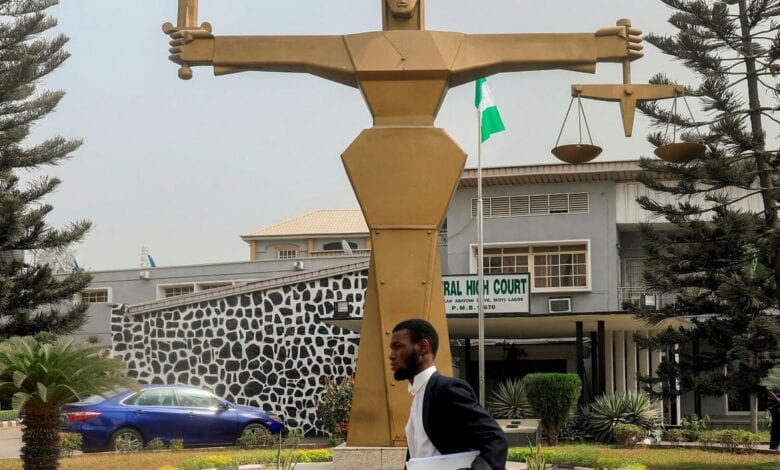
Newsmen report that the strike, the longest industrial action in the Nigerian judiciary was suspended on June 9, following a meeting between officials of the union and the National Judicial Council (NJC) led by the Chief Justice of Nigeria (CJN), Justice Ibrahim Muhammad.
Media reports that courts were supposed to re-open on June 14, but the Federal Government had declared a public holiday in commemoration of Democracy Day, which fell on Saturday.
The union JUSUN had begun a nationwide strike on Tuesday, April 6, when the union directed all its members across the federation to shut down all courts after the expiration of the 21-day ultimatum earlier given over the failure of the government to implement the law.
Media report that a verdict of the Federal High Court in Nigeria’s capital, Abuja, had in January 2014 held that financial autonomy for the judiciary is a constitutional provision that must be complied with by the executive branch of government.
Recall that on May 23, President Buhari signed into law the Executive Order to grant financial autonomy to the legislature and the judiciary across the 36 states of the country.
The order also mandates the Accountant-General of the Federation to deduct from source amount due to state legislatures and judiciaries from the monthly allocation to each state for states that refuse to grant such autonomy.
The Attorney General of the Federation Minister of Justice, Abubakar Malami, said Executive Order No. 10 of 2020 made it mandatory that all states of the federation should include the allocations of both the legislature and the judiciary in the first-line charge of their budgets.
According to the AGF: “A Presidential Implementation Committee was constituted to fashion out strategies and modalities for the implementation of financial autonomy for the State Legislature and State Judiciary in compliance with section 121(3) of the Constitution of the Federal Republic of Nigeria, 1999 (as Amended).”
Newsmen report that the Nigeria Governors Forum said it will start implementing financial autonomy for the judiciary latest by May ending, a pledge that indicated that an end to the ongoing strike that has crippled the nation’s judiciary may be in sight.
The governors also called on striking members of the JUSUN to call off their two weeks old strike then.
The Chairman of the NGF, Gov. Kayode Fayemi of Ekiti, gave this assurance in an interview with journalists after meeting with “stakeholders” from the state judiciary and legislature at the Presidential Villa in Abuja.
Fayemi said the modalities for the implementation were worked out at the meeting held at the Presidential Villa.
AFN not autonomous – Minister
According to him, the meeting, chaired by the Chief of Staff to President Buhari, Ibrahim Gambari, was attended by the Solicitor-General of the Federation, representatives of the judiciary, Conference of Speakers, and House of Representatives.
The first line charge status, which is being respected by the Federal Government in respect of the federal judiciary, entitles the state judiciaries to get funds due to them directly from the Federation Account.