By Nathaniel Zaccheaus, Abuja
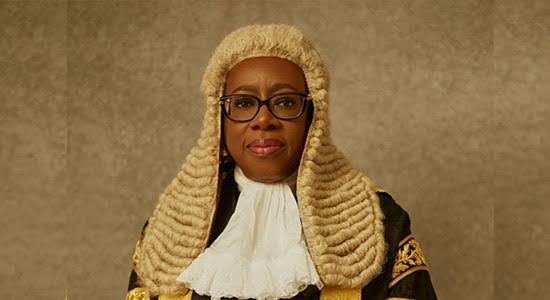
The Senate yesterday confirmed Justice Kudirat Kekere-Ekun appointment as the substantive Chief Justice of Nigeria after an extensive two-hour screening during plenary.
Kekere-Ekun was accompanied by her colleagues in the Supreme Court, the heads of the Appeal Court, the Federal High Court, and other senior judicial officers.
She answered various questions from federal lawmakers on how she would transform the nation’s judiciary.
She promised to apply her wealth of experience to her new assignment when she was confirmed by the Senate and sworn in by President Bola Tinubu.
While answering questions from the lawmakers during the screening session, Kekere-Ekun specifically advocated that all pre-election matters should be terminated at the Appeal Court
She pledged to encourage virtual hearings of cases and complete digitalization of the courts.
The CJN also told lawmakers that the National Judicial Council should adopt a strict process for appointing judges.
*Senior lawyers commenting on ongoing cases in court will face severe consequences
She decried frivolous comments by senior lawyers in the media about ongoing cases pending before the Courts and threatened strict consequences against the affected lawyer.
The CJN equally frowned against judges who grant conflicting judgments and avoidable exparte orders.
She said, “One of the things that I’m known for is integrity. I’m also known for being strict on discipline.
“Therefore, to ensure that the integrity of the judiciary is maintained, I will ensure that the code of conduct is fully complied with.
“I will ensure that there is zero tolerance for corruption. We have a committee of the NJC that deals with performance evaluation.
“I know that we are even making moves now to tighten that performance evaluation process so that we can, when judges submit returns, for instance, it’s not about quality but quantity.
“It’s also about how they carry out their responsibilities, whether they are punctual, upright, and things like that.
“Now, in the NJC, we will ensure that petitions are dealt with speedily. This is another way to inform the public that the judiciary’s integrity will be upheld in all circumstances.
“Another area for upholding the judiciary’s integrity is that there is a need also to insulate the judiciary from external influence.”
She commended President Bola Tinubu and the National Assembly for passing the bill increasing the salaries of judicial officers but said there was still some way to go.
She said, “When we are talking about the integrity of the judiciary, it involves not only the take-home pay but also the infrastructure that we are working with. What is available? Is it conducive? These are all things that affect how the judiciary performs.
“In that regard, I will still push for better welfare for judicial officers so they too can perform at their optimum best.”
While responding to the question of the Chief Whip, Senator Tahiru Mugunu, who asked about the independence of the judiciary, Kekere-Ekun confirmed that there are many complaints about appointing judicial officers.
She said, “This is an area that I will also take very seriously. The NJC also has a committee working on this to ensure that we make the screening process rigorous and transparent and that the citizenry will be satisfied with it when judges are appointed.
“I will make sure that this is done and with dispatch. We are looking at other jurisdictions to see how they carry out this process and how we can improve it.
“I know that once the citizens are comfortable with how judicial officers are appointed, they have more confidence in the system.
“I will also be encouraging or supporting improvement in our laws. So again, when it comes to the independence of the judiciary, all hands have to be on deck.”
She pledged to work with the National Assembly and the executive arm of government to ensure the country’s complete independence of the Judiciary.
The CJN said, “I look forward to working with the National Assembly and the Executive to ensure that we have laws in place that enhance our independence.”
She lamented the Supreme Court’s inability to dispense with the barrage of cases before it and recommended the termination of certain categories of cases at the Appeal Court.
She said, “I am very firmly of the view that there needs to be a limit to the cases that get to the Supreme Court. One of the reasons for this is that the Supreme Court is a Policy Court.
“The Supreme Court is supposed to determine matters that have public policy significance, issues relating to the position of the Constitution, or matters where very rare legal issues have come up which require a pronouncement from the Supreme Court.
“As you know, the constitutional provision gives us 90 days to deliver a judgment from the date of final address. Those 90 days are spent dealing with matters of national significance and those of no importance on the national stage.
“I believe many matters should terminate at the Court of Appeal, mainly interlocutory appeals. There is also a situation where pre-election matters come to the Supreme Court.
“National and State Assembly elections, the substantive elections terminate at the Court of Appeal; I think all pre-election matters should terminate at the Court of Appeal.
“So many matters need to terminate at the Court of Appeal so that the Supreme Court can live up to its designation as a police court.”
Kekere-Ekun said she did not believe that enlarging the number of justices would solve the rising number of cases before the Supreme Court.
She said, “The cases are so many. The backlog is tremendous. So, even if we increase the number of justices, it is still not the solution; it is more about the jurisdiction of the courts, which I think should be limited.”
On the issue of conflicting judgments, Kekere-Ekun said it was a grave concern and threatened strict consequences when a lower court, which was expected to follow the decision of a higher court, deliberately fails to follow that doctrine.
“There are so many complaints about conflicting judgments that where these conflicting judgments occur, there will be a need to have committees that will look into them and see how the court can take a position. Only the proper procedure will take place. The court cannot sit on appeal over its own decisions.
“However, where these matters arise, the court’s attention will be brought to them, and they will be dealt with speedily. In the Supreme Court, where the court’s attention is drawn to any of such matters, those matters will be fixed expeditiously so that they can be resolved.”
On those making comments over matters pending in courts, Kekere-Ekun said, “We know that it is a serious problem.”
She said, “It is also an act of misconduct if a judicial officer fails to follow a precedent. So this is something that is going to be tackled seriously.
“Regarding the code of conduct, we will deal very decisively with matters where we find this happening.
“I also want to say that there are responsibilities for both the bar and the bench. So, in this kind of situation, you also have legal practitioners who are aware of the existing precedent, and they come and mislead the court.
“So as the head of the judiciary, I shall ensure that both the bar and the bench are up and doing in this regard so that the legal practitioner disciplinary committee can also deal with those legal practitioners who are found to have deliberately misled the court.”
*Senate wants pre-election matters to terminate at Appeal Court
Meanwhile, the Senate President, Godswill Akpabio, said the Chairman of the Constitution Review Committee and that of the Electoral Act should come up with proposals on how the National Assembly could tinker with the constitution as a possible legislative intervention to ensure the implementation of the Supreme Court judgment on Local Government Autonomy.