By Anthony Otaru, Abuja
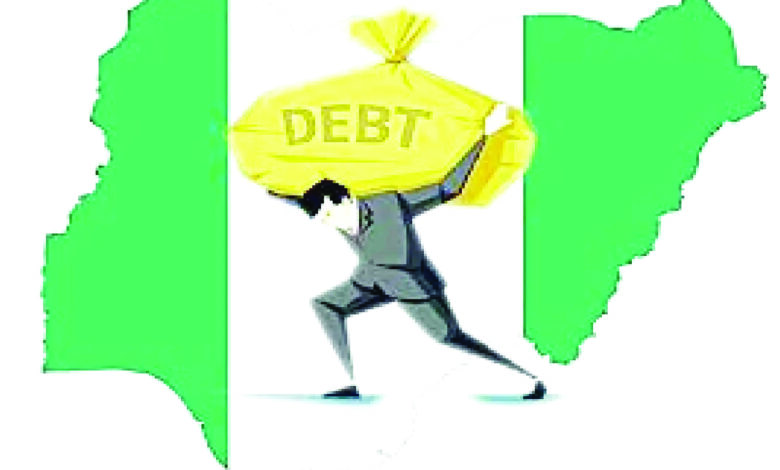
Economists have expressed their views that the over N14trn approved in the 2025 budget for debt servicing in the 2025 appropriation by the National Assembly is not healthy for Nigerian’s economic growth and development
They insist that debt servicing, set at over N14trn in the 2025 appropriation, and represents an over 90 percent increase, raising the public debt to Gross Domestic Product (GDP) ratio closer to the 40 percent threshold. This has further stressed the need for revenue diversification and prudent debt management.
A critical look at the nation’s budgets showed that Nigeria’s borrowing from the external market grew in 2024, rising to N63.07trn ($42.9bn) at the end of Q2, 2024.
The analysts argued that indicators such as the Fiscal Deficit to GDP ratio remain above the three percent ceiling approved in Nigeria’s Fiscal Responsibility Act (FRA) debt-to-GDP in 2024, which rose above the Federal Government’s approved 40 percent limit as indicated in development and financial strategy plans.
Omo-Ogun Ajayi, a professor of Agricultural Economics at the University of Calabar, told ThisNigeria that debt sustainability depends on a country’s ability to manage its debt relative to its economic capacity.
He emphasised that sustainability and capacity should be closely aligned with the productivity/ value of debt-consuming projects or investments.
Ajayi said, “Although the government remains confident as the debt to GDP ratio lies within the World Bank and International Monetary Fund (IMF) 70 percent threshold, while this may not be concerning as debt backed by productivity is encouraged, a major concern lies in the trend of Nigeria’s debt service to GDP and debt service to revenue ratios, indicating that Nigeria continues to utilise at least 50 percent of her growth turnover in repayment of borrowing.”
Also, the Lead Director of the Centre for Social Justice (CSJ), Eze Onyekpere, pointed out that the identified extra revenue could have been used to cushion the debt servicing instead of increasing the budget.
Onyekpere said, “When the President and the Senate said that they saw more money and now realised that some MDAs could generate more, which has increased the government’s revenue profile, I expected that if they found more money at the MDAs that increased revenue profile, such could have been applied for the reduction of our deficit.
“Instead of using it to offset a deficit of N13trn and because you will borrow more, the implication is that the money set aside for debt payment next year will be higher than this year.
“So, if we are going to borrow more to repay the new ones from the existing ones, we shall then require about N17trn to N18trn. For me, it was not necessary for the government to increase the budget but to reduce the deficits in the budget; this is my take on this.”
According to him, the major budget that defines development is capital expenditures. He added, “Although the capital budget has been increased to N23trn now, the challenge remains that a good portion of the capital budget is administrative capital.
“In capital expenditure, we have developmental and administrative. Administrative capital is that part of the capital that touches on administration, which is more or less for the running of bureaucracy, it includes new office buildings, rehabilitation of repair of some offices, buying of new cars like SUVs, for directors and permanent secretaries and ministers and capacity training for them, these are not expenditures that touches the lives of the ordinary people.
“It is different from building a new hospital, new schools, so part of the approved capital is what we call administrative, which shouldn’t be the case, but it would have been better if such funds were used to build new railways, put in place better electricity for 15 hours a day, get good pipe-born water for the people so that manufacturing companies will come for investment that would also provide jobs for the people, these are not happening, and challenges before the 2025 budget for me, it is a continuation of the norm, no difference.”
*Rule out debt forgiveness mentality
On debt cancellation, the civil society advocate said that no country will ever agree to debt forgiveness for Nigeria again.
“It is very clear because nobody will be ready to forgive your debts when they know you’ll come back to borrow another time after squandering the initial ones. I will never support any debt forgiveness again for Nigeria. I will never be part of such campaigns because that is irresponsibility in the highest order,” he said.
Sheriffdeen Tella, an economics professor emeritus, cautioned the Federal Government to reduce borrowing and focus on how best to turn the economy around by reducing the quest for materialism and self-aggrandisement.
“You’ll agree with me that most of our leaders still live high-profile lives by wasting the nation’s resources on non-essentials; this must stop. Corruption in offices must be curtailed. Our leaders should focus on improving the economy and shun everyday borrowing. A borrowing nation is a sorrowing nation,” he said.
He called on political leaders to know that the nation’s wealth in their hands is meant for all. Nigeria must focus more on a productive economy so that it can export to get foreign exchange. We must also shun foreign-made goods and make use of what we have. This will also help the local industry grow and create jobs. The issues of security need to be addressed. We must end them before it is too late,” he noted.